- Product Description Description
- Table of Contents TOC
- List of Table & Figure LOT
- Get Free Sample PDF Sample PDF
Market Size, 2025
$14.32 BnMarket Estimate, 2026
$14.94 BnMarket Forecast, 2034
$20.95 BnCAGR, 2026–2034
4.32%Africa Solar Market Size
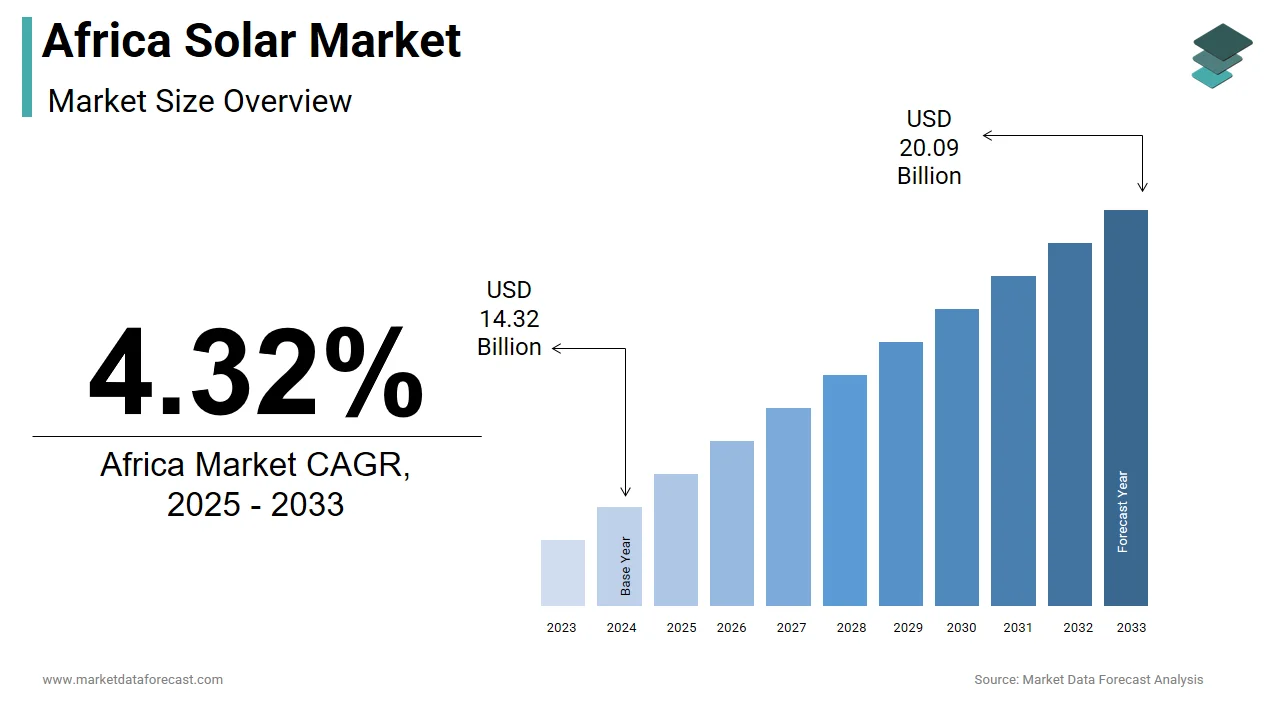
The Africa solar market was valued at USD 14.32 billion in 2025, is estimated to reach USD 14.94 billion in 2026, and is projected to reach USD 20.95 billion by 2034, growing at a CAGR of 4.32% from 2026 to 2034.
Solar are solar energy technologies across residential, commercial, industrial, and off-grid applications throughout the continent. Characterized by abundant insolation levels averaging between 4.5 and 6.5 kWh/m²/day, solar power presents a transformative solution to Africa’s persistent energy deficits. As per the International Energy Agency, over 600 million people in sub-Saharan Africa lacked access to electricity in 2022, creating an urgent need for decentralized and scalable energy solutions. Countries such as South Africa, Kenya, and Morocco have emerged as regional leaders in grid-connected solar installations, while nations like Nigeria and Ethiopia are increasingly adopting solar home systems. The African Union’s Agenda 2063 underscores renewable energy as a cornerstone of industrialization, with solar energy positioned at the forefront of sustainable electrification strategies.
MARKET DRIVERS
Expanding Energy Access through Off-Grid Solar Solutions
The critical deficit in electricity access across rural Africa is a primary catalyst for solar market expansion. As per the World Bank, approximately 568 million people in sub-Saharan Africa remained unconnected to the electrical grid in 2022, with rural electrification rates averaging just 28%. This energy poverty has spurred demand for off-grid solar solutions, including solar home systems (SHS) and mini-grids. Companies like M-KOPA and Lumos have leveraged pay-as-you-go (PAYG) financing models to distribute over 1 million SHS units across East and West Africa. The scalability of decentralized solar systems, combined with declining technology costs solar PV module prices have dropped by nearly 89% since 2010, as noted by the International Renewable Energy Agency has made solar the most viable pathway to universal electrification.
Favorable Solar Irradiance and Land Availability
Africa receives some of the highest solar irradiation levels globally, with vast regions experiencing over 300 clear-sky days annually. According to the Global Solar Atlas developed by the World Bank Group, the continent’s average daily solar potential exceeds 5 kWh/m², surpassing most regions in Europe and North America. This natural endowment enables high energy yields from photovoltaic installations, enhancing project viability. Additionally, large tracts of arid and sparsely populated land in countries like Namibia, Sudan, and Algeria offer ideal conditions for utility-scale solar farms without competing with agriculture. The Sahara Desert alone, spanning over 9 million square kilometers, holds theoretical solar generation potential exceeding 20,000 GW, as estimated by the United Nations Environment Programme. These geographic advantages, when combined with improving transmission infrastructure, position solar as a dominant energy source in Africa’s long-term energy mix.
MARKET RESTRAINTS
Inadequate Grid Infrastructure and Integration Capacity
Despite growing solar capacity, Africa’s power infrastructure remains a significant bottleneck to large-scale integration. As per the African Development Bank, over 40% of the continent’s transmission and distribution networks are either obsolete or operate beyond capacity, resulting in technical losses averaging 18%, nearly double the global average. Countries such as the Democratic Republic of Congo and Malawi suffer from grid instability, limiting the ability to absorb variable solar input. Furthermore, the lack of smart grid technologies and energy storage systems exacerbates intermittency concerns. The World Bank reports that fewer than 15 African countries have comprehensive grid codes that accommodate renewable energy injection, impeding the seamless scaling of solar projects even where generation potential is high.
Limited Access to Long-Term Project Financing
The high upfront capital costs of solar infrastructure are compounded by constrained access to affordable, long-term financing across Africa. According to the Climate Policy Initiative, only 12% of global climate finance flows reached Africa in 2022, despite the continent hosting over 17% of the world’s population. Local financial institutions cannot often underwrite multi-year renewable energy projects, and foreign investors face perceived risks related to regulatory instability and currency volatility. As per the International Finance Corporation, the cost of capital for solar projects in sub-Saharan Africa averages 10–15%, compared to 3–5% in developed markets. This disparity inflates the levelized costs of electricity and discourages private investment. Additionally, fewer than 30 African banks offer dedicated green financing products, as highlighted by the Sustainable Energy Fund for Africa, further constraining project scalability.
MARKET OPPORTUNITIES
Integration of Solar with Agricultural Value Chains
The convergence of solar energy and agriculture presents a transformative opportunity across Africa’s agrarian economies. As per the Food and Agriculture Organization, over 65% of Africa’s labor force is engaged in agriculture, yet only 6% of cultivated land is irrigated, largely due to energy constraints. Solar-powered irrigation systems are emerging as a solution, with pilot programs in Ghana and Senegal showing yield increases. As per the International Water Management Institute, over 7 million hectares of African farmland could be sustainably irrigated using solar pumps by 2030. Moreover, solar cold storage units are reducing post-harvest losses, which currently affect 30–40% of perishable produce, as noted by the African Union. Initiatives like the African Development Bank’s “Desert to Power” program aim to deploy 10 GW of solar across the Sahel to energize agro-industrial zones, unlocking new economic value.
Regional Power Pools and Cross-Border Solar Trade
The development of regional electricity markets enables surplus solar generation to be traded across borders, enhancing energy security and economic efficiency. As per the Southern African Development Community (SADC), the Southern African Power Pool (SAPP) includes 12 member states and has facilitated cross-border electricity trade worth over USD 1.2 billion annually. Countries like Zambia and Namibia, with high solar potential, are positioning themselves as net exporters. The West African Power Pool (WAPP) plans to integrate 3.5 GW of renewable energy by 2030, with solar contributing over 60% of new capacity. The African Union’s African Single Electricity Market (AfSEM), set for full operation by 2030, aims to create a continent-wide trading framework.
MARKET CHALLENGES
Policy and Regulatory Fragmentation
The absence of harmonized regulatory frameworks across African nations impedes the uniform development of the solar market. As per the African Legal Support Facility, only 28 out of 54 African countries have established clear net metering policies, creating uncertainty for distributed solar investments. As per the World Bank, 60% of renewable energy projects in Africa face delays due to inconsistent permitting procedures. Furthermore, the lack of standardized power purchase agreement (PPA) templates increases transaction costs and deters private developers. While regional bodies like ECOWAS have introduced model regulations, implementation remains uneven, undermining investor confidence and slowing market maturation.
Skills Shortage in Solar Technology Deployment and Maintenance
The rapid expansion of solar infrastructure is outpacing the development of a skilled technical workforce across Africa. According to the International Labour Organization, the continent will require over 250,000 trained solar technicians by 2030 to maintain and operate existing and planned installations, yet current vocational training programs produce fewer than 15,000 annually. In Kenya, only 30% of solar technicians are formally certified, leading to substandard installations and high failure rates. While initiatives such as the Global Partnership for Output-Based Aid (GPOBA) are funding technical training, the geographic and institutional dispersion of programs limits scalability. Without a coordinated human capital strategy, system longevity and performance will remain compromised.
REPORT COVERAGE
| REPORT METRIC | DETAILS |
| Market Size Available | 2025 to 2034 |
| Base Year | 2025 |
| Forecast Period | 2026 to 2034 |
| Segments Covered | By Technology and Region. |
| Various Analyses Covered | Global, Regional and Country-Level Analysis, Segment-Level Analysis, Drivers, Restraints, Opportunities, Challenges; PESTLE Analysis; Porter’s Five Forces Analysis, Competitive Landscape, Analyst Overview of Investment Opportunities |
| Countries Covered | Sudan, Egypt, Kenya, Ethiopia, Ghana, South Africa, Rest of Africa |
| Market Leaders Profiled | Adani Enterprises Ltd, Jinko Solar Holdings Co. Ltd, First Solar Inc., Azure Power Global Limited, and Emmvee Photovoltaic Power Private Limited. |
SEGMENTAL ANALYSIS
By Technology Insights
The solar photovoltaic technology segment dominated the Africa solar market by accounting for a substantial share of total installed solar capacity in 2025. This overwhelming share is due to the modular nature of PV systems, which can be deployed at utility, commercial, and household levels without requiring complex infrastructure. The rapid scalability of solar PV is particularly suited to Africa’s fragmented energy landscape, where decentralized solutions are often the only viable option. As per the World Bank, over 80% of new solar capacity added across sub-Saharan Africa between 2018 and 2023 was based on photovoltaic technology, driven by plummeting costs and compatibility with off-grid applications. The levelized cost of electricity (LCOE) for utility-scale solar PV in Africa has fallen to as low as USD 0.035/kWh in optimal locations, making it the cheapest source of new electricity generation, as per the International Energy Agency. This cost advantage, combined with the ease of integration with battery storage and PAYG business models, has cemented solar PV’s dominance. Its adaptability to off-grid and mini-grid electrification, which is critical in rural Africa is a key driver of solar PV’s supremacy. According to the African Development Bank, 70% of the population in rural sub-Saharan Africa lacks access to reliable electricity, and solar PV systems are the primary solution being deployed to bridge this gap. As per the Global Off-Grid Lighting Association, over 22 million off-grid solar products, including solar home systems and lanterns, have been distributed across Africa since 2015, with annual sales exceeding 3 million units. Countries like Kenya and Nigeria have seen exponential growth in PAYG solar adoption, with M-KOPA alone connecting over 1 million households to solar power. The flexibility of PV systems to scale from watts to megawatts, coupled with declining import tariffs in nations such as Rwanda and Ethiopia, further accelerates deployment. As per IRENA, local assembly of PV modules in Kenya and South Africa has reduced delivery timelines by up to 40%, enhancing supply chain resilience and market penetration.
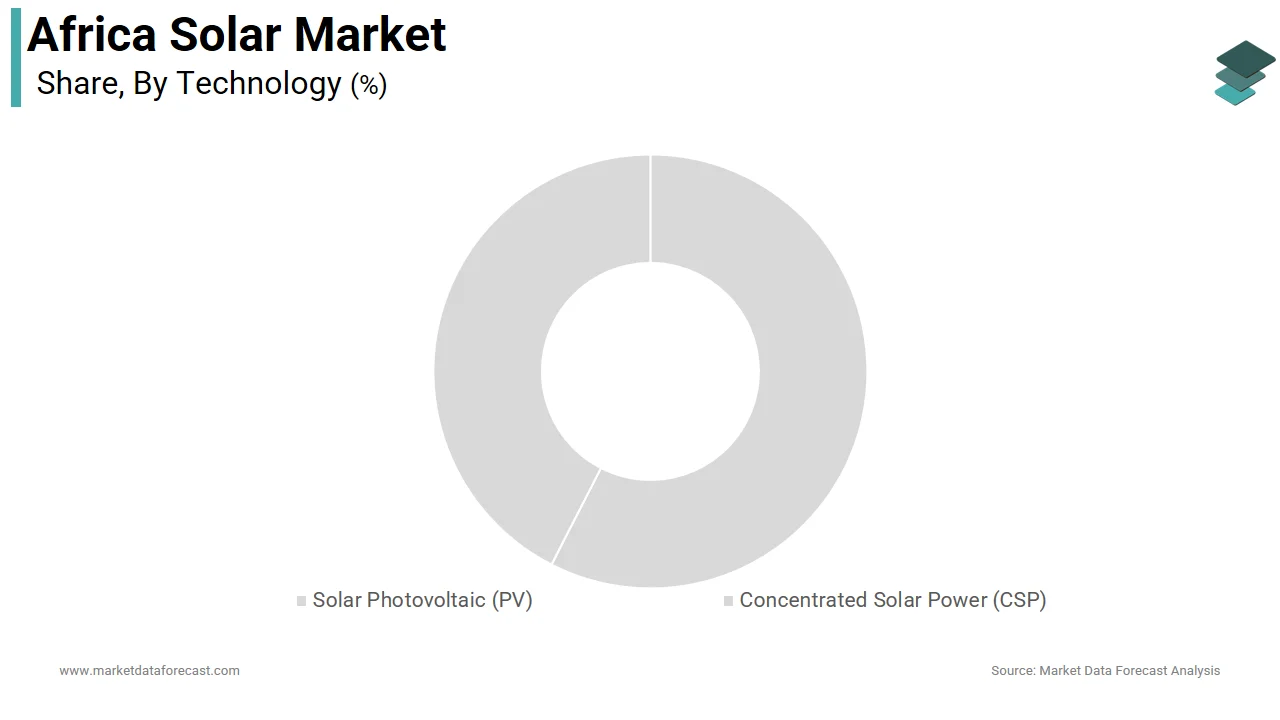
The concentrated Solar Power segment is emerging as the fastest-growing solar technology in Africa and is projected to expand at a CAGR of 11.3% from 2026 to 2034. While currently representing only 6% of Africa’s total solar capacity, CSP is gaining momentum due to its unique ability to store thermal energy and deliver dispatchable power, a critical advantage in stabilizing grids with high renewable penetration. The technology is particularly viable in regions with high direct normal irradiance (DNI), such as the Sahara and Kalahari deserts, where DNI levels exceed 2,000 kWh/m²/year, as per the World Bank’s Global Solar Atlas. Morocco’s Noor Ouarzazate complex, one of the world’s largest CSP plants with 510 MW capacity, exemplifies this trend, providing stable power even after sunset through molten salt storage. Its integration with hybrid renewable systems is a primary factor fueling CSP’s accelerated growth. As per the Desert to Power Initiative led by the African Development Bank, 10 GW of CSP capacity could be integrated across the Sahel by 2035 to provide baseload support to solar PV and wind farms. Unlike PV, CSP can deliver power for up to 7–8 hours post-sunset, addressing the evening peak demand that off-grid PV systems often fail to meet. The United Nations Environment Programme highlights that CSP plants in South Africa, such as the 100 MW Kaxu Solar One, have achieved capacity factors exceeding 40% nearly double that of standalone PV plants, due to thermal storage. Additionally, CSP supports industrial applications; the technology is being explored for solar-driven desalination in coastal North Africa. These multifunctional benefits are positioning CSP as a strategic asset in Africa’s energy transition.
COUNTRY-LEVEL ANALYSIS
Tanzania Solar Market Insights
Tanzania is positioned as a rising contender in East Africa’s renewable energy landscape and has made significant strides in solar adoption despite starting from a relatively low base. A critical driver of growth is the government’s Rural Energy Agency (REA), which has facilitated the installation of over 1,200 solar mini-grids since 2018, bringing electricity to more than 500,000 rural households. According to the World Bank, only 37% of Tanzania’s population had access to electricity in 2022, creating a vast untapped market for decentralized solar solutions. The country’s adoption of the Scaling Solar program, backed by the International Finance Corporation, has streamlined project procurement, resulting in a 50 MW solar plant in Singida being commissioned at a tariff of USD 0.06/kWh, the lowest in East Africa at the time. Furthermore, Tanzania’s stable regulatory environment and exclusion of VAT on solar equipment imports have enhanced affordability and attracted private investment.
Kenya Solar Market Insights
Kenya stands as a regional leader in solar energy deployment in East Africa. The country’s solar capacity exceeds 420 MW, with a notable emphasis on both grid-connected projects and off-grid solutions. The Lake Turkana Wind-Solar Hybrid Project, though primarily wind-based, has spurred interest in hybrid renewable integration, while the 50 MW Malindi Solar Plant exemplifies utility-scale growth. Kenya’s growth is underpinned by progressive policies such as the feed-in tariff mechanism and the removal of import duties on solar components, as per the Energy and Petroleum Regulatory Authority (EPRA). According to the Global Off-Grid Lighting Association, Kenya hosts the highest penetration of pay-as-you-go solar systems in Africa, with over 1.2 million households using SHS. The country’s mobile money infrastructure, with M-Pesa reaching 80% of adults as per the Central Bank of Kenya, has enabled seamless financing models, making solar energy accessible even in remote areas.
Uganda Solar Market Insights
Uganda occupies a strategic position in the East African solar market. Despite abundant solar resources, the country’s electrification rate remains at 40%, creating strong demand for alternative energy solutions. The government’s Electricity Access Roll-Out Program has prioritized solar mini-grids in off-grid districts, with over 300 projects funded through the World Bank’s Energy Sector Support Program. A key development is the 50 MW Soroti Solar Plant, which supplies power to the national grid at USD 0.07/kWh, demonstrating competitive pricing. However, regulatory delays have stalled over 200 MW of planned solar projects, as highlighted by the African Legal Support Facility. Uganda’s potential is further amplified by initiatives like the Renewable Energy Performance Platform, which has de-risked private investment in solar projects across the northern and eastern regions.
Ghana Solar Market Insights
Ghana is a pivotal player in West Africa’s solar energy transition. The country’s solar growth is anchored in its National Energy Transition Framework, which targets 40% renewable energy in the electricity mix by 2030. The 20 MW Kaleo Solar Plant and the 40 MW Bole Solar Project are among the key installations contributing to grid stability. According to the World Bank, Ghana’s electricity access rate stands at 86%, yet rural areas still face supply inconsistencies, driving demand for solar hybrid systems. The government’s collaboration with the African Development Bank under the Desert to Power initiative has unlocked funding for 100 MW of new solar capacity. Additionally, the Ghanaian government has introduced tax exemptions on solar equipment, reducing import costs by up to 25%, as confirmed by the Ghana Revenue Authority, thereby accelerating private and commercial sector adoption.
COMPETITIVE LANDSCAPE
The competition in the Africa solar market is intensifying as global developers, regional utilities, and innovative startups converge on a fragmented yet high-potential landscape. Unlike mature markets with consolidated players, Africa’s solar sector is characterized by a dynamic mix of international independents, state-backed firms, and off-grid specialists, each targeting different segments. Utility-scale projects attract multinational developers like Scatec and Engie, while decentralized solar is dominated by nimble enterprises such as M-KOPA and Zola Electric. The absence of a single dominant player has fostered innovation in financing, distribution, and technology integration. However, competition is not solely price-driven; reliability, after-sales service, and community engagement increasingly differentiate market leaders. Regulatory disparities across countries create uneven playing fields, but firms with adaptable business models gain traction. As project pipelines grow and cross-border energy trade expands, strategic positioning through partnerships and localized operations will determine long-term success.
KEY MARKET PLAYERS
Some of the noteworthy companies in the Africa solar market profiled in this report are
- Adani Enterprises Ltd
- Jinko Solar Holdings Co. Ltd
- First Solar Inc.
- Azure Power Global Limited
- Emmvee Photovoltaic Power Private Limited
TOP LEADING PLAYERS IN THE MARKET
- Engie has established a robust footprint across the Africa solar market through a blend of utility-scale projects and decentralized energy solutions. The company operates solar installations in countries such as South Africa, Senegal, and Egypt, with a strong emphasis on hybrid systems integrating solar and storage. The company also launched solar-powered mini-grids in rural Mali and Burkina Faso through its subsidiary Engie Energy Access, targeting underserved communities. Engie has strengthened its position by partnering with development finance institutions like the European Investment Bank to de-risk investments. Its focus on energy-as-a-service models, particularly in commercial and industrial segments, has enabled scalable, pay-per-use solar solutions tailored to African market dynamics.
- Scatec has emerged as a pivotal player in Africa’s solar energy landscape, with a portfolio spanning South Africa, Uganda, Ghana, and Egypt. The Norwegian renewable energy company has developed and operates several utility-scale solar plants, including the 179 MW AC Kipeto Wind-Solar Hybrid Project in Kenya and the 150 MW Nzema Solar Plant in Ghana. The company has also expanded into decentralized solar, launching solar home systems in Uganda through a joint venture with the Norfund-backed Fenix International. Scatec’s vertically integrated model covering development, financing, construction, and operations enables faster project execution and long-term asset management. Its collaboration with African utilities and multilateral agencies has solidified its reputation as a reliable and technically proficient developer.
- Masdar, the Abu Dhabi-based renewable energy company, has significantly expanded its presence in the Africa solar market through strategic investments and international partnerships. The company operates solar projects in Seychelles, Ghana, and South Africa, with a focus on technology transfer and local capacity building. The company also entered a joint development agreement with the Democratic Republic of Congo to build a 100 MW solar facility near Kinshasa. Masdar’s approach combines project financing from Gulf investors with technical collaboration from European engineering firms, enabling rapid deployment. Its participation in the African Union’s Desert to Power initiative highlights its strategic alignment with continental energy goals. By leveraging its experience in arid climate solar deployment, Masdar is positioning itself as a long-term infrastructure partner in Africa.
TOP STRATEGIES USED BY THE KEY MARKET PARTICIPANTS
Key players in the Africa solar market are deploying a range of strategic initiatives to consolidate their presence and drive scalability. One dominant strategy is the formation of public-private partnerships to secure power purchase agreements and reduce regulatory risk. Companies are increasingly adopting hybrid energy models, combining solar with battery storage or wind to enhance grid stability. Another prevalent approach is localization establishing regional offices, training local technicians, and assembling solar components domestically to reduce costs and improve supply chain resilience. Leading firms are also leveraging digital financing platforms and mobile money integration to scale pay-as-you-go solar systems in off-grid areas. Strategic alliances with development banks and climate funds enable de-risking of investments, particularly in fragile markets. Additionally, companies are focusing on corporate power purchase agreements with mining and agro-industrial firms to ensure revenue stability and expand commercial solar adoption.
RECENT MARKET DEVELOPMENTS
- In June 2023, Scatec signed a power purchase agreement with Uganda’s Electricity Regulatory Authority to develop a 100 MW solar plant in the northern region, enhancing its footprint in East Africa’s utility-scale market.
- In February 2024, Engie launched a new solar home system product line in Mali under its Engie Energy Access brand, incorporating advanced IoT monitoring and pay-as-you-go financing to expand rural electrification.
- In September 2022, Masdar completed the acquisition of a 40% stake in the 50 MW Garissa Solar Plant in Kenya, reinforcing its long-term operational presence in East Africa.
- In January 2023, TotalEnergies commissioned a 50 MW solar facility in the Democratic Republic of Congo, marking its entry into Central Africa’s utility solar segment.
- In April 2024, ACWA Power began construction on a 300 MW solar project in Egypt’s New Administrative Capital, supported by funding from the African Development Bank, solidifying its role in North Africa’s energy transition.
MARKET SEGMENTATION
This Africa solar market research report is segmented and sub-segmented into the following categories.
By Technology
- Solar Photovoltaic (PV)
- Concentrated Solar Power (CSP)
By Country
- Sudan
- Egypt
- Kenya
- Ethiopia
- Ghana
- South Africa
- Rest of Africa