- Product Description Description
- Table of Contents TOC
- List of Table & Figure LOT
- Get Free Sample PDF Sample PDF
Market Size, 2025
$3.66 BnMarket Estimate, 2026
$4.19 BnMarket Forecast, 2034
$12.38 BnCAGR, 2026–2034
14.5%Asia Pacific Data Center Liquid Cooling Market Size
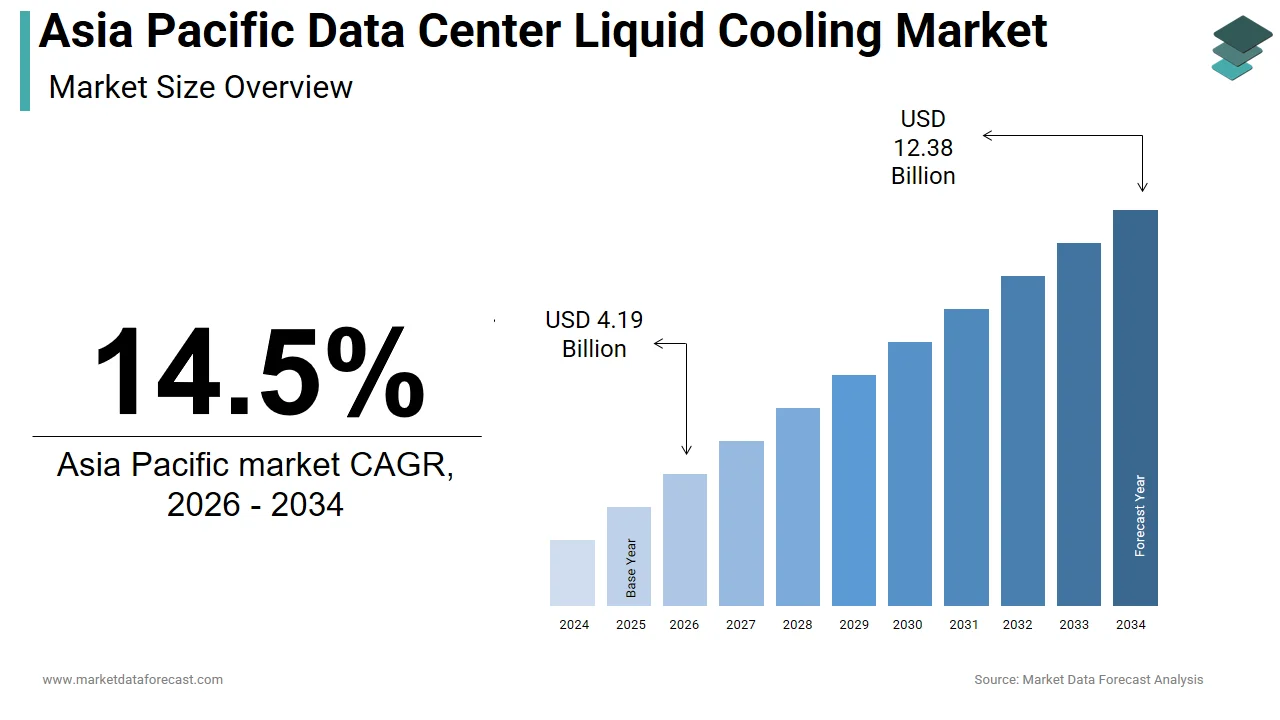
The Asia Pacific data center liquid cooling market was valued at USD 3.66 billion in 2025, is estimated to reach USD 4.19 billion in 2026, and is projected to reach USD 12.38 billion by 2034, growing at a CAGR of 14.5% from 2026 to 2034.
The Asia Pacific data center liquid cooling market refers to the deployment of advanced thermal management solutions that utilize liquid-based heat dissipation techniques to maintain optimal operating temperatures in data centers. As computing densities rise with the proliferation of high-performance servers, AI workloads, and edge computing infrastructure, traditional air cooling systems are proving insufficient. Liquid cooling technologies such as direct-to-chip, immersion cooling, and rear door heat exchangers are increasingly being adopted to address these challenges efficiently.
In recent years, the region has witnessed a surge in hyperscale and colocation data center investments driven by digital transformation across sectors such as finance, healthcare, and telecommunications. Countries like Singapore, Japan, and South Korea have emerged as early adopters due to their high energy costs and limited physical space for large-scale facilities.
Moreover, as governments in India and China push for sustainable infrastructure development, there is growing interest in next-generation cooling methods that align with environmental goals.
MARKET DRIVERS
Increasing Demand for High-Density Computing Infrastructure
The rising demand for high-density computing infrastructure is one of the primary drivers fueling the growth of the Asia Pacific data center liquid cooling market. With the expansion of artificial intelligence (AI), machine learning (ML), and big data analytics, enterprises across the region are deploying high-performance computing (HPC) clusters that generate significantly higher heat loads than conventional server racks. Traditional air cooling systems struggle to manage these elevated thermal outputs efficiently, making liquid cooling an essential alternative.
In Japan, where land constraints limit the expansion of large-scale data centers, companies are prioritizing compact, high-density server deployments supported by liquid cooling solutions.
Besides, the gaming and fintech industries in Southeast Asia are contributing to this trend. In Malaysia and Thailand, where real-time transaction processing and online gaming platforms require robust computational power, data center operators are investing in direct-to-chip cooling systems. This increasing reliance on high-density computing underscores the critical role of liquid cooling in sustaining the performance and sustainability of modern data centers across the Asia Pacific region.
Rising Emphasis on Energy Efficiency and Carbon Neutrality Goals
The growing emphasis on energy efficiency and carbon neutrality goals set by both governments and private sector players is a significant catalyst driving the adoption of liquid cooling in the Asia Pacific data center market. As data centers consume vast amounts of electricity, particularly for cooling purposes, organizations are under increasing pressure to minimize their environmental impact while maintaining operational reliability.
In Singapore, where energy costs are among the highest in the region, the government has mandated stricter energy usage effectiveness (EUE) benchmarks for new data center constructions. Similarly, in Australia, major tech firms such as Atlassian and Google have pledged to achieve net-zero emissions by 2040 and 2030, repectively, prompting them to invest in liquid-cooled infrastructure at their local facilities.
In China, the Ministry of Industry and Information Technology has introduced policies encouraging green data center development, pushing operators to adopt liquid cooling solutions that can deliver superior thermal efficiency. Also, immersion cooling reduced overall power usage effectiveness (PUE) by up to 0.2 points compared to air-based systems. These regulatory and corporate sustainability efforts are a strategic enabler of eco-friendly data center operations across the Asia Pacific.
MARKET RESTRAINTS
High Initial Investment and Complex Implementation Requirements
The high initial investment and complex implementation processes associated with these systems is one of the key restraints impeding the widespread adoption of liquid cooling in the Asia Pacific data center market. Unlike conventional air cooling setups, liquid cooling requires specialized hardware, customized piping, and extensive modifications to existing infrastructure, which can significantly increase capital expenditures.
In India, where many data centers still operate on legacy architectures, the cost barrier remains a major deterrent. Similarly, in Indonesia, where small and mid-sized data center operators dominate the market, financial constraints have slowed the uptake of advanced cooling technologies.
Moreover, the complexity of integrating liquid cooling with existing IT equipment poses technical challenges. In Japan, despite strong interest in high-density computing, many organizations hesitate to adopt direct-to-chip or immersion cooling due to concerns about system compatibility and maintenance risks. These economic and technical hurdles continue to limit the scalability of liquid cooling solutions across the Asia Pacific region.
Lack of Standardization and Skilled Workforce
The lack of standardized guidelines and a shortage of trained professionals capable of managing and maintaining these advanced systems is another significant constraint affecting the growth of the Asia Pacific data center liquid cooling market. Unlike traditional cooling mechanisms, liquid-based solutions require specialized knowledge in fluid dynamics, heat transfer engineering, and facility design, which are not widely available in the regional workforce.
In Vietnam and the Philippines, where data center infrastructure is still evolving, there is a noticeable gap in technical expertise related to liquid cooling deployment. Apart from these, in Thailand, industry stakeholders have pointed out inconsistencies in vendor-specific designs, making it difficult to establish uniform best practices.
Furthermore, the scarcity of certified service providers capable of offering post-installation support adds another layer of complexity. These challenges draw attention to the urgent need for skill development programs and regulatory harmonization to facilitate broader adoption of liquid cooling technologies in the Asia Pacific region.
MARKET OPPORTUNITIES
Expansion of Edge Data Centers Requiring Efficient Cooling Solutions
The rapid proliferation of edge computing infrastructure presents a substantial opportunity for the Asia Pacific data center liquid cooling market. As industries increasingly rely on real-time data processing for applications such as smart cities, autonomous vehicles, and industrial IoT, the demand for localized edge data centers is surging. These facilities often operate in constrained environments with limited airflow and high-density computing loads, making traditional air cooling inefficient and impractical.
In South Korea, where 5G and AI-driven services are expanding rapidly, telecom operators and cloud providers are deploying micro data centers at network edges to reduce latency.
In India, the government's push for digital infrastructure in tier-2 and tier-3 cities is also driving the deployment of edge data centers equipped with efficient cooling systems. These trends indicate that the growth of edge computing will be a pivotal driver for liquid cooling adoption across the Asia Pacific region.
Integration of Liquid Cooling with Renewable Energy Infrastructure
The convergence of liquid cooling technology with renewable energy sources presents a compelling opportunity for the Asia Pacific data center market. As governments and enterprises commit to reducing carbon footprints, there is a growing emphasis on deploying clean energy-powered data centers that maximize energy efficiency. Liquid cooling, with its superior thermal management capabilities, complements these sustainability goals by minimizing energy waste and improving overall system performance.
In Singapore, where land and energy resources are limited, several hyperscale data center operators have begun integrating solar energy with liquid cooling systems to optimize energy consumption. Similarly, in Australia, data center developers are leveraging wind and hydroelectric power alongside liquid cooling to meet aggressive carbon neutrality targets set by federal regulators.
In China, the government’s push for green data parks has led to the adoption of liquid cooling in conjunction with geothermal and hydroelectric power sources. These developments illustrate how the synergy between liquid cooling and renewable energy is unlocking new avenues for sustainable data center expansion across the Asia Pacific region.
MARKET CHALLENGES
Compatibility Issues with Legacy Data Center Architectures
The incompatibility of liquid cooling systems with existing legacy infrastructures is one of the foremost challenges confronting the Asia Pacific data center liquid cooling market. Many data centers in the region were originally designed around air-based cooling methodologies, making retroactive integration of liquid cooling solutions technically complex and costly. Retrofitting older facilities with liquid cooling components such as cold plates, manifolds, and fluid distribution units requires extensive redesign, posing logistical and financial barriers.
In countries like India and Indonesia, where a majority of data centers operate on outdated infrastructure, the transition to liquid cooling is hindered by concerns over system reliability and maintenance.
Moreover, the risk of operational downtime during the transition phase discourages many enterprises from adopting liquid cooling, especially in mission-critical sectors such as banking and healthcare. In Malaysia, a survey by Universiti Teknologi Petronas revealed that 35% of data center operators delayed planned upgrades due to concerns over system integration complexities. These challenges shows the need for phased migration strategies and modular cooling solutions tailored for legacy environments across the Asia Pacific region.
Operational Risks Associated with Fluid Leakages and System Failures
The perceived risk of fluid leakages and system failures is a significant challenge impeding the widespread adoption of liquid cooling in the Asia Pacific data center market. Despite technological advancements, concerns regarding potential damage to sensitive IT equipment persist, particularly in regions with high humidity and frequent natural disasters such as typhoons and earthquakes. The fear of coolant leaks causing short circuits or hardware malfunctions deters many enterprises from transitioning away from traditional air cooling methods.
In Japan, where seismic activity is a constant concern, data center operators remain cautious about implementing liquid cooling solutions without fail-safe mechanisms. Similarly, in Taiwan, where typhoon-induced flooding poses a risk to infrastructure stability, concerns about water-based cooling systems exacerbate hesitancy among potential adopters.
Moreover, the complexity of monitoring and maintaining liquid cooling systems increases operational overheads. In Australia, where data centers serve critical public services, facility managers have highlighted the need for continuous leak detection systems and emergency shutoff protocols.
REPORT COVERAGE
| REPORT METRIC | DETAILS |
| Market Size Available | 2025 to 2034 |
| Base Year | 2025 |
| Forecast Period | 2026 to 2034 |
| Segments Covered | By Cooling Technology, End-user Vertical, and Region. |
| Various Analyses Covered | Global, Regional and Country-Level Analysis, Segment-Level Analysis, Drivers, Restraints, Opportunities, Challenges; PESTLE Analysis; Porter’s Five Forces Analysis, Competitive Landscape, Analyst Overview of Investment Opportunities |
| Countries Covered | India, China, Japan, South Korea, Australia, New Zealand, Thailand, Malaysia, Vietnam, Philippines, Indonesia, Singapore, Rest of APAC |
| Market Leaders Profiled | Vertiv Co., Stulz GmbH, Schneider Electric SE, Rittal GmbH & Co. KG, Mitsubishi Electric Hydronics & IT Cooling Systems SpA, and Others. |
SEGMENTAL ANALYSIS
By Cooling Technology Insights
The Air-based Cooling segment continued to dominate the Asia Pacific data center cooling market by accounting for 62.5% of total revenue in 2024. The relatively lower initial investment compared to liquid cooling solutions is one key driver behind this continued reliance on air-based cooling. This dominance is also attributed to the widespread presence of legacy data centers across the region that were originally designed around conventional air cooling systems. Further, in countries like Thailand and the Philippines, where ambient temperatures are high but computing density remains moderate, traditional cooling methods such as Computer Room Air Conditioning (CRAC) units and hot/cold aisle containment continue to be sufficient for most operational needs. The slow transition rate from existing infrastructure is another contributing factor. Many enterprises in Australia and Japan operate large-scale facilities built decades ago, making retrofitting with liquid cooling complex and expensive.
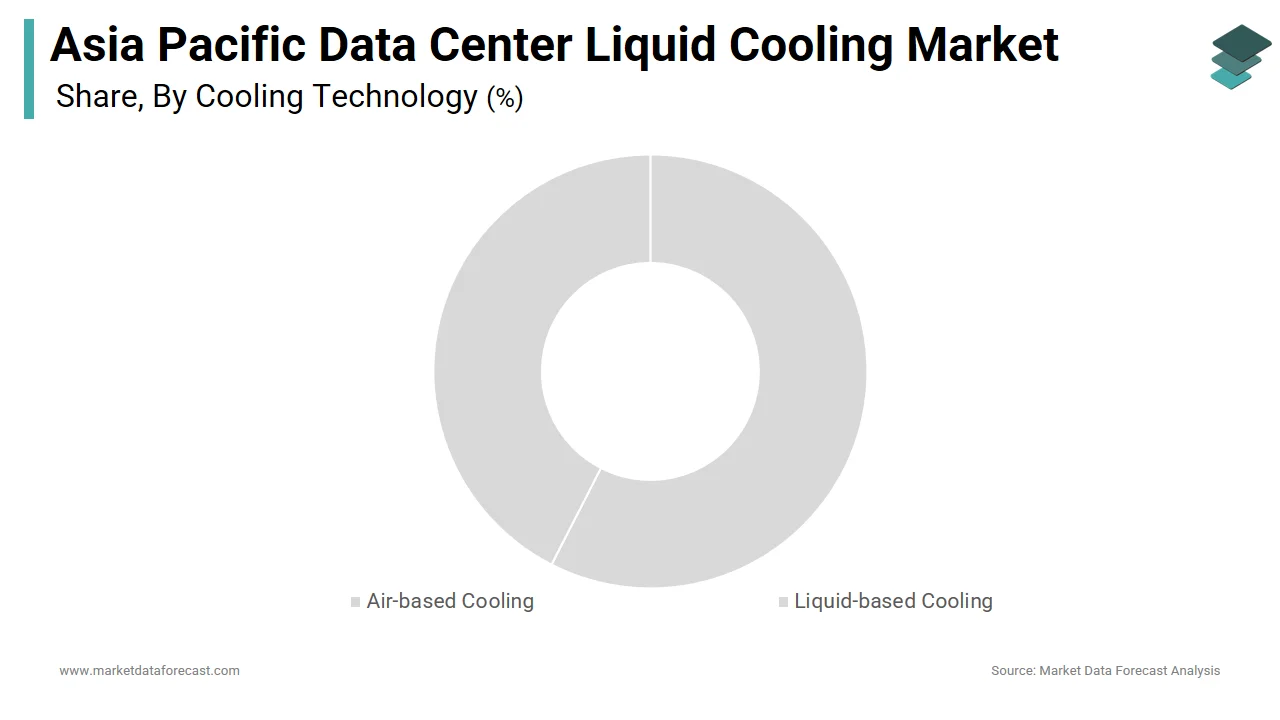
The Liquid-Based Cooling segment is projected to grow at the fastest pace and is likely recording a CAGR of 18.9% between 2026 to 2034. The increasing demand for energy-efficient and high-density thermal management solutions in response to rising computational workloads and sustainability mandates is driving the rapid expansion of the Liquid-Based Cooling segment. The surge in hyperscale and colocation data center investments, particularly in countries like Singapore, South Korea, and China, is also a major growth factor. Moreover, government initiatives promoting green data centers are accelerating the adoption of liquid cooling technologies. In Australia, major tech firms including Google and Atlassian have pledged to achieve net-zero emissions by 2030, prompting them to invest in liquid-cooled infrastructure. These trends underline why the liquid-based cooling segment is outpacing other technologies in terms of growth within the Asia Pacific data center market.
By End-User Vertical Insights
The IT & Telecom vertical holds the largest share of the Asia Pacific data center liquid cooling market by accounting for 41.3% of total revenue in 2024. The rapid expansion of hyperscale cloud infrastructures, 5G rollouts, and AI-driven services across the region is largely driving the dominance of IT & Telecom vertical.
The increasing deployment of high-performance computing (HPC) clusters in telecom and cloud service provider environments is among the drivers of this growth. In China, where companies like Alibaba Cloud, Tencent, and Huawei are aggressively expanding their data center footprints, liquid cooling has become essential to manage elevated thermal loads.
The growing reliance on edge computing in the telecommunications sector is another key factor. In Japan, where land availability for large-scale data centers is limited, telecom operators are increasingly adopting compact, high-density server racks supported by liquid cooling. These developments show the IT & Telecom vertical’s continued leadership in driving demand for liquid cooling solutions across the Asia Pacific region.
The Healthcare vertical is expected to register the highest growth in the Asia Pacific data center liquid cooling market, with a CAGR of 20.3% during the forecast period. The increasing digitization of healthcare services, the rise of AI-powered diagnostics, and the need for secure, high-performance data storage solutions is propelling the rapid expansion of Healthcare vertical.
The proliferation of telemedicine and electronic health records (EHRs), which require robust and scalable data center infrastructure, is also a key growth factor. In India, where digital health initiatives such as Ayushman Bharat Digital Mission are gaining momentum, hospitals and research institutions are investing in advanced data centers equipped with efficient cooling mechanisms.
The increasing use of AI and machine learning in genomics, drug discovery, and personalized medicine is another contributing element. In South Korea, where biotech firms and research labs are leveraging AI-intensive workloads, liquid cooling is being adopted to support high-density GPU clusters used for predictive analytics. These advancements position the healthcare sector as the fastest-growing end-user of liquid cooling technologies in the Asia Pacific data center market.
COUNTRY-LEVEL ANALYSIS
China Data Center Liquid Cooling Market Insights
China remained the top contributors to the Asia Pacific data center liquid cooling market with 28% of regional revenue in 2024. The country's massive digital transformation agenda, coupled with aggressive investments in hyperscale cloud infrastructure, has positioned it as a key player in the adoption of advanced cooling technologies. One of the primary growth drivers is the government’s push for green data centers under its dual carbon strategy, which aims to reduce carbon emissions from industrial sectors. Besides, major cloud providers such as Alibaba Cloud, Tencent Cloud, and Huawei Cloud have been actively integrating immersion cooling and rear-door heat exchangers into their next-generation facilities to support AI and big data applications. Moreover, the rise of edge computing in manufacturing and smart cities is further fueling demand for high-efficiency thermal management solutions.
India Data Center Liquid Cooling Market Insights
India occupies a strong position in the Asia Pacific data center liquid cooling market. The country’s growing digital economy, increasing internet penetration, and rising demand for cloud services have spurred significant investments in next-generation data center infrastructure. One of the key growth enablers is the government’s initiative to establish data center corridors in states like Maharashtra, Tamil Nadu, and Karnataka. Apart from these, with the rollout of 5G and the expansion of AI-driven services, telecom operators and cloud providers are prioritizing thermal optimization to handle increased workloads. Another important factor is the increasing awareness of sustainable infrastructure practices. In line with India’s net-zero commitments, several private sector players including Tata Communications, Reliance Jio, and Hiranandani Group are piloting liquid cooling solutions in their upcoming data center projects.
Singapore Data Center Liquid Cooling Market Insights
Singapore is a significant player in the Asia Pacific data center liquid cooling market. As one of the world’s premier data center hubs, Singapore faces unique challenges related to space constraints and high energy costs, making liquid cooling an attractive alternative to traditional air-based systems. One of the key drivers of adoption is the Infocomm Media Development Authority (IMDA)'s mandate requiring new data center builds to meet strict energy efficiency benchmarks. Further, global hyperscalers such as Google, Amazon Web Services (AWS), and Microsoft Azure have established local facilities with advanced liquid cooling systems to optimize thermal performance and reduce operational expenditures. Another contributing factor is the increasing focus on sustainability and carbon neutrality goals. In line with Singapore’s Green Plan 2030, several data center operators have committed to achieving net-zero emissions through the adoption of immersion cooling and rear-door heat exchanger technologies. These initiatives have resulted in an improvement in power usage effectiveness (PUE) metrics compared to conventional cooling methods.
Japan Data Center Liquid Cooling Market Insights
Japan holds a prominent position in the Asia Pacific data center liquid cooling market. The country’s aging data center infrastructure, combined with rising demand for high-density computing, has created a favorable environment for the adoption of advanced thermal management solutions. A major growth driver is the increasing deployment of artificial intelligence (AI) and edge computing applications in industries such as automotive, finance, and healthcare. Moreover, the country’s land scarcity and high electricity costs are pushing enterprises to explore more efficient cooling alternatives. Another key factor is the government’s emphasis on green data center development. Under Japan’s Green IT Strategy, regulatory authorities have introduced guidelines encouraging energy-efficient infrastructure upgrades.
Australia Data Center Liquid Cooling Market Insights
Australia held a key position in the Asia Pacific data center liquid cooling market. The country’s well-developed digital infrastructure, strong regulatory framework, and growing emphasis on sustainability have contributed to the increasing adoption of liquid cooling technologies. One of the key growth drivers is the rising number of hyperscale and colocation data center investments by global cloud providers. Besides, with Australia’s pledge to achieve net-zero emissions by 2050, enterprises are seeking energy-efficient cooling alternatives to reduce their environmental footprint. Another contributing factor is the expansion of AI, 5G, and edge computing applications across sectors such as finance, logistics, and government services.
COMPETITIVE LANDSCAPE
The competition in the Asia Pacific data center liquid cooling market is intensifying as global and regional players vie to meet the growing demand for energy-efficient and sustainable thermal management solutions. With the rapid expansion of hyperscale data centers, edge computing infrastructure, and AI-driven applications, enterprises across the region are re-evaluating traditional air-based cooling systems in favor of more efficient alternatives. This shift has led to a surge in innovation, with companies introducing advanced liquid cooling technologies that offer superior performance, scalability, and environmental benefits.
Market participants are differentiating themselves through customized cooling architectures, including direct-to-chip, immersion cooling, and rear-door heat exchangers, each designed to address specific operational challenges. While established global players bring extensive technical expertise and proven track records, local startups and niche vendors are leveraging agility and regional insights to capture market share. Strategic partnerships, localized deployments, and integration with renewable energy sources have become key battlegrounds in the race for dominance.
Apart from these, the increasing emphasis on sustainability and carbon neutrality is reshaping vendor strategies, with many positioning liquid cooling not only as a performance enabler but also as an essential component of green data center development. As adoption accelerates, the Asia Pacific market is expected to witness heightened consolidation, innovation, and cross-industry collaboration in the coming years.
KEY MARKET PLAYERS
Some of the noteworthy companies in the Asia Pacific data center liquid cooling market profiled in this report are
- Vertiv Co
- Stulz GmbH
- Schneider Electric SE
- Rittal GmbH & Co. KG
- Mitsubishi Electric Hydronics & IT Cooling Systems SpA
TOP LEADING PLAYERS IN THE MARKET
One of the leading players in the Asia Pacific data center liquid cooling market is Asetek. The company specializes in rack-level and direct-to-chip liquid cooling solutions, offering scalable and energy-efficient thermal management systems for high-performance computing environments. Asetek’s innovative approach has enabled data centers across the region to enhance performance while reducing power consumption, making it a preferred choice among cloud service providers and enterprise data center operators.
Another key player is CoolIT Systems, known for its advanced liquid cooling technologies tailored for next-generation data centers. CoolIT has been actively expanding its presence in the Asia Pacific by collaborating with major server manufacturers and hyperscale operators. Its focus on modular, customizable cooling solutions has made it a strategic partner for enterprises seeking to optimize cooling efficiency without overhauling existing infrastructure.
Submer Technologies, a rising force in the market, provides full immersion cooling solutions that are gaining traction in the region due to their superior heat dissipation capabilities. Submer's technology supports sustainability goals and enables high-density computing, positioning the company as a critical innovator in the transition toward greener data center operations across the Asia Pacific.
TOP STRATEGIES USED BY KEY MARKET PARTICIPANTS
Key players in the Asia Pacific data center liquid cooling market are increasingly focusing on technology innovation and product differentiation to gain a competitive edge. Companies are investing heavily in R&D to develop advanced cooling architectures such as direct-to-chip, rear-door exchangers, and full immersion cooling that cater to evolving data center requirements.
Another prevalent strategy is strategic partnerships and collaborations with local infrastructure providers, cloud operators, and government-backed initiatives. These alliances help vendors align their offerings with regional regulatory standards and customer-specific needs, enhancing deployment feasibility and market acceptance.
Lastly, market localization and expansion into emerging economies is becoming a core growth driver. Vendors are establishing regional offices, engaging with local engineering firms, and tailoring their solutions to address country-specific challenges such as space constraints, high ambient temperatures, and energy cost variations, ensuring deeper market penetration and long-term sustainability.
RECENT MARKET DEVELOPMENTS
- In March 2024, Asetek expanded its regional footprint by opening a new technical support center in Singapore, aimed at providing on-site engineering assistance and after-sales services to hyperscale and enterprise customers across Southeast Asia.
- In June 2024, Submer Technologies partnered with a leading Japanese data center operator to pilot full immersion cooling systems in an urban colocation facility, demonstrating the viability of the technology in high-density computing environments.
- In September 2024, CoolIT Systems announced a joint development initiative with a major South Korean telecom provider to integrate direct-to-chip cooling into upcoming 5G-enabled edge data centers, enhancing thermal efficiency and system reliability.
- In November 2024, Schneider Electric, a global leader in digital energy management, launched a localized suite of liquid cooling solutions tailored for Indian data centers, addressing regional challenges related to climate conditions and energy costs.
- In February 2025, Vertiv, a prominent infrastructure provider, entered into a strategic distribution agreement with a Chinese data center equipment supplier to accelerate the deployment of rear-door heat exchangers across mainland China and neighboring markets.
MARKET SEGMENTATION
This Asia Pacific data center liquid cooling market research report is segmented and sub-segmented into the following categories.
By Cooling Technology
- Air-based Cooling
- CRAH
- Chiller and Economizer
- Cooling Tower (covers direct, indirect & two-stage cooling)
- Others
- Liquid-based Cooling
- Immersion Cooling
- Direct-to-Chip Cooling
- Rear-Door Heat Exchanger
By End-user Vertical
- IT & Telecom
- Retail & Consumer Goods
- Healthcare
- Media & Entertainment
- Federal & Institutional agencies
- Other end-users
By Country
- India
- China
- Japan
- South Korea
- Australia
- New Zealand
- Rest Of APAC