- Product Description Description
- Table of Contents TOC
- List of Table & Figure LOT
- Get Free Sample PDF Sample PDF
Market Size, 2025
$1,460.00 MnMarket Estimate, 2026
$1,550.00 MnMarket Forecast, 2034
$2,540.00 MnCAGR, 2026–2034
6.37%Global Computer on Module Market Size, Growth, Trends & Forecast (2026–2034)
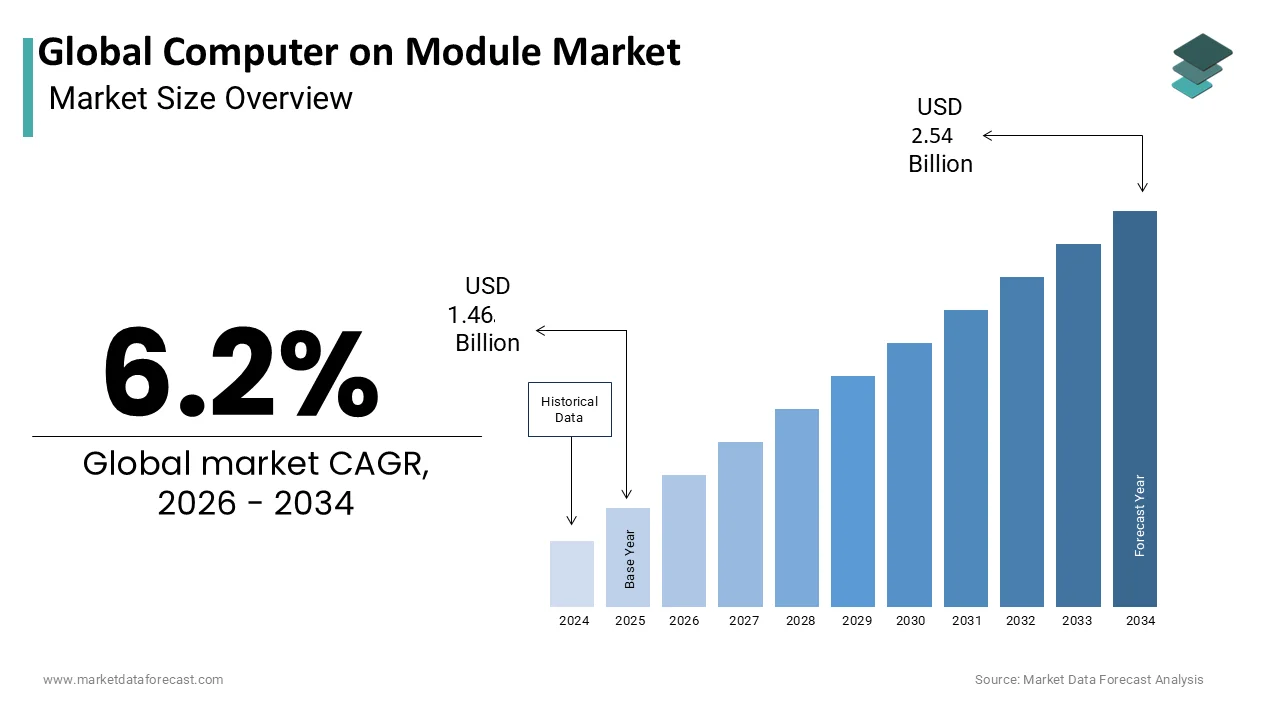
The global computer on module (COM) market size was valued at USD 1.46 billion in 2025, is estimated to reach USD 1.55 billion in 2026, and is projected to scale up to USD 2.54 billion by 2034, registering a compound annual growth rate (CAGR) of 6.37% during the forecast period from 2026 to 2034. Driven by the rapid expansion of industrial automation, Industry 4.0, and the proliferation of smart edge devices, the global COM market continues its steady growth trajectory.
Key Executive Metrics (At-a-Glance)
- 2025 Base Valuation: USD 1.46 Billion
- 2026 Current Valuation: USD 1.55 Billion
- 2034 Forecast Valuation: USD 2.54 Billion
- Compound Annual Growth Rate (CAGR): 6.37% (2026–2034)
- Dominant Processor Segment: ARM Processor (held the dominant market share due to its load-store architecture and low power consumption)
- Dominant Form Factor Segment: COM Express (expected to maintain dominant share via high integration and mezzanine-based flexibility)
- Dominant Industry Vertical: Industrial Automation (largest market share fueled by robotics, SCADA, and PLC integration)
- Dominant Regional Market: Asia-Pacific (projected to display the highest CAGR growth, led by manufacturing hubs in China, Taiwan, and India)
Core Market Drivers
- Industrial Automation & Industry 4.0: Rising deployment of advanced robotics, programmable logic controllers (PLCs), and smart factory applications to boost operational efficiency and cut industrial expenses.
- AI & Automotive Integration: Growing adoption of COMs in smart/autonomous vehicles and embedded AI devices requiring compact footprints and robust multi-core processing.
Primary Market Restraints & Challenges
- IoT Security Concerns: High complexity and development time required for manufacturers to design secure IoT network access and protect sensitive data against potential cyber threats.
Global Computer on Module Market Segmentation Breakdown
| Segment Category | Leading Sub-Segment | Fastest-Growing Sub-Segment |
|---|---|---|
| By Processor | ARM Processor (Dominant share driven by energy-efficient RISC architecture) | ARM & Multi-Core X86 |
| By Form Factor | COM Express (Leads market share via high integration and carrier board versatility) | SMARC & Open Standard Modules (OSM) |
| By Industry Vertical | Industrial Automation (Largest share supported by robotics and factory machinery) | Automotive & Healthcare |
| By Region | Asia-Pacific (Led by China and Taiwan with robust industrial manufacturing) | Asia-Pacific (Highest CAGR) |
Major Industry Players Profiled
Key enterprises shaping the competitive global computer on module market include Kontron, Congatec, MSC Technologies (Avnet), Advantech, ADLink, Portwell, Eurotech, SECO srl, and Technexion.
 Download Free Sample Report
Global Computer on Module Market Size
The size of the global computer on module market was worth USD 1.46 billion in 2025. The global market is anticipated to grow at a CAGR of 6.37% from 2026 to 2034 and be worth USD 2.54 billion by 2034, up from USD 1.55 billion in 2026.
The computer on module is embedded computing that delivers compact integrated processing units containing central processors, memory,y aninput/outputut interfaces. These modules serve as foundational building blocks for diverse industrial applications requiring scalable and reliable computational power without extensive custom design efforts.
This substantial revenue figure underscores the critical role of semiconductor-based technologies, including computer-on-modules, in enabling modern digital infrastructure and intelligent systems worldwide.
The proliferation of these connected devices directly correlates with increased adoption of modular computing platforms that offer flexibility,y rapid deployment, and reduced time to market for original equipment manufacturers developing smart sensors, gateways, and edge computing nodes. Computer-on-modules facilitate seamless integration into carrier boards,s allowing designers to focus on application-specific functionalities.
MARKET DRIVERS
Rising Adoption of Edge Computing Infrastructure
The escalating deployment of edge computing architectures is greatly influencing the growth of the computer-on-module market.
The significant financial commitment demonstrates how organizations prioritize low-latency data processing and real-time decision-making, which computer-on-modules enable through their compact form factors and powerful integrated processors.
The transition from centralized cloud models to edge-based systems requires hardware that can withstand harsh environmental conditions while delivering consistent performance metrics essential for industrial automation, autonomous vehicles,s and smart city applications. Computer-on-modules provide the necessary computational density and thermal efficiency to operate effectively in space-constrained environments where traditional server racks are impractical.
Expansion of Industrial Automation and Robotics
The continuous growth in industrial automation and robotics installations that require robust, reliable,e and scalable computing platforms for machine control and monitoring is escalating the growth of the computer-on-module market. The substantial expansion in robotic deployments necessitates advanced embedded computing solutions that can manage complex motion control, vision systems, and artificial intelligence algorithms in real time.
Computer-on-modules offer the modularity and performance required to integrate seamlessly into robotic controllers, rs enabling manufacturers to upgrade processing capabilities without redesigning entire mechanical systems. The versatility of these modules allows them to support various communication protocols and interface standards essential for connecting robots with enterprise resource planning systems and other factory floor equipment.
Each robotic unit typically incorporates multiple computing nodes for different subsystems, creating multiplied demand for computer-on-modules that provide standardized interfaces and long-term availability crucial for industrial equipment with life cycles spanning decades. This enduring requirement ensures steady market growth as manufacturers seek to enhance productivity, reduce labor costs, and improve product quality through increasingly automated production lines powered by advanced modular computing technologies.
MARKET RESTRAINTS
Complexity in Standardization and Interoperability
The fragmented technical standards create compatibility challenges between different module formats and carrier board designs, which is limiting the growth of the computer on module market
This lack of universal standardization forces original equipment manufacturers to invest significant resources in validating interoperability between modules from different vendors and ensuring long-term supply chain stability for specific form factors.
The existence of several standardization bodies, including PICMG and SGE, T further complicates the ecosystem, em as each promotes distinct architectural approaches that may not align with all application requirements. Designers must carefully evaluate which standard best suits their performance, power, and connectivity needs, often resulting in prolonged development cycles and delayed product launches. This ambiguity discourages some potential adopters who prefer single-vendor proprietary solutions despite higher costs because they offer guaranteed compatibility and dedicated technical support.
Supply Chain Volatility and Component Shortages
The ongoing disruptions in the global electronics supply chain are additionally impeding the growth of the computer on module market. The electronics supply chain faced major upheaval due to trade and geopolitics in early 2026, creating unprecedented risks for manufacturers relying on timely delivery of semiconductors and passive components.
These disruptions directly impact the ability of computer module vendors to maintain consistent inventory levels and meet customer demand schedules, leading to extended lead times and potential project cancellations. The dependence on specialized integrated circuits manufactured by a limited number of foundries exacerbates vulnerability to geopolitical tensions, natural disasters,s and logistical bottlenecks that can halt production for weeks or months.
Computer on module producers must navigate these challenges by securing long-term supply agreements, diversifying supplier bases, and potentially redesigning products to use alternative components, which increases engineering overhead and validation requirements. The volatility in component availability also affects pricing stability, ty making it difficult for vendors to offer fixed-price contracts to customers who require budget certainty for large-scale deployments.
MARKET OPPORTUNITIES
Integration of Artificial Intelligence at the Edge
The growing demand for artificial intelligence processing at the network edge is expected to amplify the growth of the computer-on-module market. Computer-on-modules equipped with neural processing units and graphics processing capabilities can execute machine learning inference tasks directly on devices such as security cameras, industrial sensors,s and autonomous vehicles without relying on cloud connectivity.
This capability allows organizations to implement real-time anomaly detection, predictive maintenance, and object recognition applications that enhance operational efficiency and safety. Computer on module vendors can capitalize on this trend by offering specialized variants optimized for artificial intelligence acceleration with enhanced thermal management and memory bandwidth to handle intensive computational tasks.
The modularity of these platforms enables easy upgrades as artificial intelligence algorithms evolve,e allowing customers to extend the life cycle of their hardware investments while maintaining cutting-edge performance.
Adoption in Healthcare and Medical Devices
The increasing integration of advanced computing in medical equipment to support healthcare applications requiring high reliability and regulatory compliance is another factor driving the growth of the computer-on-module market.
Computer-on-modules provide the compact form factor and deterministic performance necessary for portable medical devices, wearable health monitors,s and hospital infrastructure, where space constraints and power efficiency are paramount considerations. The modular nature of these platforms simplifies regulatory certification processes since the core computing unit can be validated once and reused across multiple medical device designs, ns reducing time to market and development costs.
Computer-on-module vendors can differentiate themselves by offering variants with extended temperature ranges, enhanced electromagnetic compatibility, and long-term availability guarantees that align with the lengthy product life cycles typical of medical equipment. The aging global population and rising prevalence of chronic diseases drive demand for home healthcare solutions and telemedicine platforms.
MARKET CHALLENGES
Thermal Management in Compact Form Factors
Managing heat dissipation in increasingly powerful devices, as performance demands continue to rise, is restricting the growth of the computer-on-module market. According to research, power consumption has become a critical challenge in embedded system design as complexity grows and designers struggle to balance performance with thermal constraints in limited physical spaces.
Computer-on-modules integrate high-performance processors, memory, and other components into small footprints, generating substantial heat that must be efficiently removed to prevent throttling and ensure long-term reliability. The absence of active cooling fans in many embedded applications due to space, noise,e and reliability requirements forces designers to rely on passive cooling methods such as heat sinks and thermal interface materials, which have limited effectiveness as power densities increase.
Computer-on-module vendors must invest in advanced packaging technologies, es improved printed circuit board layouts,uts and novel materials to enhance heat transfer away from critical components, while maintaining compatibility with standard carrier board interfaces. This technical hurdle requires continuous research and development efforts, increasing costs and extending design cycles for vendors striving to deliver next-generation modules that meet evolving performance expectations without exceeding thermal limits imposed by target applications.
Long-Term Availability and Obsolescence Risks
Ensuring long-term component availability also poses a risk to the growth of the computer-on-module market. Computer-on-modules are deployed in industrial applications with life cycles spanning decades, requiring vendors to guarantee supply continuity for extended periods beyond typical consumer electronics timelines.
However, the fast-paced evolution of processor architectures, memory technologies,s and interface standards pressures manufacturers to introduce new products frequently, ly risking discontinuation of older modules that customers still depend on for maintenance and expansion projects. The open standards aim to mitigate this issue by promoting multi-vendor compatibility,ity but proprietary elements and varying implementation details can still lead to supply gaps when specific vendors exit markets or discontinue product lines.
Original equipment manufacturers face significant risks if critical computer-on-module components become unavailable, forcing costly redesigns, recertification efforts,t s and potential service disruptions for end users in sectors such as healthcare, transportation,tion and energy, where system replacements are complex and expensive. Computer-on-module vendors must balance innovation with legacy support, maintaining production of older variants while introducing new features,s creating inventory management complexities and increased operational costs. The challenge is compounded by the reliance on third-party semiconductor suppliers, who may discontinue chips used in modules without sufficient notice, leaving module manufacturers scrambling to find alternatives or redesign products.
REPORT COVERAGE
| REPORT METRIC | DETAILS |
| Market Size Available | 2025 to 2034 |
| Base Year | 2025 |
| Forecast Period | 2026 to 2034 |
| Segments Covered | By Processor, Form Factor, Industry Vertical, and Region. |
| Various Analyses Covered | Global Regional, Country-Level Analysis, Segment-Level Analysis, DROC, PESTLE Analysis, Porter’s Five Forces Analysis, Competitive Landscape, Analyst Overview of Investment Opportunities |
| Regions Covered | North America, Europe, APAC, Latin America, Middle East & Africa |
| Market Leaders Profiled | Kontron, Congatec, MSC Technologies (Avnet), Advantech, ADLink, Portwell, Eurotech, SECO srl, Technexion, and Others. |
SEGMENTAL ANALYSIS
By Processor Insights
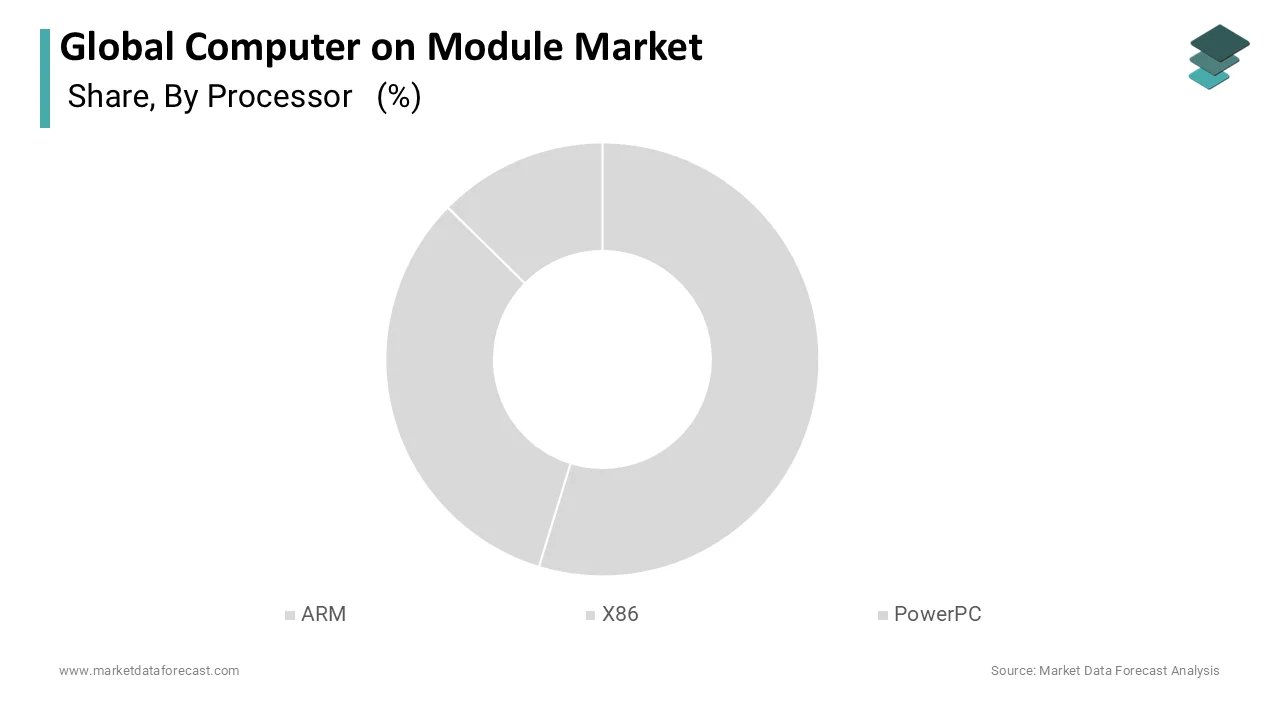
The ARM processor segment was the largest, holding 44.6% of the computer on module market share in 2025 due to its superior power efficiency and widespread adoption in embedded systems requiring low energy consumption.
- These devices rely on the thermal efficiency and compact design capabilities of ARM processors to operate continuously without active cooling mechanisms. The extensive software ecosystem and developer support for ARM architecture reduce time to market for original equipment manufacturers who can leverage pre-validated libraries and operating system ports.
- This combination of hardware efficiency and software availability ensures that ARM remains the preferred choice for designers prioritizing long battery life and minimal heat generation in space-constrained environments.
- The X86 processor segment is expected to register the fastest CAGR of 12.3% from 2-26 to 2034, with the increasing demand for high-performance computing in industrial automation and edge artificial intelligence applications. X86-based computer-on-modules are ideally suited for these demanding workloads as they offer higher computational throughput and support for standard peripheral interfaces required by industrial machinery and vision systems.
- The ability of X86 modules to run full desktop operating systems and specialized industrial software without emulation overhead makes them indispensable for applications requiring deterministic performance and extensiveinput/outputt connectivity. The growth is further accelerated by advancements in X86 manufacturing processes that improve power efficiency, narrowing the gap with ARM, while maintaining superior raw performance for heavy-duty computing tasks in harsh industrial environments.
By Form Factor Insights
The COM Express form factor segment held a dominant share in the computer-on-module market in 2025 due to its versatility, broad industry acceptance,e and comprehensive specifications covering various performance levels. The standardization reduces integration risks and accelerates product development cycles for original equipment manufacturers, who can rely on consistent mechanical and electrical interfaces across multiple generations of hardware.
- The widespread availability of carrier board reference designs and development kits further lowers barriers to entry for companies new to modular computing. The mature ecosystem surrounding COM Express includes extensive software support and diagnostic tools that simplify debugging and maintenance operations.
- This established infrastructure ensures that COM Express remains the default choice for many industrial, medical,ical and transportation applications, where reliability and long-term availability are critical success factors.
- The SMARC form factor segment is expected to witness the fastest CAGR of 12.2% during the forecast period, with the optimization for mobile and ultra-low power applications requiring compact dimensions and efficient thermal management. SMARC modules excel in this environment by offering high performance-per-watt ratios and support for advanced power management features that extend battery life in portable devices.
- The open standards for embedded hardware promote multi-vendor compatibility for SMARC modules, ensuring that designers have access to a competitive supply base and flexible sourcing options. The specification supports modern interface technologies such as PCI Express and USB 3.0, enabling high-speed data transfer despite the small physical size of the module.
- The growing adoption of SMARC in healthcare wearables, smart retail terminals, and autonomous mobile robots underscores its suitability for applications where space is at a premium and power efficiency is paramount.
By Vertical Insights
The industrial automation vertical segment held a significant share of the computer-on-module market due to the extensive deployment of programmable logic controllers, human-machine interfaces, and robotic systems in manufacturing facilities worldwide.
- Each of these robotic systems typically incorporates multiple computer-on-modules for motion control, vision processing,g and network connectivity, driving sustained demand for rugged,d reliable computing platforms. The dominance of this vertical is further reinforced by the ongoing trend towards Industry 4.0, which emphasizes smart factory initiatives requiring real-time data collection and analysis at the machine level.
- Computer-on-modules provide the necessary durability and long-term availability required by industrial equipment that often operates in harsh environments with extreme temperatures, vibration,n and electromagnetic interference. The ability to upgrade processing power without redesigning entire mechanical assemblies makes computer-on-modules cost-effective solutions for manufacturers seeking to extend the life cycle of their automation infrastructure.
- The healthcare vertical segment is swiftly emerging at the fastest CAGR of 14.3% from 2026 to 2034 with the rapid adoption of portable medical devices, telemedicine platforms, and advanced diagnostic imaging systems. Computer-on-modules enable the development of compact, lightweight medical devices such as portable ultrasound machines, patient monitors,s and infusion pumps that require high reliability and regulatory compliance.
- According to research, embedded system design complexity continues to grow, making pre-certified modules attractive for medical device manufacturers who must ensure strict adherence to safety standards such as IEC 60601. The shift towards value-based care and preventive medicine encourages investment in connected health technologies that leverage computer-on-module for secure data transmission and real-time analytics.
COUNTRY LEVEL ANALYSIS
North America Computer On Module Market Analysis
North America was the largest contributor in the computer on module market, accounting for 49.1% of the share in 2025, with advanced technological infrastructure and a strong presence of key industry players.
- The region benefits from substantial investments in research and development, particularly in sectors such as aerospace,e defense, and healthcare,e which drive demand for high-performance embedded computing solutions. The strategic expansion enhances supply chain resilience and reduces dependency on overseas components, ensuring stable availability of critical processors for computer-on-module assembly.
- The presence of major technology hubs in Silicon Valley and Boston fosters innovation in embedded systems design, attracting talent and capital that accelerate product development cycles.
Europe Computer On Module Market Analysis
The European computer-on-module market was ranked second,y holding a 22.3% share in 2025, with a robust industrial base and stringent regulatory frameworks promoting sustainability and energy efficiency.
- The region is home to leading automotive and industrial automation manufacturers who extensively utilize computer-on-modules for vehicle control systems and factory robotics. The high concentration of automated production facilities creates consistent demand for reliable embedded computing platforms that can withstand harsh industrial environments and operate continuously for extended periods.
- The standardization efforts reduce integration complexities and encourage adoption among original equipment manufacturers who seek verified design guides and compatible carrier boards. The European Union's focus on digital sovereignty and green technology initiatives drives investment in energy-efficient embedded systems that minimize power consumption and carbon footprints. Computer on module vendors respond by offering variants optimized for low-power operation and extended temperature ranges, aligning with regional sustainability goals.
Asia Pacific Computer On Module Market Analysis
Asia Pacific computer on module market growth is likely to grow at a fastest CAGR during the forecast period with the massive manufacturing activities and growing adoption of Internet of Things technologies.
- The region benefits from lower production costs and favorable government policies encouraging electronics manufacturing and digital transformation initiatives across various industries. The proliferation of connected devices drives demand for cost-effective and scalable computer-on-modules that can be integrated into smart sensors, gateways, and consumer electronics.
- The region's dominance in semiconductor manufacturing ensures ready availability of components for computer-on-module assembly, reducing lead times and improving supply chain efficiency. Countries such as China, a Jap, an, and South Korea are investing heavily in smart factory initiatives and autonomous vehicle development,e nt creating lucrative opportunities for embedded computing providers. The growing middle class and increasing disposable income in emerging economies boost demand for consumer electronics and home automation systems that rely on modular computing platforms.
Latin America Computer On Module Market Analysis
Latin America computer on module market growth is likely to grow with the gradual adoption of industrial automation and digital infrastructure improvements.
- The region faces challenges related to economic volatility and limited local manufacturing capabilities but shows potential in sectors such as agriculture, mining,g and healthcare. Despite these hurdles, the region is increasingly focusing on modernizing its industrial base to enhance productivity and compete globally.
- Computing modules offer a viable solution for small and medium enterprises seeking to upgrade existing machinery with smart capabilities without substantial capital expenditure. The growing awareness of Industry 4.0 benefits among local manufacturers drives interest in modular embedded systems that provide flexibility and scalability. Government initiatives in countries like Brazil and Mexico aim to promote technological innovation and attract foreign investment in electronics manufacturing.
- These efforts slowly improve the regional ecosystem for embedded computing, although progress remains slower compared to North America or Europe. The healthcare sector also shows promise as public and private institutions invest in portable diagnostic devices and telemedicine platforms to improve access to medical services in remote areas.
Middle East And Africa Computer On Module Market Analysis
The Middle East and Africa computer on module market growth is driven by infrastructure development and diversification efforts away from oil dependence.
- Countries in the Gulf Cooperation Council are investing heavily in smart city projects, renewable energy, and tourism, which require advanced embedded computing solutions for monitoring and control systems. These developments gradually improve access to computer-on-modules for local integrators and system builders.
- The African continent shows potential in telecommunications and agricultural technology, where mobile connectivity and remote monitoring solutions are important for economic development. Computer-on-modules enable the deployment of ruggedized gateways and sensors that can operate in harsh climatic conditions with limited maintenance infrastructure.
- The region's young and growing population drives demand for consumer electronics and educational technology, creating opportunities for affordable embedded computing platforms. Howevere,r market growth is constrained by limited technical expertise and fragmented regulatory environments across different countries. International vendors are increasingly partnering with local distributors and system integrators to provide training and support, rt facilitatingadoption of computer-on-module technologies.
COMPETITIVE LANDSCAPE
- The Computer on Module Market exhibits a moderately consolidated competitive landscape characterized by the presence of established global players and specialized regional manufacturers. Key participants compete primarily on product performance, reliability, long-term availability, and technical support rather than price alone.
- Companies strive to differentiate themselves through adherence to open standards such as COM Express and COM HPC, which ensure interoperability and reduce customer lock-in risks. The competitive intensity is heightened by the growing demand for edge computing and artificial intelligence capabilities, prompting vendors to integrate specialized accelerators into their modules. The emphasis on sustainability and energy efficiency also drives competition as customers seek modules that minimize power consumption and environmental impact.
KEY MARKET PLAYERS
Some of the companies that are playing a dominant role in the Global Computer on Module Market include
- Kontron
- Congatec
- MSC Technologies (Avnet)
- Advantech
- ADLink
- Portwell
- Eurotech
- SECO Srl
- Technexion
TOP LEADING PLAYERS IN THE MARKET
Congatec AG
- Congatec AG serves as a pivotal leader in the Computer on Module Market by delivering comprehensive embedded computing solutions tailored for industrial and medical applications. The company actively expands its portfolio through the introduction of high-performance modules based oon thelatest processor technologies from Intel and AMD.
- In recent developments, Congatec launched advanced server-class modules supporting artificial intelligence workloads at the edge. This strategic move enables customers to deploy complex machine learning algorithms directly on factory floors without relying on cloud connectivity. The firm also emphasizes long-term availability guarantees, which are critical for industrial equipment manufacturers requiring stable supply chains over decades.
- By maintaining strong partnerships with silicon vendors,s Congatec ensures early access to new chips,s allowing rapid integration into modular formats. Their commitment to open standards such as COM HPC and SMARC fosters interoperability and reduces development time for original equipment manufacturers.
Advantech Co Ltd
- Advantech Co Ltd contributes significantly to the Computer on Module Market through its extensive global distribution network and diverse product offerings spanning various form factors. The company leverages its expertise in industrial automation to design robust modules capable of withstanding extreme temperatures and vibration.
- Advantech recently enhanced its edge intelligence capabilities by integrating neural processing units into compact computer-on-module systems. This innovation supports real-time data analytics for smart city and transportation applications where low latency is essential. The firm also provides comprehensive software tools and reference designs that simplify integration for system integrators and developers.
AAEON Technology Inc
- AAEON Technology Inc plays a crucial role in the Computer on Module Market by specializing in high-quality embedded boards and customized solutions for demanding applications. The company focuses on delivering innovative products that balance performance, power efficiency, and compact size. AAEON recently introduced new modules featuring enhanced security features to protect sensitive data in Internet of Things deployments.
- These security enhancements include hardware-based encryption and secure boot mechanisms that safeguard against cyber threats. The firm also invests heavily in research and development to stay ahead of the technological curve in processor architecture and interface standards. Their customer-centric approach includes offering customization services that tailor standard modules to specific client requirements. This flexibility attracts original equipment manufacturers who need unique functionalities without incurring high non-recurring engineering costs.
GLOBAL COMPUTER ON MODULE MARKET NEWS
-
SGET raises the bar for embedded modules by releasing a design guide. In comparison to any Gen1 standard, the new OSM standard provides machine-solderable Computer-on-Modules with cost savings in assembly and test in series production. Another advantage of OSM 1.1 is that it allows for smaller form factors in terms of pinout-to-module size ratio.
-
The AbacusBasic, a computer integrated inside a keyboard, was unveiled by Pentaform. It comes with Windows 10 and all of the software you'll need to get started with computers. You'll still need a monitor, but there are a few options, including a VGA or HDMI output, which allows you to connect to practically any TV or computer display.
MARKET SEGMENTATION
This research report on the global computer-on-module market has been segmented and sub-segmented based on processor, form factor, industry vertical, and region.
By Processor
- ARM
- X86
- PowerPC
By Form Factor
- COM Express
- SMARC
- Qseven
- ETX Module
By Industry Vertical
- Industrial Automation
- Aerospace & Defence
- Consumer Electronics
- Healthcare
- Automotive
By Region
- North America
- Europe
- Asia Pacific
- Latin America
- Middle East & Africa