Europe Anti-Counterfeiting Packaging Market Size, Share, Trends, and Growth Analysis Report, Segmented by Usage Feature, Technology, End User, and Country – Industry Forecast From 2026 to 2034
Market Size, 2025
$67.90 BnMarket Estimate, 2026
$75.60 BnMarket Forecast, 2034
$178.54 BnCAGR, 2026–2034
11.34%Europe Anti-Counterfeiting Packaging Market Report Summary
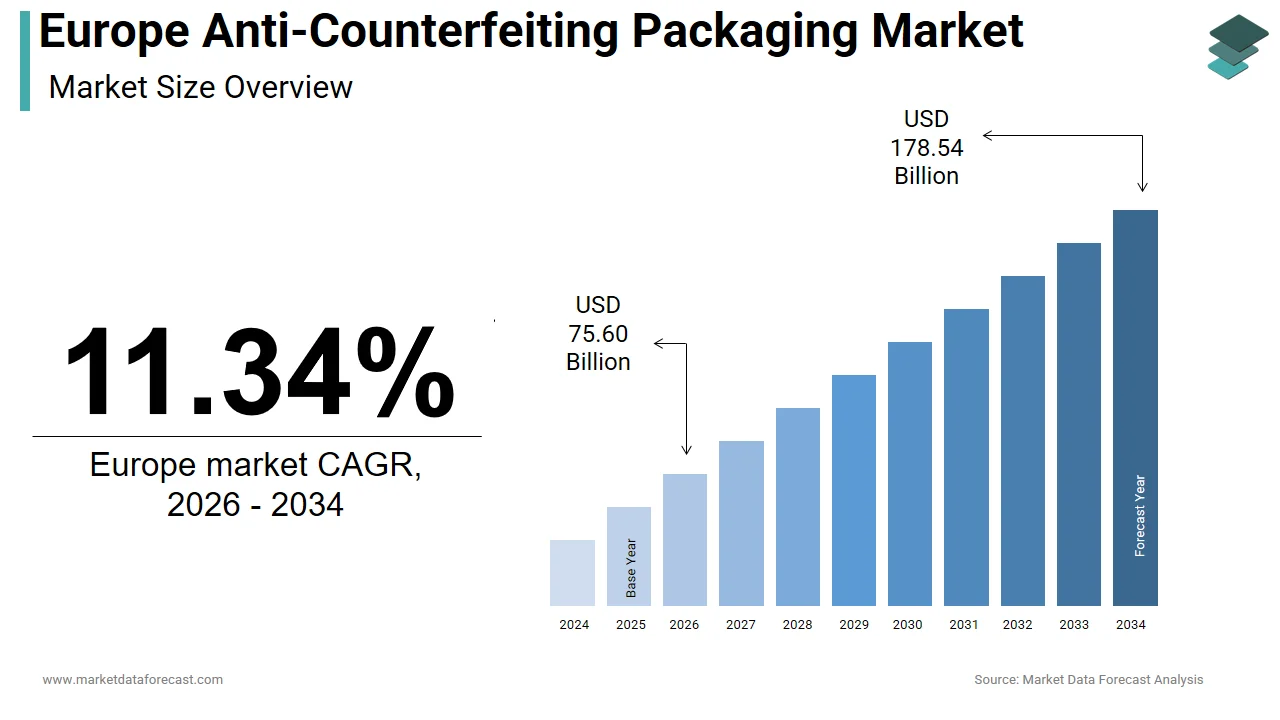
The Europe anti-counterfeiting packaging market was valued at USD 67.90 billion in 2025, is estimated to reach USD 75.60 billion in 2026, and is projected to reach USD 178.54 billion by 2034, growing at a strong CAGR of 11.34% from 2026 to 2034. Market growth is driven by rising counterfeit activities across pharmaceuticals, food & beverages, luxury goods, and consumer electronics, along with increasingly stringent regulatory requirements for product traceability and authentication. European manufacturers are investing in advanced packaging technologies to protect brand integrity, ensure patient safety, and enhance supply chain transparency. The growing adoption of smart packaging, serialization systems, and digital authentication tools is further accelerating market expansion.
Key Market Trends
- Rising adoption of serialization and track-and-trace systems across regulated industries.
- Increasing use of smart labels and digital authentication technologies.
- Growing demand for tamper-evident and secure packaging solutions.
- Expansion of blockchain-enabled supply chain transparency initiatives.
- Strengthening focus on regulatory compliance in pharmaceuticals and healthcare.
Segmental Insights
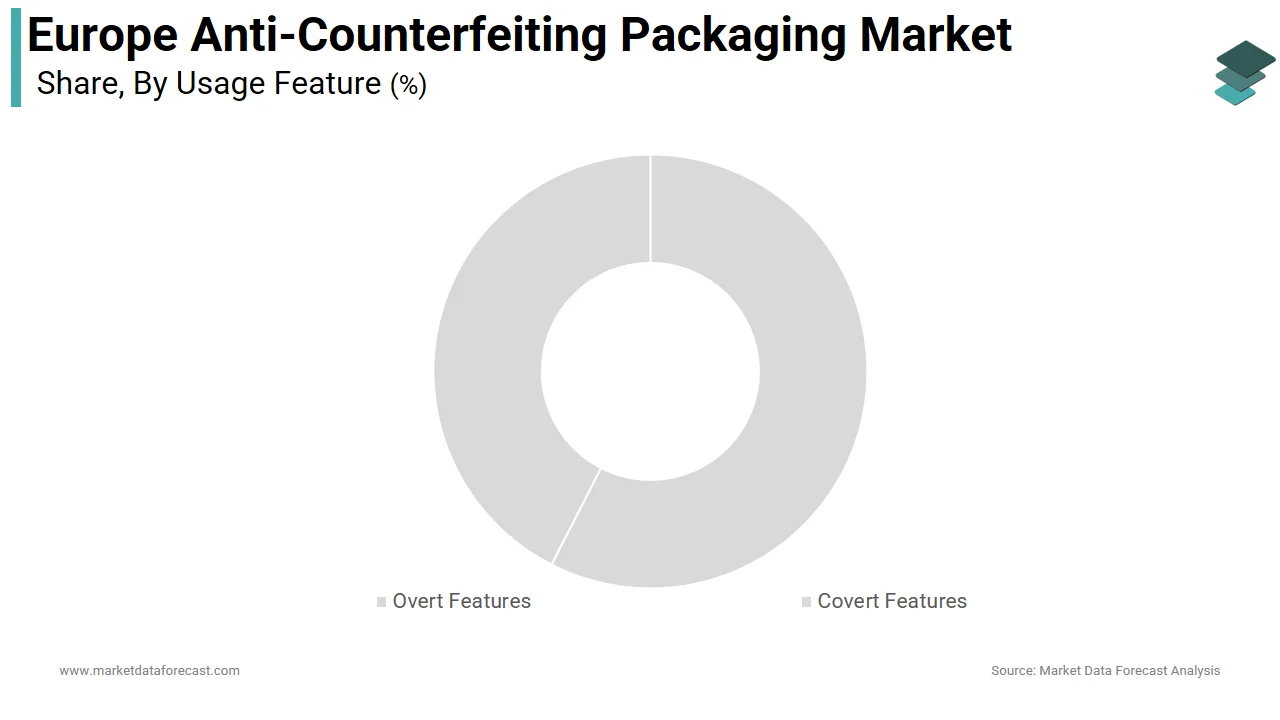
- Based on usage feature, the overt features segment dominated the market in 2025 by holding 58.3% market share, driven by widespread use of visible authentication elements such as holograms, color-shifting inks, and security labels.
- Based on technology, the hologram technology segment led the market by capturing 41.5% share in 2025, supported by its cost-effectiveness, strong visual deterrence capabilities, and high adoption across pharmaceutical and consumer goods packaging.
- Based on end user, the healthcare and pharmaceutical segment held the largest share of 46.8% in 2025, driven by strict anti-counterfeiting regulations, patient safety concerns, and serialization mandates.
Regional Insights
The Europe anti-counterfeiting packaging market is witnessing strong growth across major economies, supported by regulatory enforcement, advanced manufacturing infrastructure, and growing awareness of counterfeit risks.
- Germany led the regional market in 2025 with 18.3% share, driven by strong pharmaceutical production, advanced packaging technologies, and strict regulatory oversight.
- France ranked second with 15.7% share in 2025, supported by robust healthcare regulations and expanding luxury goods markets.
- The United Kingdom maintains a significant share, influenced by post-Brexit regulatory divergence and continued investments in product authentication and traceability systems.
Competitive Landscape
The Europe anti-counterfeiting packaging market is characterized by strong competition among global packaging manufacturers, security technology providers, and digital authentication solution companies. Market players are focusing on integrating physical and digital security features, expanding serialization capabilities, and enhancing supply chain transparency. Strategic collaborations, technological innovation, and regulatory compliance initiatives are shaping competitive dynamics across the region.
Prominent companies operating in the Europe anti-counterfeiting packaging market include Avery Dennison Corporation, CCL Industries Inc., 3M Company, DuPont, Zebra Technologies Corporation, Amcor plc, SICPA Holding SA, Applied DNA Sciences Inc., SAVI Technology, Inc., Authentix, Inc., and AlpVision S.A.
Europe Anti-Counterfeiting Packaging Market Size
The Europe anti-counterfeiting packaging market was valued at USD 67.90 billion in 2025, is estimated to reach USD 75.60 billion in 2026, and is projected to reach USD 178.54 billion by 2034, growing at a CAGR of 11.34% from 2026 to 2034.
Anti-counterfeiting packaging is the technology and methodology deployed to protect products from replication, tampering, and unauthorized distribution across regulated sectors such as pharmaceuticals, luxury goods, and electronics. According to the Organisation for Economic Co-operation and Development, counterfeit and pirated goods accounted for approximately 3% of global trade in 2023, with Europe experiencing disproportionate exposure due to its open internal market and dense supply chains. As per Europol, over 25 million counterfeit products were seized at the European Union external borders in 2022, reflecting a persistent and evolving threat landscape. The European Commission has intensified legislative scrutiny through measures such as the Falsified Medicines Directive, which mandates unique identifiers and anti-tampering devices on pharmaceutical packaging. This regulatory momentum, combined with escalating consumer demand for product authenticity, fuels advanced packaging innovation across member states.
MARKET DRIVERS
Stringent Regulatory Mandates Strengthen Brand Protection Imperatives
The regulatory interventions in highly monitored sectors, such as pharmaceuticals and food is propelling the growth of Europe anti countering packaging market. The Falsified Medicines Directive, enforced since February 2019, requires all prescription medicines to carry a unique identifier and an anti-tampering device on their outer packaging. According to the European Medicines Verification Organisation, over 2 billion medicines were verified through the European Medicines Verification System in 2023 alone, indicating extensive deployment of serialization technologies. Similarly, the European Commission’s Intellectual Property Rights Enforcement Directive compels member states to implement measures that deter commercial-scale counterfeiting. As per the European Union Intellectual Property Office, counterfeit goods caused an estimated 67 billion euro loss to legitimate businesses in 2022. This regulatory environment compels manufacturers to integrate overt, covert, and digital authentication solutions into packaging architecture. France, Germany, and Italy have emerged as leaders in regulatory enforcement, prompting multinational corporations to upgrade packaging lines with tamper-evident seals, RFID tags, and QR-based verification systems. The convergence of legal obligation and brand reputation management ensures sustained investment in anti-counterfeiting packaging infrastructure across diverse European industrial verticals.
Escalating Consumer Awareness Fuels Demand for Transparent Packaging Solutions
The consumers are increasing prioritize product authenticity, safety, and traceability, driving demand for packaging that enables verification and builds trust, which is also propelling the growth of Europe's anti-counterfeiting packaging market. As per a 2024 survey by the European Consumer Organisation, 58% of respondents stated they would avoid purchasing products if they suspected counterfeiting even once. This behavioral shift compels brands to embed consumer-facing authentication features such as digital watermarks, holograms, and smartphone scannable codes. The rise of e-commerce intensifies this dynamic, with online sales accounting for twenty two% of total retail in the European Union in 2023, according to Eurostat, increasing exposure to counterfeit listings on third-party platforms. In response, companies like LVMH and Nestle have pioneered blockchain-enabled packaging, allowing end users to trace product journeys from origin to shelf. Germany leads in consumer-initiated counterfeit reporting, with over twelve thousand cases logged through national customs portals in 2023, as per the German Federal Ministry of Finance. Consequently, packaging is no longer a passive container but an active communication channel between brand and buyer, reinforcing loyalty through verifiable integrity and real-time authentication.
MARKET RESTRAINTS
High Implementation Costs Impede Small and Medium Enterprise Adoption
The deployment of advanced anti-counterfeiting packaging technologies entails substantial capital expenditure, which poses a significant barrier for small and medium enterprises operating in the growth of Europe anti counterfeiting packaging market. Integrating solutions, such as RFID tags, nano barcodes, or blockchain verification, requires overhauling existing production lines, procuring specialized materials, and training personnel. According to the European Commission, small and medium enterprises represent ninety nine% of all businesses in the European Union, yet only thirty four% reported using any form of advanced anti-counterfeiting packaging in 2023. The average cost of implementing serialization infrastructure for a mid-sized pharmaceutical packager exceeds four hundred thousand euros, as per the European Association of Pharmaceutical Full Line Suppliers. Similarly, the European Packaging Federation estimates that adopting smart labels increases per unit packaging costs by fifteen to thirty% depending on volume and complexity. These financial thresholds are especially prohibitive in lower margin sectors such as food and cosmetics, where price sensitivity constrains premium packaging investments. Although public funding initiatives like the Horizon Europe program offer partial support, uptake remains limited due to bureaucratic hurdles and technical incompatibility.
Fragmented Cross-Border Enforcement Undermines Systemic Effectiveness
Despite harmonized directives, the practical enforcement of anti-counterfeiting measures remains uneven across European member states, creating operational vulnerabilities that counterfeiters exploit. The fragmented cross-border enforcement undermines systemic effectiveness and is also degrading the growth of Europe's anti-counterfeiting packaging market. Differences in customs protocols, judicial efficiency, and resource allocation result in inconsistent interception rates at internal and external borders. According to the European Union Intellectual Property Office, seizure discrepancies between neighboring countries, such as Germany and Poland, exceeded 40% in 2023 for identical product categories. As per the study, only 39% of counterfeit goods detected in transit were successfully prosecuted due to jurisdictional complexities and evidentiary gaps. This fragmentation is exacerbated by the Schengen Area’s minimal internal border checks, which facilitate the rapid movement of illicit goods once they enter the bloc. Italy and Spain, for instance, reported an annual increase in counterfeit cosmetics between 2021 and 2023, as per national customs authorities, yet lacked coordinated tracing mechanisms with Northern European distributors. Moreover, divergent national interpretations of the Digital Services Act affect platform accountability for counterfeit listings, further weakening deterrence. Without unified operational frameworks, real-time intelligence sharing, and standardized forensic packaging analysis, anti-counterfeiting packaging technologies operate in a compromised ecosystem where technical sophistication is offset by institutional disarray.
MARKET OPPORTUNITIES
Integration of Digital Product Passports Unlocks Circular Economy Synergies
The European Union’s emerging framework for digital product passports by embedding verifiable data directly into product lifecycles is creating new opportunities for the growth of the Europe anti-counterfeiting packaging market. Mandated under the Ecodesign for Sustainable Products Regulation, digital product passports will require detailed information on material composition, origin, and authenticity accessible via secure digital channels. As per the European Environment Agency, over 60% of counterfeit electronics in Europe in 2023 contained hazardous substances, violating REACH regulations with the need for embedded compliance verification. By linking anti-counterfeiting features, such as NFC chips or cryptographic seals, to these passports, brands can simultaneously authenticate products and support circular economy goals such as reuse, repair, and recycling. France has already piloted such integration in the textile sector with H&M and Patagonia using QR-based passports that verify both origin and sustainability claims. According to the research, the digital product passport initiative could reduce counterfeit circulation by up to 25% in regulated sectors by 2030. This emergence of regulatory innovation, environmental policy, and brand protection creates a compelling value proposition for packaging stakeholders to adopt interoperable, secure, and data-rich solutions that serve dual market imperatives.
Expansion of AI-Enabled Authentication Technologies Opens New Frontiers
The artificial intelligence-driven authentication tools offer a scalable and adaptive solution for enhancing, which is another attribute prompting new opportunities for the growth of Europe anti-counterfieting packaging market. Machine learning algorithms can analyze microscopic variations in printed patterns or material textures to generate unique digital fingerprints that are nearly impossible to replicate. As per the European Institute of Innovation and Technology, over 40 pilot projects leveraging AI for packaging authentication were launched in the European Union in 2024 with a focus on pharmaceuticals and luxury goods. These systems often operate through smartphone applications, allowing consumers or inspectors to verify products using standard cameras without specialized hardware. For example, a collaboration between the Technical University of Munich and Bayer uses convolutional neural networks to authenticate blister packs with 99.7% accuracy, as per published validation studies. The European Defence Agency has also endorsed AI authentication for securing supply chains of critical medical components, citing reduced reliance on centralized databases and enhanced resilience against spoofing. With Europe’s strong emphasis on digital sovereignty and data privacy, such decentralized AI models align with the General Data Protection Regulation while delivering robust anti-counterfeiting assurance. This technological trajectory enables cost-effective, scalable, and user-centric verification that complements existing physical security features.
MARKET CHALLENGES
Proliferation of Sophisticated Counterfeiting Techniques Erodes Trust in Traditional Security Features
Counterfeiters are increasingly deploying high-resolution printing, 3D replication, and chemical mimicry to bypass conventional anti-counterfeiting measures, such as holograms or watermarks, which is a major challenge for the growth of the Europe anti-counterfeiting packaging market. As per the European Union Intellectual Property Office, many seized counterfeit goods in 2023 exhibited near-perfect replication of brand packaging, including tactile finishes and color accuracy. This technological escalation diminishes the reliability of static overt features, which once served as primary consumer verification tools. In the pharmaceutical sector, falsified medicines replicated serialized codes and entered legitimate distribution channels through compromised logistics nodes. Such sophistication forces brands to continuously innovate, often rendering previous packaging investments obsolete within 18 to 24 months. The reactive nature of this arms race increases operational complexity and delays the establishment of standardized verification norms across the European countries. Consequently, even well-resourced companies face persistent uncertainty about the longevity and efficacy of their current anti-counterfeiting strategies in the face of rapidly evolving illicit capabilities.
Lack of Standardized Interoperability Among Authentication Systems Hinders Scalability
The absence of universal protocols for packaging technologies impedes seamless integration across supply chains and borders, and also inhibits the growth of Europe anti-counterfeiting packaging market. Multiple competing standards for RFID, NFC, and blockchain authentication coexist without mutual recognition, creating siloed verification ecosystems. According to the European Committee for Standardization, authentication platforms used by European manufacturers in 2023 complied with common interoperability frameworks. This fragmentation complicates multi-brand verification for retailers, logistics providers, and customs authorities who must manage disparate scanning devices and software interfaces. For instance, a Dutch logistics company reported an increase in processing time for pharmaceutical consignments due to incompatible serialization formats across suppliers as per internal performance audits shared with the European Logistics Association. Similarly, consumer-facing apps often fail to read codes from competing platforms, reducing public trust in digital verification. The European Commission’s attempt to establish the EU Authenticity Verification Framework remains in draft phase, with industry consensus delayed by proprietary interests.
REPORT COVERAGE
| REPORT METRIC | DETAILS |
| Market Size Available | 2025 to 2034 |
| Base Year | 2025 |
| Forecast Period | 2026 to 2034 |
| Segments Covered | By Usage Feature, Technology, End User, and Country. |
| Various Analyses Covered | Global, Regional, and Country-Level Analysis, Segment-Level Analysis, Drivers, Restraints, Opportunities, Challenges; PESTLE Analysis; Porter’s Five Forces Analysis, Competitive Landscape, Analyst Overview of Investment Opportunities |
| Countries Covered | UK, France, Spain, Germany, Italy, Russia, Sweden, Denmark, Switzerland, Netherlands, Turkey, Czech Republic, and the Rest of Europe. |
| Market Leaders Profiled | Avery Dennison Corporation, CCL Industries Inc., 3M Company, DowDuPont (DuPont), Zebra Technologies Corporation, SICPA Holding SA, Applied DNA Sciences Inc., SAVI Technology, Inc., Authentix, Inc., and AlpVision S.A. |
SEGMENTAL ANALYSIS
By Usage Feature Insights
The overt features segment was accounted for in holding 58.3% of the European anti-counterfeiting packaging market share in 2025, owing to the consumer-facing visibility and ease of verification, which align with regulatory transparency mandates and brand protection strategies. European consumers increasingly rely on instantly recognizable security elements, such as color-shifting inks, holographic foils, and tamper-evident seals to assess product legitimacy. As per the European Consumer Organisation, 52% of consumers in 2023 reported using visual cues as their primary method to detect counterfeits before purchase. This behavioral preference compels fast-moving consumer goods and luxury brands to prioritize overt features that require no specialized tools. Germany alone registered over 8000 consumer complaints related to packaging authenticity in 2023, according to the Federal Office of Consumer Protection, reinforcing the need for intuitive visual safeguards.
The covert features segment is expected to witness the fastest CAGR of 11.4% throughout the forecast period. Covert features, such as invisible inks, DNA tagging, and micro text, are increasingly embedded into packaging to support backend authentication without altering consumer-facing aesthetics. In the pharmaceutical sector, where serialization is mandatory, the European Medicines Verification Organisation reported that some manufacturers in 2024 combined overt QR codes with covert chemical markers to prevent code cloning. Germany’s Merck KGaA implemented a covert luminescent taggant system across its vaccine packaging, which reduced diversion incidents by 29% in pilot distribution corridors, according to internal compliance data shared with health regulators. National customs agencies in the Netherlands and Sweden have begun subsidizing covert feature integration for small exporters under the Secure Trade Lane Initiative, reflecting institutional endorsement.
By Technology Insights
The hologram technology segment was the largest by holding 41.2% of the Europe anti-counterfeiting packaging market share in 2025. The European Union mandates tamper-proof visual indicators for all prescription medicines under the Falsified Medicines Directive, a requirement widely fulfilled through holographic seals. As per the European Medicines Verification Organisation, pharmaceutical packagers in the EU use holograms as part of their primary anti-tampering strategy. Similarly, the EU Tobacco Products Directive requires prominent health warnings and authentication marks, which holograms effectively deliver. This regulatory anchoring ensures consistent industrial demand, particularly in Southern and Eastern Europe, where compliance infrastructure is still scaling.
The RFID segment is growing at an anticipated CAGR of 15.2% throughout the forecast period. Germany’s pharmaceutical logistics network now processes many RFID-tagged units monthly, according to the German Association of Pharmaceutical Manufacturers. The technology enables real-time inventory tracking, temperature monitoring, and diversion alerts that surpass barcodes in functionality. In France and the United Kingdom, high-end fashion retailers including Louis Vuitton and Burberry embed RFID tags not only for anti-theft but also for verifying authenticity during resale and after-sales service. According to the European Luxury Goods Association, 68% of premium apparel brands plan a full RFID rollout by 2026 to support circular economy initiatives like repair and resale. The UK’s Office for Product Safety and Standards noted a 33% decline in counterfeit luxury seizures in 2023, attributable to RFID-enabled authentication at customs and retail checkpoints.
By End User Insights
The healthcare and pharmaceutical sector was the largest by holding 46.3% of the Europe anti-counterfeiting packaging market share in 2025. Counterfeit medicines pose direct threats to public health, with the World Health Organization estimating that 1 in 10 medical products in low and middle-income countries is substandard or falsified, a risk that Europe mitigates through aggressive packaging controls. In 2023, the European Medicines Agency recalled over two hundred thousand units of cardiovascular drugs due to suspected counterfeiting, all of which lacked mandated anti-tampering devices. The Falsified Medicines Directive’s requirement for unique identifiers and verification has led to near universal adoption of serialized anti-counterfeiting packaging across EU pharmaceutical manufacturers. Germany alone verifies over nine million medicine packs daily through its national repository as per the German Medicines Verification Organisation, underscoring the operational depth of this compliance ecosystem.
The electronics and automotive segment is projected to expand at a CAGR of 12.8% from 2026 to 2034. The European Automobile Manufacturers Association reported that in 2023, over 35,000 counterfeit automotive parts were seized at EU borders, including brake pads, airbags, and engine sensors posing severe safety risks. Similarly, the European Semiconductor Industry Association documented a 24% year on year increase in fake microchips entering industrial supply chains. These components often lack proper certification yet mimic original packaging, leading to system failures. In response, companies like Bosch and Siemens now embed tamper-evident seals and serialized QR codes on all critical electronic modules. Post pandemic and post Ukraine conflict the Europe has accelerated efforts to de-risk electronics sourcing, leading to greater scrutiny of component provenance. The European Chips Act explicitly links packaging authentication to supply chain resilience, recommending anti-counterfeiting measures for all semiconductors used in infrastructure. As per the European Commission, over 60% of new electronics procurement contracts in 2024 include anti-counterfeiting packaging clauses.
COUNTRY-LEVEL ANALYSIS
Germany Anti-Counterfeiting Packaging Market Analysis
Germany was the top performer of the Europe anti-counterfeiting packaging market by holding 18.3% of the market share in 2025. Germany’s position as Europe’s manufacturing powerhouse necessitates a robust anti-counterfeiting infrastructure across pharmaceuticals, automotive, and engineering goods. The country hosts over 500 packaging technology providers, including leading firms like Schreiner MediPharm and UPM Raflatac, which develop integrated security solutions for domestic and export markets. Regulatory enforcement is exceptionally stringent, with the German Customs Administration seizing over 42 million counterfeit items in 2023 alone as per official records. The national implementation of the Falsified Medicines Directive is among the most advanced, with 99% of pharmacies connected to the real time verification system operated by securPharm. Furthermore, Germany’s dual emphasis on Industry 4.0 and product safety has driven early adoption of smart packaging, including RFID and digital watermarks.
France Anti-Counterfeiting Packaging Market Analysis
France was positioned second by holding 15.7% of the Europe anti-counterfeiting packaging market share in 2025. France’s anti-counterfeiting packaging ecosystem is uniquely shaped by its dominance in high-value consumer sectors where brand integrity is paramount. The world’s luxury goods production is making packaging a defense against imitation. Brands like Chanel and Dior invest heavily in proprietary holograms, micro engraving, and NFC-enabled boxes that authenticate both at the point of sale and during resale. France enforces some of the EU’s strictest pharmaceutical packaging rules, with the National Agency for the Safety of Medicines requiring tamper-evident closures and serialization for all prescription drugs. Public-private collaboration is also advanced with the Union des Fabricants operating a centralized anti-counterfeiting platform that links brands, customs, and law enforcement.
United Kingdom Anti-Counterfeiting Packaging Market Analysis
The United Kingdom anti-counterfeiting packaging market is expected to witness a prominent growth opportunity in the coming years. The United Kingdom maintains strong anti-counterfeiting packaging adoption due to its dense concentration of global brands, pharmaceutical innovators, and financial services that support authentication ecosystems. London remains a global hub for luxury retail with over two hundred flagship stores requiring sophisticated packaging to deter grey market and counterfeit infiltration. The Medicines and Healthcare products Regulatory Agency enforces packaging rules comparable to the EU’s Falsified Medicines Directive, ensuring continuity in pharmaceutical security standards. In 2023, UK customs seized over nineteen million counterfeit items, with electronics and clothing as the top categories, as per Home Office data. Notably, the UK has pioneered blockchain-based verification through initiatives like the Anti-Counterfeiting Consortium, which includes companies like Unilever and Rolls-Royce. The British Standards Institution recently published PAS 2060 for digital product authentication, further institutionalizing advanced packaging norms.
Italy Anti-Counterfeiting Packaging Market AnalysisItaly'sy anti-counterfeiting packaging market growth is likely to grow steadily throughout the forecast period. Italy faces exceptional counterfeit pressure due to its global reputation in fashion, automotive, and food sectors, with the Italian Patent and Trademark Office estimating that counterfeiting costs the economy over 6 billion euros annually. In response, Italian manufacturers have become early and aggressive adopters of anti-counterfeiting packaging. The agri-food sector also leads in adoption, with Parmigiano Reggiano and Prosecco consortia mandating tamper-evident seals and blockchain traceability on all export packaging. The government supports this through the National Anti-Counterfeiting Committee, which funds SME packaging upgrades and coordinates cross-agency enforcement.
Spain Anti-Counterfeiting Packaging Market Analysis
Spain anti-counterfeiting packaging market is likely to grow eventually in the coming years. Spain’s geographic position as a southern EU entry point makes it disproportionately exposed to counterfeit goods arriving from North Africa and the Middle East. Spain fully implements the Falsified Medicines Directive with pharmacies connected to the EU verification system. Local companies like Grifols have pioneered serialization and tamper-evident blister packs that are now exported as best practices. Regional governments such as Catalonia and Madrid also offer subsidies for SMEs to integrate security packaging under the Secure Brand Initiative. This combination of threat response, regulatory compliance, and digital commerce growth underpins Spain’s established and expanding market position.
COMPETITIVE LANDSCAPE
The Europe anti counterfeiting packaging market features intense competition driven by rapid technological innovation, stringent regulatory demands, and cross-sector adoption. Established multinational corporations compete alongside specialized European security solution providers, creating a dynamic landscape of collaboration and differentiation. Companies prioritize agility in responding to evolving counterfeit tactics while ensuring compatibility with EU-wide directives such as the Falsified Medicines Directive and the Ecodesign for Sustainable Products Regulation. The convergence of physical packaging with digital identity systems has raised entry barriers, favoring firms with integrated hardware, software, and data capabilities. Simultaneously, pressure to reduce costs for small and medium enterprises fuels demand for modular, scalable solutions. This competitive environment fosters continuous advancement in authentication accuracy, supply chain integration, and environmental compliance as participants strive to balance security functionality and sustainability across diverse end-user industries throughout Europe.
KEY MARKET PLAYERS
The leading companies operating in the Europe anti-counterfeiting packaging market include:
- Avery Dennison Corporation
- CCL Industries Inc.
- 3M Company
- DowDuPont (DuPont)
- Zebra Technologies Corporation
- Amcor plc
- SICPA Holding SA
- Applied DNA Sciences Inc.
- SAVI Technology, Inc.
- Authentix, Inc.
- AlpVision S.A
TOP PLAYERS IN THE MARKET
- Amcor plc plays a pivotal role in advancing anti-counterfeiting packaging solutions across Europe through its integrated global innovation network. The company specializes in developing tamper-evident closures, smart labels, and serialized packaging for pharmaceuticals and premium consumer goods. In recent years, Amcor has intensified its focus on digital authentication by embedding QR codes and near-field communication tags into flexible and rigid packaging formats. It partnered with several European regulatory bodies to align its solutions with the Falsified Medicines Directive and sustainability mandates. Amcor launched a blockchain-enabled packaging pilot with a leading European vaccine manufacturer to enhance end-to-end traceability and combat diversion in cold chain logistics.
- Avery Dennison Corporation significantly contributes to the European anti-counterfeiting packaging landscape through its portfolio of intelligent labeling and radio frequency identification technologies. The company provides covert and overt security features tailored for the luxury fashion, pharmaceuticals, and electronics sectors. Avery Dennison has invested heavily in digital product identity platforms that link physical tags to cloud-based verification ecosystems. It introduced a new generation of tamper-evident RFID labels compliant with EU digital product passport guidelines. The firm also expanded its collaboration with European customs authorities to integrate its authentication data into border inspection workflows, enhancing real-time counterfeit detection across Schengen countries.
- SICPA Holding SA is a key enabler of secure packaging in Europe through its expertise in visible and invisible security inks, authentication technologies, and traceability systems. The company’s solutions are widely adopted in regulated industries, including tobacco, pharmaceuticals, and government documents. SICPA has pioneered the integration of molecular tagging with digital verification, creating hybrid systems that serve both consumer and regulatory authentication needs. SICPA enhanced its Product Identification and Integrity platform to support the European Union’s evolving anti-counterfeiting directives. It also launched a new suite of eco-compatible covert markers designed for recyclable packaging, aligning security with circular economy objectives across multiple European markets.
TOP STRATEGIES USED BY THE KEY MARKET PARTICIPANTS
Key players in the Europe anti-counterfeiting packaging market pursue strategic investments in digital authentication platforms to align with regulatory mandates and consumer expectations. They forge public-private partnerships with customs agencies, health authorities, and industry consortia to embed verification into enforcement workflows. Continuous innovation in covert and overt technologies enables differentiation while maintaining cost efficiency. Companies increasingly integrate anti-counterfeiting features with sustainability goals by developing recyclable and biodegradable secure packaging. Geographic expansion through localized production and compliance hubs strengthens responsiveness to country-specific regulatory frameworks across the European Union.
MARKET SEGMENTATION
This research report on the Europe anti-counterfeiting packaging market has been segmented and sub-segmented into the following categories.
By Usage Feature
- Overt Features
- Covert Features
By Technology
- Barcodes
- RFID
- Hologram
- Packaging Designs
- Others
By End User
- Food & Beverage
- Healthcare & Pharmaceutical
- Electronics & Automotive
- Consumer Durables
- Clothing & Apparel
- Others
By Country
- United Kingdom
- France
- Spain
- Germany
- Italy
- Russia
- Sweden
- Denmark
- Switzerland
- Netherlands
- Rest of Europe
Frequently Asked Questions
What is the Europe anti-counterfeiting packaging market?
The Europe anti-counterfeiting packaging market provides authentication technologies protecting brands from fake products across industries.
Why is the Europe anti-counterfeiting packaging market growing?
The Europe anti-counterfeiting packaging market grows due to rising counterfeit threats and stringent regulatory requirements.
What technologies lead the Europe anti-counterfeiting packaging market?
RFID, holograms, and serialization dominate the Europe anti-counterfeiting packaging market for product verification.
Which industries drive the Europe anti-counterfeiting packaging market?
Pharmaceuticals and luxury goods lead the Europe anti-counterfeiting packaging market demand for secure solutions.
What trends shape the Europe anti-counterfeiting packaging market?
Trends in the Europe anti-counterfeiting packaging market include blockchain integration and smart NFC tags adoption.
How does RFID work in the Europe anti-counterfeiting packaging market?
RFID enables wireless tracking in the Europe anti-counterfeiting packaging market throughout complex supply chains.
What role does serialization play in the Europe anti-counterfeiting packaging market?
Serialization assigns unique codes in the Europe anti-counterfeiting packaging market for end-to-end traceability.
Which countries lead the Europe anti-counterfeiting packaging market?
Germany, France, and UK pioneer the Europe anti-counterfeiting packaging market through advanced manufacturing hubs.
What regulations impact the Europe anti-counterfeiting packaging market?
Falsified Medicines Directive drives compliance needs in the Europe anti-counterfeiting packaging market pharmaceuticals.
How does the Europe anti-counterfeiting packaging market protect luxury goods?
Holographic labels secure premium brands in the Europe anti-counterfeiting packaging market against fakes effectively.
Related Reports
Access the study in MULTIPLE FORMATS
Purchase options starting from
$ 2000
Didn’t find what you’re looking for?
TALK TO OUR ANALYST TEAM
Need something within your budget?
NO WORRIES! WE GOT YOU COVERED!
Call us on: +1 888 702 9696 (U.S Toll Free)
Write to us: sales@marketdataforecast.com