- Product Description Description
- Table of Contents TOC
- List of Table & Figure LOT
- Get Free Sample PDF Sample PDF
Market Size, 2025
$2.04 BnMarket Estimate, 2026
$2.25 BnMarket Forecast, 2034
$4.95 BnCAGR, 2026–2034
10.34%Europe Automotive Cyber Security Market Summary
Europe’s automotive cybersecurity market is expanding steadily, driven by mandatory cybersecurity regulations, rapid growth of connected and software-defined vehicles, and increasing deployment of over-the-air (OTA) update ecosystems across passenger and commercial fleets. The market is shaped by the enforcement of UNECE R155, the EU Cyber Resilience Act, and ISO-based cybersecurity frameworks that mandate cyber-resilient vehicle architectures, intrusion detection, and end-to-end security lifecycle management. Growth is reinforced by rising cyber-attack risks, electrification, and fleet digitalization, while challenges persist around high implementation costs, fragmented supply chains, and a shortage of specialized cybersecurity engineering talent across the region.
Market Growth & Size
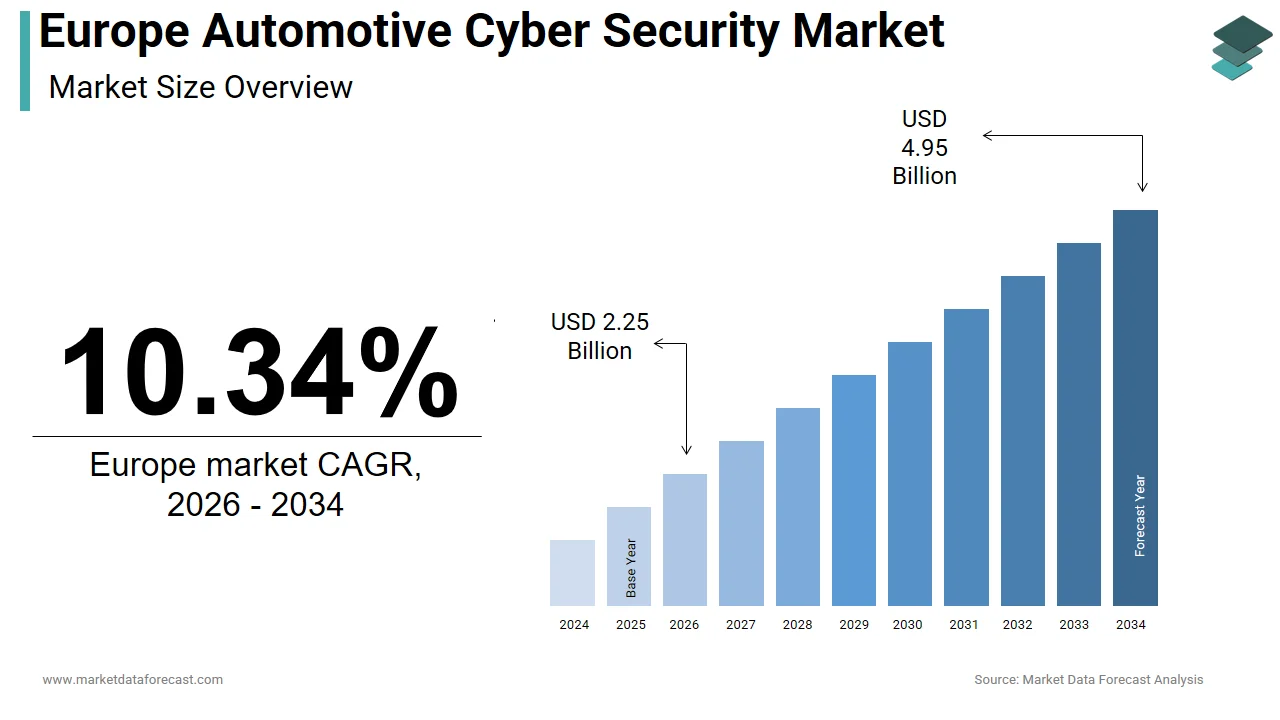
- Strong Expansion: The Europe automotive cybersecurity market was valued at USD 2.04 billion in 2025, is expected to reach USD 2.25 billion in 2026, and is projected to reach USD 4.95 billion by 2034, growing at a CAGR of 10.34% from 2026 to 2034. Growth is underpinned by regulatory-driven security adoption, expanding connected vehicle deployment, and increasing investment in embedded security, intrusion detection, and secure OTA ecosystems across European automotive platforms.
- Key Segments: Embedded in-vehicle security currently leads due to regulatory mandates requiring hardware-based protection, secure gateways, and ECU-level authentication, while standalone & fleet cybersecurity services are witnessing fast growth as mobility operators and logistics fleets adopt centralized monitoring, post-production security, and Cybersecurity-as-a-Service models.
Drivers & Trends
- Policy & Compliance Enforcement: Mandatory adoption of UNECE R155, ISO/SAE 21434, and EU cyber resilience frameworks is accelerating cybersecurity integration across the full vehicle lifecycle — from design and homologation to OTA maintenance and end-of-life threat management.
- Software-Defined Vehicles & OTA Expansion: Rising deployment of software-defined architectures, remote diagnostics, and OTA updates is increasing cyber-risk exposure, driving demand for secure boot mechanisms, cryptographic authentication, and real-time anomaly detection across in-vehicle networks.
- AI-Enabled Threat Detection: Automakers are increasingly adopting AI-driven behavioral analytics and machine-learning intrusion detection systems to identify zero-day attacks and secure CAN, Ethernet, and zonal vehicle architectures in real time.
- Fleet Cybersecurity Services: Growth in shared mobility, logistics fleets, and public transport electrification is boosting demand for centralized cyber monitoring, vulnerability assessment, and continuous compliance reporting across large-scale connected vehicle deployments.
Key Players & Ecosystem
- Local & Global Technology Leaders: The ecosystem includes leading cybersecurity and automotive technology providers such as Continental AG, Argus Cyber Security, HARMAN, Bosch, NXP, Vector Informatik, Infineon, Aptiv, GuardKnox, and Trillium Secure, alongside OEM cybersecurity programs and Tier-1 security engineering hubs.
- Cybersecurity innovation is supported by regulatory certification bodies, automotive testing centers, fleet monitoring platforms, and security-focused engineering ecosystems, which collectively strengthen cyber-resilience across European vehicle production and fleet operations.
Challenges
- Supply Chain Fragmentation: Diverse multi-tier supplier ecosystems and varying security maturity levels create inconsistent cyber protection across ECUs and components, increasing systemic risk exposure.
- High Implementation & Compliance Costs: Smaller suppliers face difficulties absorbing costs of CSMS deployment, penetration testing, SOC operations, and security engineering, slowing uniform adoption across the value chain.
- Regulatory & Liability Ambiguity: Unclear accountability around cyber incident liability and breach disclosure creates legal uncertainty, particularly in multi-vendor connected vehicle ecosystems.
- Talent Shortage: Europe faces a shortage of professionals trained in automotive cybersecurity engineering, secure ECU development, and in-vehicle network forensics, constraining scalable implementation across OEM and Tier-1 programs.
Europe Automotive Cyber Security Market Size
The size of the Europe automotive cybersecurity market was worth USD 2.04 billion in 2025. The regional market is anticipated to grow at a CAGR of 10.34% from 2026 to 2034 and be worth USD 4.95 billion by 2034 from USD 2.25 billion in 2026.
Automotive cyber security refers to the technologies, processes, and solutions designed to protect connected and automated vehicles from malicious digital intrusions targeting electronic control units in vehicle communication networks and over-the-air update systems. The expanding complexity of modern vehicles, which are packed with extensive lines of code and numerous sensors, increases their vulnerability to cyber threats. Europe has established a framework for automotive regulation, requiring certified cybersecurity management systems for certain new vehicles. Most passenger vehicles in Europe include built-in connectivity that supports various remote features and requires ongoing cyber protection. All new vehicles registered in the European Union must meet specific cyber resilience requirements. This regulatory imperative, coupled with rising consumer awareness and escalating threat sophistication, defines a market where security is no longer optional but foundational to vehicle design certification and operation.
MARKET DRIVERS
Mandatory Compliance with UNECE R155 and EU Cyber Resilience Framework
The enforcement of UNECE Regulation No 155 and the complementary EU Cyber Resilience Act constitutes the key driver for the Europe automotive cybersecurity market. New rules in the European Union have introduced mandatory cybersecurity requirements for all new vehicle type approvals. This framework covers the complete lifespan of a vehicle, starting from its design phase and extending all the way to its eventual decommissioning. The regulatory shift compels original equipment manufacturers and their tier one suppliers to integrate security by design principles into every electronic architecture. Authorities have been processing a substantial number of these vehicle type certifications, each of which requires a thorough examination of potential threats, risk assessments, and systems for ongoing monitoring. The enforcement of these new standards appears to be strict, as a notable percentage of initial applications in one member state were found to have insufficient plans for managing cyber risks and were subsequently not approved. In a related development, new audit guidelines have been established across the region. These guidelines specify the need for features such as immediate intrusion detection and secure methods for delivering software updates over the air for any connected vehicle functions. These binding requirements have transformed cybersecurity from an optional feature into a non-negotiable engineering deliverable, accelerating procurement of embedded firewalls, secure gateways, and vulnerability assessment tools across the European automotive supply chain.
Proliferation of Software-Defined Vehicles and Over-the-Air Update Capabilities
The rapid adoption of software-defined vehicle architectures has dramatically increased the attack surface and thus the necessity for robust cybersecurity, which is among the major accelerators of the expansion of the Europe automotive cybersecurity market. Modern European vehicles utilize numerous software applications to manage functions ranging from battery thermal management to adaptive cruise control, with updates delivered remotely. A substantial percentage of new passenger cars sold in the European Union are equipped to support remote software updates. Each update cycle introduces potential vulnerabilities if not secured through cryptographic authentication and secure boot mechanisms. In addition, the volume of attempted breaches targeting vehicle update servers at major European automakers indicates this area is a significant cybersecurity concern. Consequently, manufacturers are investing heavily in end-to-end security stacks, including hardware security modules, trusted execution environments, and cloud-based update management platforms. One manufacturer adopted a more secure architecture for its remote update system, allowing for granular access control and real-time anomaly detection throughout its vehicle fleet. This technological evolution ensures that cybersecurity becomes an integral and recurring component of vehicle lifecycle management rather than a one-time hardware feature.
MARKET RESTRAINTS
Fragmented Supply Chain and Lack of Standardized Security Protocols
The highly distributed nature of the region’s automotive supply ecosystem impedes consistent implementation of cybersecurity measures across vehicle platforms, which in turn hampers the growth of the Europe automotive cybersecurity market. Individual vehicles often incorporate components from numerous suppliers who manage their own electronic control units without following universal security protocols. A significant portion of secondary and tertiary suppliers struggle to meet basic industry requirements for secure coding and threat modeling. This lack of uniformity creates vulnerabilities within the supply chain that can be exploited to compromise diagnostic interfaces across multiple vehicle brands. Moreover, the absence of a pan-European certification body for component-level cyber resilience leaves original equipment manufacturers to conduct redundant security assessments, adding cost and delay. The lack of standardized protocols and shared threat intelligence platforms means that supply chain opacity will continue to be a key structural weakness, which erodes the resilience of the entire cyber system.
High Implementation Costs and Return on Investment Ambiguity
The substantial financial burden associated with embedding end to end cyber security deters comprehensive adoption, especially among small and medium-sized automotive suppliers, and this ultimately inhibits the expansion of the Europe automotive cybersecurity market. Implementing a compliant Cyber Security Management System often requires substantial investments across various critical areas. These areas typically include establishing secure development environments, acquiring advanced penetration testing tools, setting up dedicated security operation centers, and hiring specialized personnel. Moreover, these costs can represent a notable operational load, particularly for smaller organizations. The expenditures may be disproportionately challenging for suppliers with more limited annual revenues. Furthermore, the lack of standardized metrics to quantify risk reduction or breach prevention makes it difficult to justify security investments to corporate leadership. Unlike functional safety, where failure consequences are well defined, cyber threats remain probabilistic and often invisible until exploited. This uncertainty leads to underinvestment in proactive measures such as runtime intrusion detection or hardware-based root of trust, particularly in cost-sensitive vehicle segments, thereby creating uneven security postures across the European automotive landscape.
MARKET OPPORTUNITIES
Integration of Artificial Intelligence for Real-Time Threat Detection
The application of artificial intelligence and machine learning to automotive cyber defense offers a major growth opportunity for the Europe automotive cybersecurity market. This is achieved by enabling dynamic anomaly identification in complex in-vehicle networks. Traditional rule-based intrusion detection systems struggle to keep pace with evolving attack patterns in controller area network and Ethernet-based vehicle architectures. In response, European automakers are deploying AI-driven behavioral analytics that establish baseline communication profiles and flag deviations in real time. A specific pilot program demonstrated the efficacy of using unsupervised learning models for detecting zero-day attacks on electronic power steering systems. Funding has been allocated to an initiative focused on developing federated learning frameworks, which allow vehicles to share threat signatures while maintaining data privacy. A dedicated testbed has been established for automotive AI security research, which simulates numerous attack scenarios monthly to facilitate the training of advanced detection algorithms. These innovations shift cybersecurity from static protection to adaptive resilience, offering a scalable solution for increasingly autonomous and connected vehicle fleets.
Rise of Cyber Security as a Service for Mobility Fleets
The emergence of Cyber Security as a Service models tailored for commercial and shared mobility operators opens new expansion possibilities beyond original equipment integration, which are accelerating the European automotive cybersecurity market. Fleet managers in Europe are encountering increasing risks related to their connected vehicles, including concerns over unauthorized access, telematics interference, and potential remote control issues. The connected nature of modern fleets introduces new challenges for maintaining security and control of these vehicles. Unlike private vehicles, fleets require centralized monitoring, continuous compliance reporting, and rapid incident response across thousands of units. Public transport authorities are beginning to require external certification for digital monitoring systems on transit vehicles. Transit operators are transitioning toward cloud-based security platforms provided by specialized technology firms. Large-scale logistics companies are deploying endpoint protection across delivery fleets to improve threat visibility and automate software maintenance. Mobility providers are shifting their focus from one-time hardware security measures toward ongoing operational security services. Industry trends indicate a growing prioritization of system uptime, data integrity, and passenger trust within the transportation sector. This service-oriented model decouples cyber protection from vehicle manufacturing, creating recurring revenue streams and broader market participation.
MARKET CHALLENGES
Evolving Regulatory Ambiguity Around Liability and Incident Disclosure
The lack of clear legal frameworks defining cyber incident liability and mandatory breach disclosure creates significant uncertainty for automotive stakeholders across the region, which limits the growth of the Europe automotive cybersecurity market. While the UNECE R155 regulation requires systems to manage cybersecurity, it does not explicitly assign legal accountability when a breach occurs within complex vehicle ecosystems. Connected car owners frequently express considerable concern about potential data theft or vehicle hijacking, but many are uncertain about which specific entity would be held accountable in such an event. This ambiguity discourages proactive investment as companies fear disproportionate liability exposure. In one scenario involving a simulated security event in a vehicle fleet, a gap was observed in the legal frameworks, as no mechanism was available to compel specific external software providers to disclose known vulnerabilities present within third-party systems. Furthermore, the absence of harmonized breach notification timelines across member states complicates incident response. Until the European Commission establishes unified liability rules and standardized disclosure protocols, manufacturers will remain cautious in deploying advanced but potentially high-risk connected features, particularly in safety-critical domains like automated driving.
Shortage of Automotive Cyber Security Talent and Specialized Expertise
A serious deficit in professionals with cross-domain expertise in both automotive engineering and cybersecurity severely constrains the expansion of the Europe automotive cybersecurity market. There is a need for specialized engineers who can perform vehicle threat modeling, secure embedded development, and in-vehicle network forensics. This gap is most acute in Central and Eastern Europe, where automotive clusters lack dedicated academic programs. In one specific country, few universities provide relevant automotive cybersecurity courses despite a significant local automotive presence. The mismatch stems from traditional engineering curricula that treat cybersecurity as an information technology add-on rather than an integral vehicle design discipline. Consequently, original equipment manufacturers often rely on external consultants, increasing costs and reducing in-house innovation capacity. The talent bottleneck will continue to impede the implementation of robust and scalable cyber defenses across the European automotive ecosystem unless there is coordinated investment in education, certification, and cross-industry training.
REPORT COVERAGE
| REPORT METRIC | DETAILS |
| Market Size Available | 2025 to 2034 |
| Base Year | 2025 |
| Forecast Period | 2026 to 2034 |
| Segments Covered | By Form, Vehicle Type, Propulsion, Application, Security Type, Offering, and Country. |
| Various Analyses Covered | Global, Regional, and Country-Level Analysis, Segment-Level Analysis, Drivers, Restraints, Opportunities, Challenges; PESTLE Analysis; Porter’s Five Forces Analysis, Competitive Landscape, Analyst Overview of Investment Opportunities |
| Countries Covered | UK, France, Spain, Germany, Italy, Russia, Sweden, Denmark, Switzerland, Netherlands, Turkey, Czech Republic, and the Rest of Europe. |
| Market Leaders Profiled | Argus Cyber Security, HARMAN International, Continental AG, Robert Bosch GmbH, NXP Semiconductors, Aptiv PLC, Karamba Security, GuardKnox, Trillium Secure, ESCRYPT, Infineon Technologies AG, Autotalks (Qualcomm), Vector Informatik GmbH, Denso Corporation, and Others. |
SEGMENTAL ANALYSIS
By Form Insights
The embedded security segment dominated the Europe automotive cybersecurity market by accounting for a substantial share in 2025. The dominance of the embedded security segment is attributed to regulatory mandates and architectural necessity, as modern vehicles require security mechanisms to be integrated directly into electronic control units, communication gateways, and vehicle operating systems. An additional primary driver is the UNECE Regulation, which explicitly requires original equipment manufacturers to implement embedded threat detection, secure boot, and cryptographic authentication at the hardware level. New vehicle type approvals in Germany now incorporate hardware security modules within powertrain and driver assistance systems to meet regulatory standards. A further reinforcing factor is the rise of zone-based vehicle architectures where centralized compute units manage multiple functions, necessitating built-in firewalls and runtime integrity checks. A majority of new electric vehicles introduced across Europe have transitioned to architectures that necessitate the deep integration of cybersecurity defenses. These structural and regulatory imperatives ensure that embedded solutions remain the foundational layer of automotive cyber resilience.
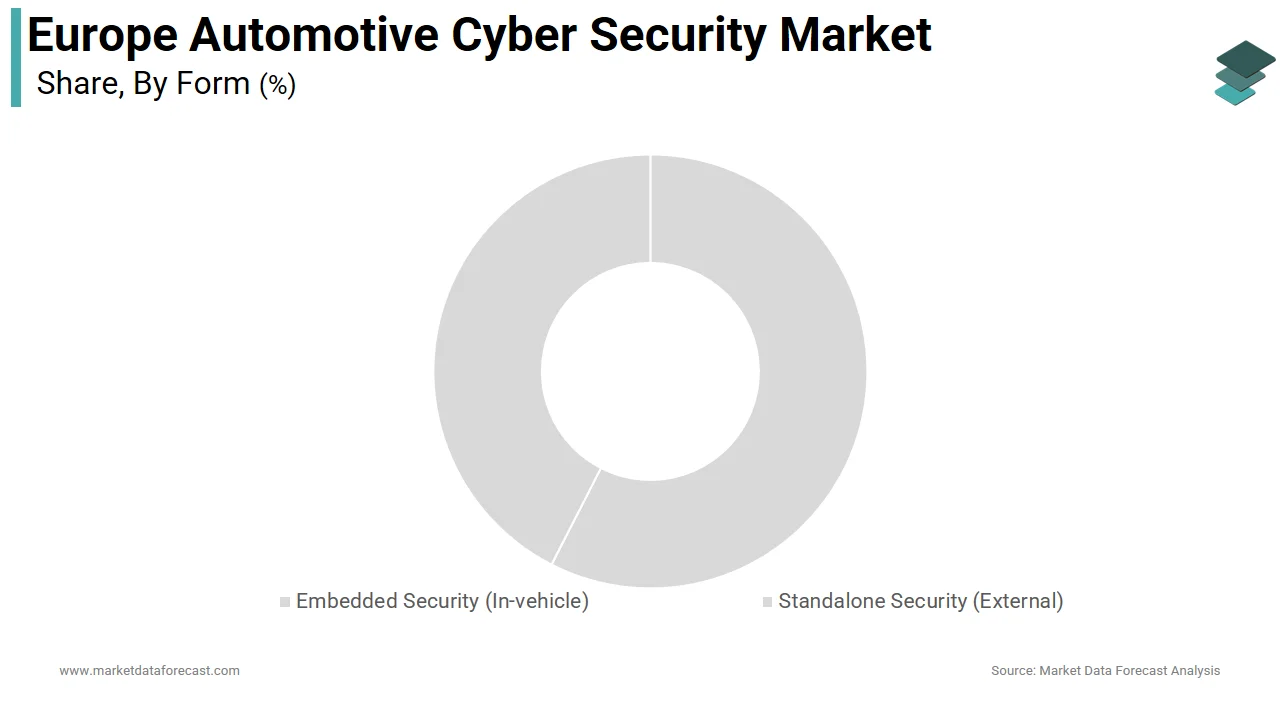
The standalone external security solutions segment is estimated to register the fastest CAGR of 18.3% from 2025 to 2033 due to the need for post production cyber monitoring, threat intelligence, and fleet-wide security orchestration that cannot be achieved through embedded systems alone. A different driver is the emergence of mobility as a service operators who manage thousands of vehicles and require centralized security operation centers to detect anomalies, manage patches, and respond to incidents in real time. In the Netherlands, public transport authorities now require electric bus fleets to use cloud-based cyber monitoring platforms, which has increased the number of security service contracts. A separate regulatory measure, the European Union's Cyber Resilience Act, mandates ongoing vulnerability assessments for vehicles, encouraging manufacturers to utilize third-party penetration testing and over-the-air security validation services. These evolving operational and compliance needs position standalone solutions as critical enablers of dynamic and scalable cyber defense beyond the factory gate.
By Vehicle Type and Propulsion Insights
The electric vehicles (EVs) segment led the Europe automotive cybersecurity market in 2025. The leading position of the EVs segment is credited to its advanced electronic architectures and high connectivity levels. Electric passenger cars represent a significant share of new vehicle registrations in the European Union, with sport utility vehicles making up a majority within that specific category. A further key driver is the inherent complexity of EV platforms, which integrate high voltage battery management, motor controllers, and bidirectional charging systems, all connected via Ethernet-based networks that expand the cyber attack surface. Electric vehicles generally contain more electronic control units compared to traditional internal combustion engine vehicles, which suggests a greater requirement for integrated security measures to prevent unauthorized access. Furthermore, incentives within Europe designed to promote sustainability goals have helped to speed up the acceptance of electric vehicles, with several countries providing substantial financial support for their purchase. These vehicles also serve as testbeds for over-the-air updates and vehicle-to-grid communication, both of which demand robust external and internal cyber protections, making EVs the epicenter of security investment in Europe.
The electric light commercial vehicles segment is anticipated to witness the fastest CAGR of 21.7% over the forecast period, owing to urban logistics electrification and the integration of telematics for last-mile delivery tracking and remote diagnostics. Several hundred thousand electric light commercial vehicles were registered across Europe, mainly within cities that have mandates for zero-emission deliveries, like those in the London and Paris areas. These initiatives are designed to encourage cleaner urban logistics. Also, these vehicles rely heavily on constant connectivity for route optimization, package tracking, and fleet management, creating persistent exposure to remote exploitation. Separately, an assessment of potential risks identified instances where electric delivery vans belonging to a few major logistics firms were subject to attempted security breaches. These incidents reportedly targeted the vans' telematics interfaces, possibly with the intent to interfere with route planning or location-based operating restrictions. In response to these security concerns, some vehicle operators have implemented new security protocols. Companies in the logistics sector have required third-party cybersecurity monitoring services and secure update systems as mandatory criteria for acquiring all new light commercial vehicles. The convergence of electrification regulatory pressure and high connectivity in urban logistics makes this segment the most dynamic frontier for automotive cybersecurity in Europe.
By Application Insights
The ADAS and safety systems segment held the leading share of 32.7% of the Europe automotive cybersecurity market in 2025. The supremacy of the ADAS and safety systems segment is propelled by the critical safety implications of cyber intrusions into functions such as automatic emergency braking, adaptive cruise control, and lane keeping assist. Regulatory frameworks require cyber resilience as a precondition for type approval for automated systems. New vehicles featuring advanced automation systems generally incorporate isolation mechanisms between perception sensors and actuation commands as a measure to prevent potential security vulnerabilities. An additional driver is consumer trust. As per a study, a portion of Europeans would not purchase a vehicle with known vulnerabilities in its driver assistance systems. Automakers conduct red team exercises simulating sensor spoofing and GPS jamming to validate system integrity before market launch, as reported by the Swedish Transport Agency. These safety-critical imperatives ensure that ADAS remains the highest priority application for cyber hardening in Europe.
The telematics systems segment is likely to experience the fastest CAGR of 19.5% during the forecast period due to the universal deployment of eCall emergency response services and the proliferation of usage-based insurance and connected fleet management platforms. Since a particular time, specific new vehicles sold in a certain region have been required to include a safety feature that transmits crash data over communication networks, potentially creating a channel that could be intercepted or manipulated. More recently, a significant number of vehicles have been reported to be equipped with these units, which now incorporate broader functions beyond basic crash notification, such as health diagnostics, remote access features, and the coordination of wireless updates. A recent security assessment revealed weaknesses in some third-party accessory devices that permitted unauthorized tracking of vehicle location and the sending of remote commands that could affect vehicle operation. In response to these types of findings, some financial service providers have started to require certification of cyber protection measures for vehicles participating in usage-based insurance programs, as guided by a regional authority. The convergence of regulatory mandates, commercial services, and high connectivity ensures telematics will remain the most rapidly evolving cybersecurity battleground in European vehicles.
COUNTRY-LEVEL ANALYSIS
Germany Automotive Cyber Security Market Analysis
Germany was the top performer in the Europe automotive cybersecurity market by capturing a 26.8% share in 2024. The prominence of the German market is fuelled by its position as the continent’s automotive engineering hub and regulatory enforcer. Home to Volkswagen, BMW, and Mercedes-Benz, the country sets de facto standards for vehicle cyber resilience across Europe. The observation indicates a significant regulatory change has been implemented, requiring specific cybersecurity certifications for vehicle type approvals. This shift reflects a growing emphasis on managing digital threats within the automotive sector. A further market driver is Germany’s stringent liability framework, which holds original equipment manufacturers fully accountable for cyber failures even if caused by third-party software. This has spurred massive investments in in-house security operations centers. Furthermore, there is a notable trend of individual manufacturers dedicating substantial internal resources and personnel toward enhancing vehicle cyber protection. Concurrently, a considerable amount of government funding has been directed toward collaborative research efforts aimed at developing advanced, long-term security solutions for future vehicle networks. These structural, regulatory, and industrial advantages solidify Germany’s leadership in both policy and technological implementation.
France Automotive Cyber Security Market Analysis
France was the second-largest country in the Europe automotive cybersecurity market and held a 16.8% share in 2024 because of a proactive national cyber strategy and strong state-backed automotive innovation. The initial publication of a national automotive cyber hygiene framework in France outlined requirements for real-time intrusion detection and secure software components across the domestic vehicle market. Subsequently, this framework influenced market entry decisions, with certain imported electric models facing rejection due to insufficient security measures in areas such as remote software updates. France is also a significant location for automotive research and development, with major manufacturers participating in collaborative projects aimed at advancing anomaly detection systems within vehicle networks. A distinctive strength is the integration of cyber requirements into public procurement, as all government vehicle fleets must undergo third-party penetration testing. France's postal service and a major automotive group have launched an advanced electric delivery van fleet with enhanced security features, including encrypted communications and secure hardware. These coordinated public-private initiatives position France as a model of regulatory foresight and industrial adaptation.
United Kingdom Automotive Cyber Security Market Analysis
The United Kingdom is another key player in the Europe automotive cybersecurity market due to world-class cyber expertise and post Brexit regulatory autonomy. The UK implemented international automotive cybersecurity regulations, like UNECE R155, into its own legal framework, establishing domestic processes for cyber approval of vehicles. Programs are in place to offer free cyber threat analysis and assistance, making it easier for smaller companies to meet security standards. The UK also leads in academic research, with the University of Surrey’s 5G and Cyber Innovation Centre partnering with Jaguar Land Rover to test vehicle-to-infrastructure security protocols under real-world conditions. Funds are being directed to help small and medium-sized businesses develop critical cyber solutions, such as intrusion detection and secure update systems. This blend of regulatory rigor, academic excellence, and targeted innovation funding sustains the UK’s influence despite its geographic exit from the EU institutional framework.
Sweden Automotive Cyber Security Market Analysis
Sweden is moving ahead steadfastly in the Europe automotive cybersecurity market owing to its command in safety-first vehicle design and open innovation ecosystems. Home to Volvo Cars and the global headquarters of Polestar, Sweden embeds cybersecurity into its core safety philosophy, treating digital threats with the same rigor as crash protection. Volvo has enabled third-party vulnerability scanning by publishing a complete vehicle software bill of materials. This development allows independent security research and analysis of their vehicle software. A unique factor influencing this approach is the existence of a national testbed for connected mobility in Sweden, which provides a platform for simulating cyber attacks on live vehicle fleets within controlled environments in specific urban areas. This platform has been utilized by a number of European startups to validate security solutions. Furthermore, national data protection requirements mandate the end-to-end encryption of all telematics data, including during over-the-air transmission, ensuring that stringent data privacy standards are met. These proactive measures, rooted in transparency and public safety, ensure Sweden punches above its weight in shaping Europe’s cyber-secure mobility future.
Netherlands Automotive Cyber Security Market Analysis
The Netherlands is likely to expand in the Europe automotive cybersecurity market from 2025 to 2033 due to its advanced digital infrastructure and forward-looking mobility policies. The country mandates cyber resilience for all vehicles used in public transport and last-mile logistics. Amsterdam and Rotterdam have requirements for certified security monitoring on all electric delivery vans and buses. This is part of a directive from the Ministry of Infrastructure and Water Management concerning low-emission urban logistics. A key element in the region's approach is a platform that shares automotive threat intelligence. This system combines anonymized attack data from several large fleet operators and disseminates real-time indicators to manufacturers and suppliers. This same system identified and addressed a unified effort to imitate charging station communications across multiple cities. Additionally, the Netherlands is home to a charging network for vehicles that has received a specific security certification. On this network, hardware-based authentication safeguards the flow of power in both directions. This integration of cybersecurity into energy mobility and urban planning positions the Netherlands as a holistic testbed for secure electrified transport ecosystems.
COMPETITIVE LANDSCAPE
The Europe automotive cybersecurity market features a dynamic competitive landscape shaped by stringent regulation technological specialization, and deep integration into vehicle engineering workflows. Competition is not driven by price but by technical depth, regulatory alignment, and ecosystem influence. Continental AG, with its dual hardware and software approach, holds structural advantages through direct integration into vehicle production lines, while specialized firms like Argus Cyber Security dominate in threat detection intelligence. Vector Informatik commands influence upstream in the development phase through its ubiquitous engineering tools. New entrants face high barriers, including certification complexity, long development cycles, and entrenched relationships with tier one suppliers. However, the market is not static as cloud-based security service providers and AI-driven analytics startups are gaining traction in fleet monitoring and vulnerability management. Overall, competition remains collaborative in nature, with players co-developing standards, participating in EU-funded consortia, and sharing anonymized threat data to collectively raise the cyber resilience of Europe’s connected vehicle fleet.
KEY MARKET PLAYERS
The leading companies operating in the Europe automotive cybersecurity market include:
- Argus Cyber Security
- HARMAN International
- Continental AG
- Robert Bosch GmbH
- NXP Semiconductors
- Aptiv PLC
- Karamba Security
- GuardKnox
- Trillium Secure
- ESCRYPT
- Infineon Technologies AG
- Autotalks (Qualcomm)
- Vector Informatik GmbH
- Denso Corporation
TOP PLAYERS IN THE MARKET
- Continental AG plays a pivotal role in the Europe automotive cybersecurity market through its integrated hardware and software security solutions embedded in vehicle electronic architectures. The company develops secure communication gateways, hardware security modules, and over-the-air update management systems deployed across major European vehicle platforms. Continental contributes globally by co-authoring industry standards under the Auto-ISAC and ISO SA 21434 frameworks. It also expanded its cybersecurity engineering center in Frankfurt to support real-time threat monitoring for connected fleets. These initiatives reinforce Continental’s position as a trusted enabler of end to end cyber resilience in next generation mobility ecosystems.
- Argus Cyber Security has established itself as a specialized leader in automotive cyber defense, with its intrusion detection and prevention systems widely adopted by European original equipment manufacturers. Founded in Israel and fully integrated into Continental’s portfolio, Argus delivers the IDPS platform used in millions of vehicles globally to monitor in-vehicle networks for anomalous behavior. In Europe, the company collaborates closely with regulatory bodies to align its solutions with UNECE R155 requirements. It also partnered with TÜV SÜD to certify its threat detection algorithms under the EU Cyber Resilience Act framework. These actions solidify Argus as a critical technology backbone for automotive cyber compliance and operational security.
- Vector Informatik GmbH is a key enabler of secure electronic systems in the European automotive industry, providing tools for secure ECU development, network validation, and cybersecurity testing. Headquartered in Germany, Vector’s CANoe and vTESTstudio platforms are standard in over ninety percent of European vehicle development programs for validating communication integrity and cryptographic protocols. The company actively contributes to global standardization through its leadership in AUTOSAR and ISO working groups. It also launched a dedicated training academy in Stuttgart, offering certified courses in automotive cyber engineering. These efforts ensure Vector remains indispensable in embedding security by design across Europe’s automotive supply chain.
TOP STRATEGIES USED BY THE KEY MARKET PARTICIPANTS
Key players in the Europe automotive cybersecurity market focus on deep integration of security into vehicle development lifecycles through compliance with UNECE R155 and ISO SA 21434 standards. They invest in proprietary intrusion detection and prevention platforms tailored for in-vehicle networks and over-the-air ecosystems. Companies establish dedicated cybersecurity engineering centers and training academies to address talent shortages and ensure client proficiency. Strategic partnerships with certification bodies like TÜV and regulatory agencies accelerate solution validation and market acceptance. Additionally, firms are expanding into fleet-wide security monitoring and cyber resilience as a service models to capture post production revenue streams driven by mobility operators and logistics companies across urban Europe.
MARKET SEGMENTATION
This research report on the Europe automotive cybersecurity market has been segmented and sub-segmented into the following categories.
By Form
- Embedded Security (In-vehicle)
- Standalone Security (External)
By Vehicle Type
- Hatchback/Sedan
- SUV
- Light Commercial Vehicle (LCV)
- Heavy Commercial Vehicle (HCV)
By Propulsion
- Internal Combustion Engine (ICE)
- Electric
By Application
- ADAS & Safety Systems
- Body Control & Comfort Systems
- Infotainment Systems
- Powertrain Systems
- Telematics Systems
By Security Type
- Network Security
- Endpoint Security
- Application Security
- Cloud Security
By Offering
- Hardware-Based Solutions
- Software-Based Solutions
By Country
- United Kingdom
- France
- Spain
- Germany
- Italy
- Russia
- Sweden
- Denmark
- Switzerland
- Netherlands
- Rest of Europe