- Product Description Description
- Table of Contents TOC
- List of Table & Figure LOT
- Get Free Sample PDF Sample PDF
Market Size, 2025
$11.57 BnMarket Estimate, 2026
$12.67 BnMarket Forecast, 2034
$26.29 BnCAGR, 2026–2034
9.55%Europe Content Management Software Market Summary:
Market Size & Growth Projections:
- 2025 Market Size: USD 11.57 billion
- 2026 Market Size: USD 12.67 billion
- Projected Market Size: USD 26.29 billion by 2034
- Growth Forecasts: 9.55% CAGR (2026–2034)
Key Regional Dynamics:
- Largest Country Market: Germany
- Second Largest Market: United Kingdom
- High-Growth Markets: France, Netherlands, Sweden
- Emerging Growth Regions: Spain, Italy, Czech Republic, Eastern Europe
Regional Highlights:
- Germany leads the Europe CMS market, driven by sovereign cloud adoption, strict data governance mandates, and large enterprise digitalization programs.
- The United Kingdom maintains strong market share supported by advanced digital public services, financial sector compliance workflows, and cloud-native CMS adoption.
- France, Netherlands, and Sweden demonstrate accelerated growth driven by AI-enabled content governance, media digitization, and public sector digital modernization.
Segment Insights:
- The cloud deployment model segment dominated the Europe content management software market in 2025, driven by data sovereignty compliance, remote collaboration, and scalable digital infrastructure.
- The cloud segment is also projected to register the fastest CAGR, supported by sovereign cloud ecosystems, EU Data Boundary frameworks, and lower on-premise maintenance costs.
- The large enterprises segment accounted for the highest market share in 2025 due to complex multilingual content workflows, regulatory audit requirements, and centralized content governance needs.
- The small & mid-sized enterprises segment is expected to grow at the fastest rate, driven by subscription-based CMS adoption, low-code platforms, and EU SME digitalization incentives.
Key Growth Drivers:
- Digital transformation of public sector services across EU member states
- Expansion of omnichannel customer engagement in regulated industries
- AI-enabled content governance, accessibility validation, and personalization
- Rising adoption of headless & composable CMS architectures
- Increased emphasis on data sovereignty and EU-compliant hosting
Major Challenges & Restraints:
- Fragmented data localization & residency regulations across countries
- Legacy IT infrastructure and integration barriers in traditional enterprises
- Shortage of CMS-skilled implementation and integration professionals
- Inconsistent accessibility & multilingual compliance across deployments
Key Players:
- Adobe, Inc., Microsoft Corporation, Sitecore, IBM Corporation, Oracle Corporation, Broadcom, Inc., HubSpot, Inc., Hyland Software, Inc., Open Text Corporation, Xerox Corporation, Acquia, Inc., and Others.
Europe Content Management Software Market Size
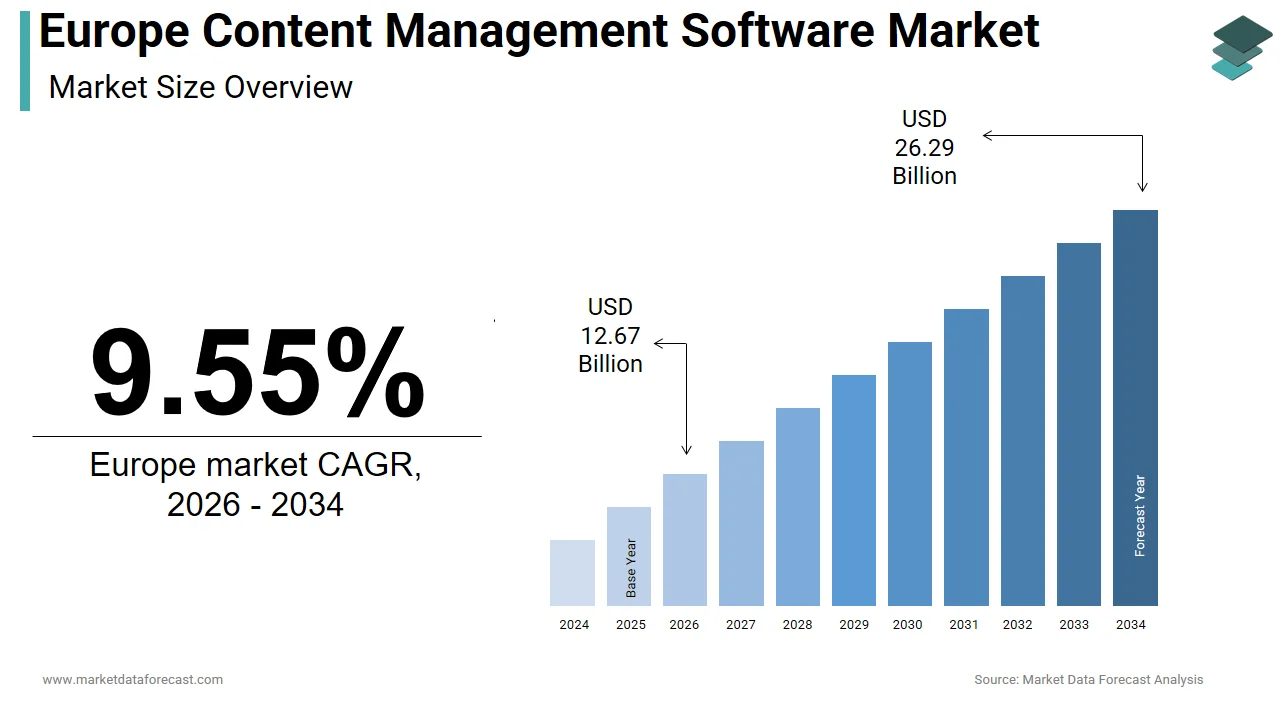
The Europe content management software market reached USD 11.57 billion in 2025, is expected to grow to USD 12.67 billion in 2026, and is anticipated to touch USD 26.29 billion by 2034, at a CAGR of 9.55% from 2026 to 2034.
Content management software is an integrated digital platforms that enable organizations to create, store, manage, distribute, and govern digital content, including text, multimedia documents, and web assets across internal workflows and external channels. These systems have evolved beyond static publishing tools into dynamic orchestration engines that support omnichannel communication, compliance, and personalized user experiences. According to Eurostat, over 92% of large enterprises and 68% of small and medium enterprises in the European Union used some form of digital content management system in 2023 to streamline documentation and customer engagement. As per the European Commission, more than 85% of public sector bodies now deliver services through digital portals requiring robust backend content governance to meet accessibility and language diversity obligations under the Web Accessibility Directive. Furthermore, the General Data Protection Regulation imposes strict controls on metadata handling, version tracking, and user access logs features now deeply embedded in European CMS architectures. In this context, content management software functions not merely as a productivity tool but as an infrastructure layer for regulatory adherence, digital sovereignty, and citizen-centric service delivery across the European digital economy.
MARKET DRIVERS
Digital Transformation of Public Sector Services Drives CMS Adoption
The European Union’s ambitious digital government agenda has made content management software indispensable for public administrations seeking to modernize citizen services and comply with interoperability mandates. The digital transformation of public sector services is eventually propelling the growth of Europe content management software market. The European Commission’s Digital Decade Policy Programme requires all member states to ensure that 100% of key public services are available online by 2030 with integrated multilingual and accessibility features. As per the European Interoperability Framework, over 20000 public sector websites across the EU underwent CMS upgrades between 2021 and 2023 to support real-time content updates, automated translation, and WCAG 2.1 compliance. In Germany, the federal E-Government Act mandates that all ministerial portals use certified open source content platforms like TYPO3 or Drupal to ensure vendor neutrality and long-term data control. Similarly, France’s “Action Publique 2025” initiative allocated 1.8 billion euros to digitize administrative workflows with centralized content repositories to eliminate document silos across 35000 local municipalities.
Rise of Omnichannel Customer Engagement in Regulated Industries
Financial services, healthcare, and insurance sectors are accelerating CMS deployment to deliver consistent personalized content across web, mobile call center, and physical touchpoints, while adhering to strict compliance protocols. The rise of omnichannel engagement in regulated industries is accelerating the growth of Europe content management software market. According to the European Banking Authority, over 78% of EU banks implemented enterprise-grade content management systems in 2023 to automate the generation of regulatory disclosures, product terms, and risk warnings in 24 official EU languages. In healthcare, the European Health Data Space framework requires hospitals and insurers to maintain auditable version histories of patient communication materials, ensuring alignment with national health authority guidelines. A 2023 survey by the European Insurance and Occupational Pensions Authority found that 71% of insurers use CMS platforms to dynamically assemble policy documents based on customer profiles and regional legal requirements. Companies like Allianz and AXA leverage AI-powered CMS modules that auto-flag non-compliant phrasing before publication.
MARKET RESTRAINTS
Fragmented Data Localization Requirements Increase Deployment Complexity
The proliferation of national data residency laws across Europe imposes significant technical and operational constraints on content management software implementation for multinational organizations, hampering the growth of Europe content management software market. While the General Data Protection Regulation establishes a baseline for personal data handling, individual member states have enacted additional localization mandates. Germany’s Federal Data Protection Act requires metadata of public sector content to remain onshore, while France’s Hebergeur de Donnees de Sante certification compels healthcare content to be hosted exclusively within French territory. According to the European Data Protection Board, over 18 EU countries now enforce sector-specific data localization rules affecting content storage, processing, and backup. A 2023 study by the Technical University of Munich found that 62% of multinational corporations delay CMS rollout in Southern and Eastern Europe due to uncertainty about compliant hosting configurations.
Legacy System Integration Barriers in Traditional Enterprises
Many European organizations in manufacturing, utilities, and public transport operate on decades-old IT infrastructures that lack modern APIs or standardized data formats, which is making integration with contemporary content management software exceptionally difficult. The legacy system integration barriers in traditional enterprises are also limiting the growth of Europe content management software market. According to the European Centre for the Development of Vocational Training, over 65% of industrial firms in Italy, Spain, and Poland still rely on custom-built enterprise resource planning systems developed before 2005 with minimal interoperability capabilities. In Germany, the Federal Office for Information Security reports that 58% of medium-sized industrial companies cite legacy integration as the top obstacle to digital content modernization. These legacy environments often store critical documentation in flat files, proprietary databases or even paper archives that cannot be automatically ingested into CMS workflows. A 2023 pilot by Deutsche Bahn revealed that migrating technical manuals from its 1990s mainframe system required 14 months of manual reformatting and metadata tagging before CMS onboarding.
MARKET OPPORTUNITIES
Integration of AI-Powered Content Governance and Personalization
The emergence of artificial intelligence with content management systems is unlocking transformative opportunities for automated compliance and contextual user experiences, which is set to set up new opportunities for the growth of Europe content management software market. Modern CMS platforms now embed machine learning models that scan content in real time for regulatory violations, brand inconsistencies, or accessibility gaps before publication. In public services, the City of Amsterdam uses an AI-enhanced CMS that dynamically rewrites citizen guidance based on user profile age and language proficiency while ensuring alignment with municipal legal frameworks. The European Commission’s AI Office confirms that such systems reduce manual compliance review time by up to 70% while improving content relevance. Furthermore, natural language generation engines can now produce localized marketing copy from a single source asset, respecting cultural nuances across 24 EU languages.
Expansion of Headless CMS in Composable Digital Architectures
The shift toward modular, composable enterprise technology stacks is driving rapid adoption of headless content management systems that decouple content creation from front-end presentation layers. This factor is also expected to escalate the growth of Europe content management software market. Unlike traditional monolithic CMS platforms, headless architectures deliver content via APIs to any digital endpoint, mobile apps, voice assistants, IoT dashboards, or augmented reality interfaces by enabling true omnichannel consistency. In Sweden, the national postal service PostNord uses a headless CMS to power real-time package tracking across web apps, smart mirrors, and in-vehicle displays from a single content source. Similarly, France Televisions leverages headless architecture to distribute news content simultaneously to websites, mobile apps, connected TVs, and social platforms with region-specific personalization. The European Commission’s Interoperable Europe Act actively promotes API first design principles, encouraging public bodies to adopt such flexible content infrastructures.
MARKET CHALLENGES
Persistent Shortage of CMS Skilled Professionals Hampers Implementation
The professionals proficient in modern content management platform configuration, governance, and integration in cloud native and headless architectures are likely to hinder the growth of the Europe content management software market. According to Eurofound, the EU is projected to experience a shortfall of over 500000 digital content and experience specialists by 2025, with CMS expertise among the most scarce due to rapid platform evolution. The European Centre for the Development of Vocational Training observes that fewer than 15% of digital marketing or IT curricula in 2023 included hands-on modules in enterprise CMS administration, API integration, or content modeling. This gap leads to extended deployment cycles. Industry data from the German Association of IT Professionals indicates that 54% of CMS projects in Central Europe exceed initial timelines by six months or more due to a lack of in-house skills. In the public sector, the problem is acute. Spain’s Ministry of Digital Transformation reported that 70% of regional administrations rely on external consultants for CMS maintenance due to insufficient internal capacity.
Inconsistent Accessibility and Language Compliance Across CMS Deployments
EU mandates that many content management implementations fail to deliver consistent accessibility and multilingual functionality due to fragmented technical execution and a lack of standardized validation protocols. The inconsistent accessibility and language compliance across CMS deployments is also hindering the growth of Europe content management market. The Web Accessibility Directive requires all public sector websites to comply with WCAG 2.1 Level AA, yet a 2023 audit by the European Commission found that 41% of national government portals still exhibit critical accessibility failures in CMS generated content, such as missing alt text, dynamic contrast errors, or keyboard navigation gaps. Similarly, the EU’s 24 official languages create immense complexity, as machine translation plugins often misinterpret regulatory or medical terminology, leading to non-compliant public information. The European Union Agency for Fundamental Rights documented cases in 2023 where automated CMS translation of social benefit guidelines in Eastern Europe resulted in materially inaccurate eligibility criteria. Compounding the issue, many CMS platforms lack built-in validation tools for real-time accessibility or linguistic quality checks, forcing reliance on manual audits.
REPORT COVERAGE
| REPORT METRIC | DETAILS |
| Market Size Available | 2025 to 2034 |
| Base Year | 2025 |
| Forecast Period | 2026 to 2034 |
| Segments Covered | By Deployment Model, Enterprise Size, Component, End Use, and Country. |
| Various Analyses Covered | Global, Regional, and Country-Level Analysis, Segment-Level Analysis, Drivers, Restraints, Opportunities, Challenges; PESTLE Analysis; Porter’s Five Forces Analysis, Competitive Landscape, Analyst Overview of Investment Opportunities |
| Countries Covered | UK, France, Spain, Germany, Italy, Russia, Sweden, Denmark, Switzerland, Netherlands, Turkey, Czech Republic, and the Rest of Europe. |
| Market Leaders Profiled | Adobe, Inc., Microsoft Corporation, Sitecore, IBM Corporation, Oracle Corporation, Broadcom, Inc., HubSpot, Inc., Hyland Software, Inc., Open Text Corporation, Xerox Corporation, Acquia, Inc., and Others. |
SEGMENTAL ANALYSIS
By Deployment Model Insights
The cloud deployment model segment was the largest by occupying a prominent share of the Europe content management software market in 2025, with its alignment with modern digital imperatives, including scalability, regulatory compliance, and remote collaboration across distributed workforces. The European Union’s push for secure and interoperable cloud infrastructure, under the Gaia-X initiative and the European Data Act. As per the European Commission, over 75% of public sector digital transformation projects launched since 2022 mandate cloud native or cloud-first CMS solutions to ensure centralized updates, multilingual support, and auditability. Cloud platforms enable real time compliance with the Web Accessibility Directive by automatically applying accessibility templates across thousands of web page a task prohibitively labor-intensive in on premise environments. The German Federal Office for Information Security confirms that 82% of federal agencies migrated their CMS to certified EU cloud providers like OVHcloud and Deutsche Telekom between 2021 and 2023 to maintain data sovereignty while benefiting from automated security patching. This regulatory endorsement has normalized cloud CMS as the default choice for both public bodies and regulated industries. In retail and media sectors, where content velocity is critical, publishing hundreds of product updates or news items daily, cloud scalability prevents performance bottlenecks during traffic spikes.

The cloud deployment model segment is expected to witness the fastest CAGR of 11.2% from 2026 to 2034, with the maturing trust in sovereign cloud ecosystems and the rising cost of maintaining legacy on-premises infrastructure. The operational cost advantage of cloud over on-premise systems is particularly for organizations managing high-volume dynamic content. In the public sector, the UK Government Digital Service documented that migrating local council websites to a shared cloud CMS platform saved an average of 220000 pounds per authority annually in maintenance and licensing fees. These savings are magnified by predictable subscription pricing that aligns with public budgeting cycles. Furthermore, cloud vendors now offer region-locked data residency guarantees. Microsoft’s EU Data Boundary and AWS’s European Sovereign Cloud ensure all content processing occurs within EU borders, satisfying GDPR and national security requirements. The seamless integration of cloud CMS with adjacent digital experience platforms, including customer data platforms, e-commerce engines, and AI analytics, is also to leverage the growth of the segment.
By Enterprise Size Insights
The large enterprises segment was the largest by capturing 61.2% of the Europe content management software market share in 2024, with their complex content governance needs, multilingual operations, and stringent regulatory obligations across multiple jurisdictions. The scale of compliance and brand consistency required by multinational corporations operating in highly regulated sectors. A single European bank may need to publish thousands of product disclosures in 24 languages while adhering to country-specific financial conduct rules. As per the European Banking Authority, many systemically important banks in the EU implemented enterprise-grade CMS platforms between 2020 and 2023 to automate version control approval workflows and audit logging. These systems enforce centralized brand guidelines while enabling local adaptations with a balance for maintaining trust across diverse markets. Similarly, in pharmaceuticals, the European Medicines Agency mandates that all patient information leaflets undergo strict version tracking and approval chains, which only enterprise CMS can reliably manage at scale.
The small and mid-sized enterprises segment is projected to witness the fastest CAGR of 13.5% from 2026 to 2034, with the proliferation of subscription-based CMS platforms with tiered pricing that aligns with SME budgets. Unlike legacy enterprise systems requiring six-figure upfront licenses, modern solutions like WordPress VIP, Contentful, and Storyblok offer entry-level plans under 50 euros per month with pay-as-you-go scalability. According to the European Small Business Portal, over 420000 SMEs in Western Europe adopted such platforms in 2023 to establish or modernize their digital presence. These tools require minimal IT expertise, drag and drop interfaces, multilingual plugins, and pre-built compliance templates allow non-technical staff to manage content independently. Platforms like Shopify Plus and BigCommerce embed content management with product catalogs, customer reviews, and promotional engines by enabling SMEs to deliver cohesive brand experiences without complex integrations. Furthermore, EU funding programs like the Digital Europe Programme provide vouchers covering up to 70% of CMS adoption costs for eligible SMEs; Germany alone issued over 18000 such grants in 2023.
By End Use Insights
The government and public sector segment was the largest by holding 28.3% of the Europe content management software market share in 2024. In Germany, the federal E-Government Act mandates that all ministerial websites use open source CMS like TYPO3 hosted on sovereign cloud infrastructure to guarantee long term data control and vendor neutrality. Similarly, France’s “MonServicePublic” initiative consolidated over 8000 municipal websites onto a single CMS backbone, enabling citizens to access birth certificates, tax forms, and benefit applications through one portal with automated translation into all regional languages. Public health emergencies, natural disasters, and geopolitical events require rapid dissemination of accurate information across languages and channels. The European Centre for Disease Prevention and Control states that during the 2023 mpox outbreak, EU health authorities used CMS platforms to publish verified guidance in 24 languages within hours of scientific updates. These systems support role-based emergency publishing workflows, where designated officials can bypass standard approvals during declared crises. In Sweden, the national crisis agency uses a dedicated CMS module that auto-populates emergency alerts across government websites, radio feeds, and SMS systems from a single input. As climate volatility and security threats increase, the public sector’s reliance on agile authoritative content infrastructure will only deepen by making CMS a critical component of democratic resilience and citizen trust in the digital age.
The healthcare end-use segment is expected to register the fastest CAGR of 14.8%from 2026 to 2034, with the patient empowerment, regulatory transparency, and digital care delivery models. The European Health Data Space regulation mandates that all healthcare providers make standardized patient information accessible through digital portals by 2025. This includes treatment guidelines, consent forms, medication instructions, and billing policies, all requiring version-controlled multilingual content management. These systems ensure that when a drug’s safety profile is updated by the European Medicines Agency, all related content, across hospital websites, patient apps, and print brochures, is automatically revised. In Denmark, the national health portal Sundhed.dk uses a CMS integrated with electronic health records to deliver personalized care instructions based on diagnosis and treatment plan, demonstrating how content in a clinical tool, rather than just informational material becomes. Chronic disease management platforms for diabetes, mental health, and cardiovascular conditions rely on CMS to deliver daily educational content, behavioral prompts, and adherence support tailored to individual patient progress. These systems must comply with medical device regulations. Germany’s Federal Institute for Drugs and Medical Devices now classifies CMS used in therapeutic contexts as Class IIa software requiring ISO 13485 certification.
COUNTRY-LEVEL ANALYSIS
Germany Content Management Software Market Analysis
Germany was the largest contributor to the Europe content management software market by occupying 22.2% of the market share in 2024, with its stringent data sovereignty requirements, robust public digitalization agenda, and concentration of multinational corporations with complex content governance needs. Germany’s e-Government Act mandates that all federal websites use certified open-source CMS platforms hosted on sovereign infrastructure to ensure long-term control and auditability. The Federal Office for Information Security reports that over 95% of federal agencies completed CMS migrations by 2023 with TYPO3 and Drupal as preferred standards. In the private sector, DAX 30 companies like Siemens and SAP operate enterprise CMS platforms managing millions of multilingual assets across 100-plus countries. Furthermore, Germany’s strong vocational training system produces a steady pipeline of CMS developers and administrators with over 1200 certified digital content specialists graduating annually from technical universities.
United Kingdom Content Management Software Market Analysis
The United Kingdom was ranked second by capturing 17.3% of the Europe content management software market share in 2024, with the advanced digital public services, mature financial sector, and post Brexit emphasis on sovereign digital infrastructure. According to the UK Government Digital Service, over 98% of central government transactions are now delivered online through a unified CMS backbone that supports real time updates, accessibility compliance, and multilingual content for devolved administrations. The Financial Conduct Authority mandates that all banks and insurers use version-controlled CMS to publish product information, ensuring auditability under MiFID II and UK GDPR. In 2023, the BBC migrated its entire global news operation to a cloud native CMS, enabling journalists to publish simultaneously to web apps, connected TVs, and social platforms while maintaining strict editorial workflows.
France Content Management Software Market Analysis
France content management software market growth is likely to grow with its centralized digital government strategy, strong public media institutions, and leadership in AI-driven content governance. Public broadcasters like France Televisions use advanced CMS with AI modules that auto-tag video archives and generate subtitles in real time, complying with the EU Audiovisual Media Services Directive. In the private sector, luxury and aerospace giants like LVMH and Airbus deploy enterprise CMS to manage global brand consistency across thousands of digital touchpoints. The French Data Protection Authority, CNIL, has also pioneered GDPR compliance certifications for CMS vendors requiring strict audit logs, data residency, and consent management features.
Netherlands Content Management Software Market Analysis
The Netherlands content management software market growth is likely to grow with the open government data, multilingual e-commerce, and cloud native digital infrastructure. Companies like Booking.com and Adyen rely on headless CMS architectures to deliver personalized experiences across web, mobile, and API driven touchpoints, while maintaining strict audit trails for financial regulators. Furthermore, the Netherlands hosts major EU cloud data centers from Microsoft and Google with certified EU data boundaries by enabling local CMS hosting that satisfies GDPR.
Sweden Content Management Software Market Analysis
Sweden content management software market growth is likely to grow with its world-leading digital public services, strong healthcare digitization, and commitment to sustainable technology. According to the Swedish Agency for Digital Government, over 99% of citizen interactions with the state occur through digital channels powered by a national CMS platform that ensures real-time updates, multilingual support, and full accessibility compliance. The healthcare sector is equally advanced, where the national portal 1177.se uses a CMS integrated with electronic health records to deliver personalized medical guidance to 10 million residents in Swedish, English, and Arabic. Additionally, the country’s innovation ecosystem supports CMS startups like Contentful, which originated in Berlin but expanded its engineering team in Stockholm to leverage local AI talent.
COMPETITIVE LANDSCAPE
Competition in the Europe content management software market is defined by a strategic divide between proprietary enterprise platforms and open-source ecosystems, each vying for dominance through compliance, agility, and digital sovereignty. Global vendors like Adobe and Sitecore compete on integrated experience orchestration and artificial intelligence, while open-source leaders like Acquia and WordPress VIP emphasize transparency, cost efficiency, and public sector trust. Regulatory complexity across 27 member states creates both fragmentation and opportunity as vendors tailor solutions to national digital government frameworks and sector-specific mandates. Unlike price-driven markets, European buyers prioritize long term risk mitigation, vendor neutrality, and alignment with EU digital principles such as interoperability and user control. As a result, competition is less about market share and more about architectural philosophy, with organizations increasingly adopting hybrid or multi-vendor CMS strategies to balance innovation with resilience in an era of heightened digital sovereignty and citizen expectations.
KEY MARKET PLAYERS
The leading companies operating in the Europe content management software market include:
- Adobe, Inc.
- Microsoft Corporation
- Sitecore
- IBM Corporation
- Oracle Corporation
- Broadcom, Inc.
- HubSpot, Inc.
- Hyland Software, Inc.
- Open Text Corporation
- Xerox Corporation
- Acquia, Inc.
TOP PLAYERS IN THE MARKET
- Adobe Inc is a pivotal force in the Europe content management software market through its Adobe Experience Manager platform, which integrates content management, digital asset management, and personalization for enterprise customers. The company serves major European banks, media houses, and public institutions requiring high compliance, multilingual support, and omnichannel delivery. In 2023, Adobe expanded its Frankfurt-based cloud infrastructure to ensure all European customer data is processed within EU borders in alignment with GDPR and the EU Data Boundary framework. The company also launched AI-powered accessibility compliance tools that auto-detect and remediate WCAG violations in real time. These enhancements strengthen Adobe’s position in regulated sectors while reinforcing its global leadership in experience-driven content orchestration across more than 70 countries.
- Sitecore plays an important role in the European market by offering composable content management solutions that empower enterprises to build personalized digital experiences across web, mobile, and emerging channels. Headquartered in the Netherlands with major R&D hubs in Poland and Sweden, Sitecore serves leading European retailers, financial institutions, and healthcare providers. In early 2024, Sitecore introduced its new Content Hub ONE platform, featuring unified content operations workflow automation and AI-assisted content creation tailored for EU language diversity and regulatory requirements. The company also deepened integration with Microsoft Azure’s European sovereign cloud to guarantee data residency.
- Acquia is a key enabler of open source content management in Europe through its Drupal Cloud platform, which powers digital experiences for public sector agencies, universities, and large enterprises seeking vendor neutrality and data sovereignty. The company operates data centers in Germany, Ireland, and the UK by ensuring full compliance with GDPR and national hosting mandates. In 2023, Acquia launched its European Government Cloud, a specialized environment pre-certified for public sector security and accessibility standards, across Germany, France, and the Nordics. The platform includes automated multilingual publishing tools and audit trail modules aligned with the Web Accessibility Directive.
TOP STRATEGIES USED BY THE KEY MARKET PARTICIPANTS
Key players in the Europe content management software market prioritize sovereign cloud deployment by establishing regional data centers and certifying compliance with EU GDPR and national data residency laws. They embed artificial intelligence for automated accessibility, multilingual translation, and regulatory compliance to reduce manual oversight. Companies are shifting toward composable and headless architectures to enable integration with best-of-breed marketing analytics and commerce systems. Strategic partnerships with public sector digital agencies and regulated industry consortia ensure alignment with evolving European standards such as WCAG and the Web Accessibility Directive. Additionally, they invest in open source ecosystems and developer communities to foster innovation while maintaining transparency and long-term vendor independence for European customers.
MARKET SEGMENTATION
This research report on the Europe content management software market has been segmented and sub-segmented into the following categories.
By Deployment Model
- Cloud
- On-Premise
By Enterprise Size
- Large Enterprises
- Small & Mid-Sized Enterprises
By Component
- Solution
- Document Management
- Web Content Management
- Collaboration Software
- Digital Rights Management
- Content Analytics
- Other Solution Type
- Services
By End Use
- BFSI
- Retail & E-commerce
- IT & Telecommunication
- Healthcare
- Government & Public Sector
- Other End Use
By Country
- United Kingdom
- France
- Spain
- Germany
- Italy
- Russia
- Sweden
- Denmark
- Switzerland
- Netherlands
- Rest of Europe