- Product Description Description
- Table of Contents TOC
- List of Table & Figure LOT
- Get Free Sample PDF Sample PDF
Market Size, 2025
$5.25 BnMarket Estimate, 2026
$6.39 BnMarket Forecast, 2034
$30.88 BnCAGR, 2026–2034
21.76%Europe Mass Notification System Market Summary
The Europe mass notification system market was valued at USD 5.25 billion in 2025 and is projected to reach USD 30.88 billion by 2034, growing at a CAGR of 21.76% from 2026 to 2034. Market growth is primarily driven by EU-wide regulatory mandates, particularly the European Electronic Communications Code (Article 110), which requires all member states to deploy geotargeted public warning systems by June 2026. The rising frequency of climate-related disasters, including floods, wildfires, and heatwaves, has further accelerated adoption across public authorities, healthcare systems, transportation networks, and critical infrastructure operators.
Market Snapshot
- 2025 Market Size: USD 5.25 Billion
- 2026 Market Size: USD 6.39 Billion
- 2034 Forecast: USD 30.88 Billion
- Growth Rate: 21.76% CAGR (2026 to 2034)
- Leading Markets: Germany, France, United Kingdom
- Primary Growth Drivers: EU public warning mandates, climate risk escalation, smart city integration
- Key Challenges: Interoperability gaps, alert fatigue, cybersecurity risks
Europe Mass Notification System Market Key Takeaways
- Germany was the largest contributor in 2025, supported by early Cell Broadcast deployment and strict national crisis-management regulations.
- The United Kingdom is expected to be among the fastest-growing markets, driven by high mobile penetration and strong enterprise adoption.
- Public alert and warning systems accounted for the largest application share in 2025 due to EU regulatory enforcement.
- Business continuity and disaster recovery (BCDR) is the fastest-growing application segment as organizations strengthen resilience planning.
- Software platforms dominated the component segment, acting as the central orchestration layer for multi-channel alert delivery.
- Distributed recipient solutions are growing fastest, reflecting demand for targeted, role-based, and location-specific notifications.
- Integration with smart cities, IoT sensors, and AI analytics is shifting the market toward predictive and automated alerting.
- Key challenges include interoperability limitations, cybersecurity vulnerabilities, alert fatigue, and workforce skill shortages.
Europe Mass Notification System Market Size
The size of the Europe mass notification system market was worth USD 5.25 billion in 2025. The regional market is anticipated to grow at a CAGR of 21.76% from 2026 to 2034 and be worth USD 30.88 billion by 2034 from USD 6.39 billion in 2026.
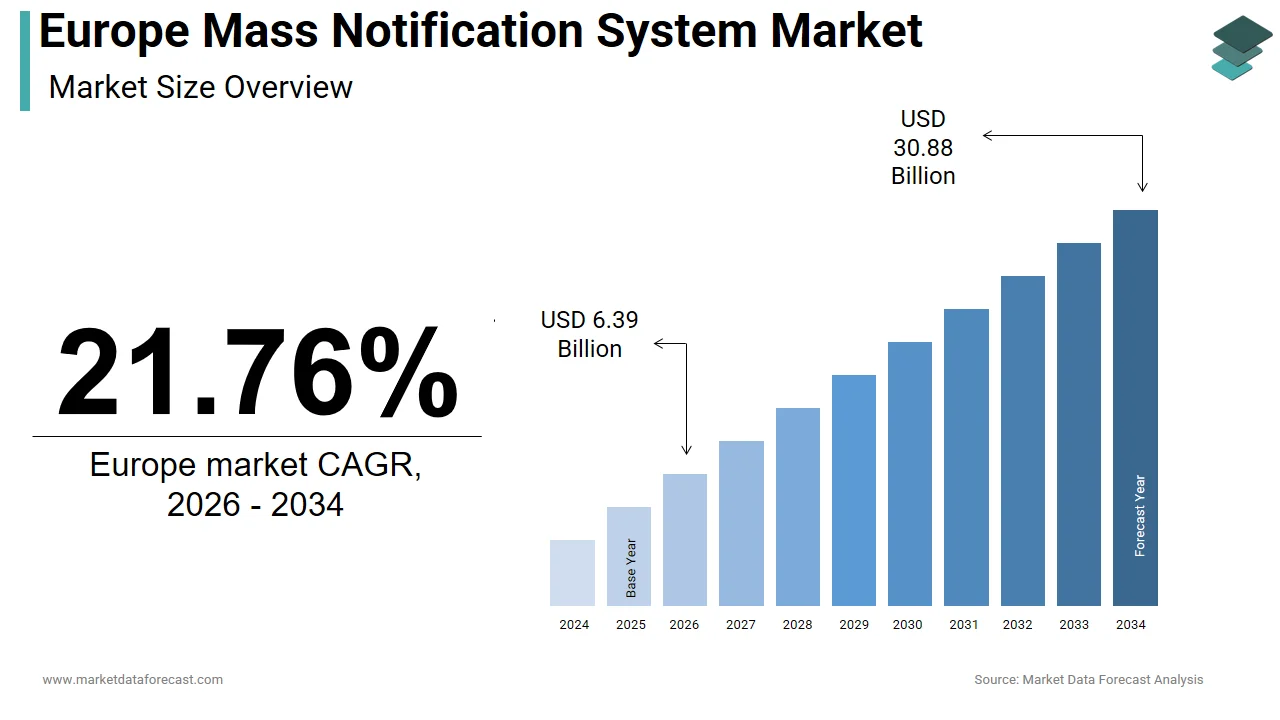
The mass notification system is an integrated platform that enables public authorities, corporate entities, and infrastructure operators to disseminate emergency alerts across multiple communication channels, including SMS mobile apps, digital signage, public address systems, and social media in real time. These systems are designed to ensure rapid coordinated response during natural disasters, terrorist incidents, industrial accidents, or public health crises. According to the European Commission, many Europeans were directly affected by extreme weather events in 2024, including floods, wildfires, and heatwaves, with the urgency of resilient alert infrastructure. As per the European Environment Agency, climate-related disasters have tripled in frequency across the continent since 2000, with economic losses exceeding annually. In response, countries like France and Sweden have already activated EU-compliant national alert systems that geotarget messages to affected zones within seconds.
MARKET DRIVERS
EU Regulatory Mandates Accelerate Public Warning System Deployment
The European Electronic Communications Code’s Article 110 requires all EU member states to implement a public warning system capable of sending geotargeted alerts to mobile devices in imminent danger zones by June 2026. The EU regulatory mandates are propelling the growth of the Europe mass notification system market. According to the European Commission, as of early 2025, 15 countries, including Germany, France, Italy, and Spain, have already launched nationwide systems compliant with this directive using Cell Broadcast technology. Cell Broadcast enables messages to reach all compatible devices in a defined area within 10 seconds without requiring phone numbers or internet connectivity, a critical advantage during network congestion. Similarly, France’s “FR Alert” platform integrated with meteorological and seismic monitoring networks issued real-time flood warnings to 2.3 million residents in the Rhône Valley in November 2024. These government-led deployments create a foundational layer of demand that drives integration with complementary systems in transportation, healthcare, and education sectors.
Rising Frequency of Climate-Induced Disasters Fuels Institutional Adoption
The escalating exposure to climate-driven emergencies is compelling hospitals, universities, and industrial facilities to invest in enterprise-grade mass notification systems beyond national public alert layers. The rising frequency of climate induced disasters is additionally leveraging the growth of Europe mass notification system market. According to the European Environment Agency, the number of extreme weather events in the EU increased from 150 annually in the 1980s to over 450 in the 2020s, with heatwaves and floods now occurring in regions previously considered low risk. As per the German Hospital Federation, tertiary care centers installed multimodal notification systems in 2024 to manage internal emergencies and coordinate with national alerts.
MARKET RESTRAINTS
Fragmented National Implementation Standards Hinder Interoperability
The common deadline for public warning system deployment, each member state has adopted different technical architectures, messaging protocols, and activation authorities, creating barriers to cross-border alert coordination. The fragmented national implementation standards are hindering the growth of Europe mass notification system market. According to the European Union Agency for Cybersecurity, only 9 countries use pure Cell Broadcast, while others blend SMS, email, and app-based push, creating inconsistent delivery performance. In border regions like the Rhine Valley, a flood alert issued in Germany may not automatically propagate to mobile users in France due to incompatible backend systems, as documented by the International Civil Protection Association. These discrepancies complicate multinational organizations’ efforts to deploy unified enterprise notification platforms and delay EU-wide crisis simulation exercises.
Public Skepticism and Alert Fatigue Undermine System Effectiveness
Repeated non-urgent or poorly targeted alerts have eroded public trust in mass notification systems, reducing compliance during genuine emergencies. This factor is also hampering the growth of Europe mass notification system market. According to a 2024 Eurobarometer survey on civil protection, Europeans reported ignoring at least one official alert in the past year due to perceived irrelevance or false alarms. In the Netherlands, a nationwide test alert in March 2024 triggered widespread social media backlash after it was activated in regions unaffected by any threat, leading to over one hundred thousand opt-outs from regional alert lists. The alert fatigue not only diminishes behavioral response but also pressures authorities to raise activation thresholds, potentially delaying life-saving warnings. Restoring public confidence requires AI-driven precision targeting and transparent communication about system reliability.
MARKET OPPORTUNITIES
Integration with Smart City Infrastructure Unlocks Proactive Alerting
European municipalities are embedding mass notification systems into broader smart city data ecosystems to enable predictive and automated emergency responses. The integration with smart city infrastructure unlocks proactive alerting, prompting the growth of Europe mass notification system market in the coming years. According to the European Innovation Partnership on Smart Cities, now link alert platforms with live feeds from environmental sensors, traffic cameras, and utility networks. In Barcelona, the city’s “Alerta BCN” system automatically triggers evacuation messages when air quality sensors detect hazardous chemical plumes near schools or when river level gauges exceed flood thresholds. Similarly, Hamburg’s integrated command center uses AI to correlate weather radar, power grid outages, and social media trends to pre-position emergency alerts before a crisis peaks.
Adoption in Critical Energy and Transport Sectors Creates New Vertical Demand
The infrastructure sectors, where operational continuity depends on rapid internal and external communication is creating new opportunities for the growth of Europe mass notification system market. According to the European Network of Transmission System Operators for Electricity, all major grid operators must now demonstrate crisis communication protocols that include employee alerting and public updates during outages. National Grid UK deployed a multi-channel platform that notifies field crews via ruggedized tablets and simultaneously updates rail operators and hospitals during substation failures. Similarly, Deutsche Bahn uses geofenced alerts to inform passengers of platform changes during security incidents with integration into national warning systems for coordinated rail evacuation.
MARKET CHALLENGES
Cybersecurity Vulnerabilities in Legacy Alert Platforms Pose Systemic Risk
Many existing systems rely on outdated software architectures that lack end-to-end encryption, secure authentication, or real-time intrusion detection, making them attractive targets for disruption or manipulation. The cybersecurity vulnerabilities in legacy alert platforms pose systemic risk, which acts as a barrier to the growth of Europe mass notification system market. According to the European Union Agency for Cybersecurity, regional alert platforms audited in 2024 used unsupported operating systems or default admin credentials. In 2023, a simulated cyberattack during a NATO exercise successfully hijacked a Baltic state’s SMS alert gateway to broadcast false evacuation orders, a scenario deemed “highly plausible” in real operations. Additionally, cloud-based notification vendors without EU data residency compliance risk exposure under the NIS2 Directive, which imposes strict security requirements on digital service providers. These vulnerabilities compel public agencies to undertake costly system replacements or layered security retrofits, often exceeding initial procurement budgets.
Shortage of Skilled Personnel to Manage Integrated Notification Ecosystems
The increasing complexity of modern mass notification systems, which integrate IoT sensors, AI analytics, multi-language messaging, and cross-agency workflows, has outpaced the availability of trained personnel to operate and maintain them. The shortage of skilled personnel to manage integrated notification ecosystems is expected to hamper the growth of Europe mass notification system market. In 2024, 63% of municipal crisis centers lacked staff qualified to configure dynamic alert templates or interpret system analytics, as per some research. This gap leads to underutilization of advanced features such as audience segmentation, escalation rules, and post-event reporting. During the 2024 Danube flood exercise, only 38% of participating cities successfully executed multi-channel alert sequences due to operator error as documented by the European Civil Protection Forum.
REPORT COVERAGE
| REPORT METRIC | DETAILS |
| Market Size Available | 2025 to 2034 |
| Base Year | 2025 |
| Forecast Period | 2026 to 2034 |
| Segments Covered | By Component, Solution, Enterprise Size, Application, Vertical, and Country. |
| Various Analyses Covered | Global, Regional, and Country-Level Analysis, Segment-Level Analysis, Drivers, Restraints, Opportunities, Challenges; PESTLE Analysis; Porter’s Five Forces Analysis, Competitive Landscape, Analyst Overview of Investment Opportunities |
| Countries Covered | UK, France, Spain, Germany, Italy, Russia, Sweden, Denmark, Switzerland, Netherlands, Turkey, Czech Republic, and the Rest of Europe. |
| Market Leaders Profiled | AlertMedia, American Signal Corporation, Anthology Inc., BlackBerry Limited, Blackboard Inc., DesktopAlert.Net, Eaton, Everbridge Inc., Honeywell International Inc., Motorola Solutions, Inc., Omnilert, OnSolve, Rave Mobile Safety, Regroup Mass Notification, Siemens AG, Singlewire Software, LLC., xMatters, and Others. |
SEGMENTAL ANALYSIS
By Component Insights
The software segment was the largest by accounting for 44.3% of the Europe mass notification system market share in 2024, due to the role software plays in orchestrating multi-channel message delivery, managing user databases, and enabling real-time analytics. Unlike hardware, which serves a static function, software platforms dynamically integrate inputs from emergency sensors, weather services, and public safety radio networks to trigger context-aware alerts. According to the European Commission, many EU member states now mandate that public warning systems support interoperability with Common Alerting Protocol standards, with a requirement fulfilled through certified software rather than physical devices. Similarly, universities and hospitals across Germany rely on modular software suites like Everbridge to automate campus lockdowns or internal incident escalation without replacing existing speaker or display infrastructure. These capabilities make software the operational brain of modern mass notification ecosystems.
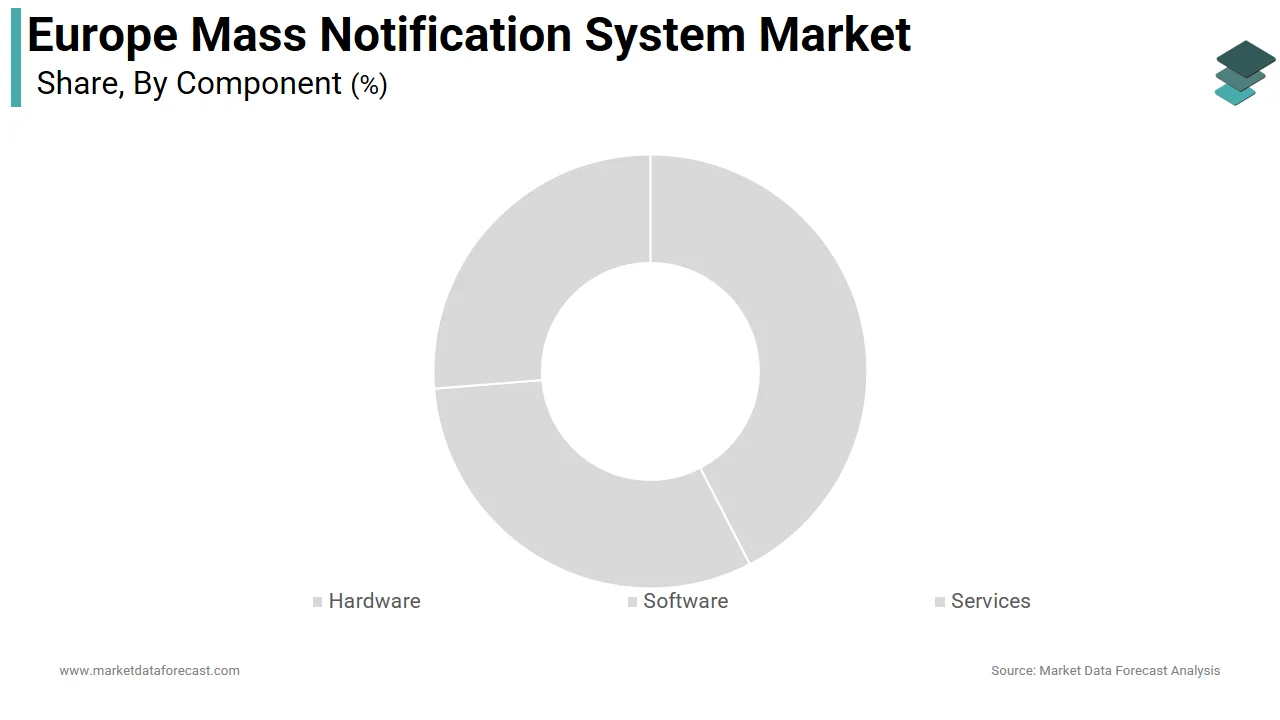
The services segment is expanding at the fastest CAGR of 14.2% throughout the forecast period, owing to the rising complexity in system integration, cybersecurity compliance, and post-deployment management across public and private sectors. According to the European Union Agency for Cybersecurity, regional alert systems audited in 2024 lacked secure authentication protocols, necessitating third-party remediation services. In France, the Ministry of the Interior now contracts specialized firms to conduct quarterly crisis simulation drills and update alert templates based on evolving threat scenarios. Similarly, large enterprises like Siemens and AstraZeneca engage managed service providers to maintain notification uptime across global campuses with multilingual message routing and audit logging.
By Solution Insights
The wide area solutions segment was the largest by holding 38.3% of the Europe mass notification system market share in 2024, with the European Union’s binding mandate under the European Electronic Communications Code requiring all member states to implement national public warning systems by June 2026. These systems rely on Cell Broadcast technology to deliver geotargeted alerts to all compatible mobile devices within seconds, covering entire regions without pre-registration. According to the European Commission, 15 countries, including Germany, France, and Spain, have already activated nationwide platforms that reached over 120 million citizens during the 2024 extreme weather events.
The distributed recipient solutions segment is solely growing at the fastest CAGR of 15.1% throughout the forecast period. This surge reflects the rising need for personalized, targeted alerts delivered across fragmented communication preferences in corporate and institutional settings. Unlike wide area broadcasts, which push uniform messages, distributed systems use dynamic recipient lists to route tailored instructions to employees, students, or contractors based on role, location, and device type. Similarly, universities in the Netherlands deploy AI-driven solutions that analyze class schedules and building occupancy to deliver lockdown guidance only to affected zones, reducing panic and improving compliance. This shift from broadcast to precision notification defines the next evolution of crisis communication in Europe.
By Application Insights
The public alert and warning segment accounted in holding 41.2% of the Europe mass notification system market in 2024, driven by EU regulatory enforcement and escalating climate risks. The European Electronic Communications Code’s Article 110 compels all member states to deploy mobile-based public warning systems capable of geotargeted emergency dissemination by mid 2026. According to the European Commission, national systems in France, Germany, and Sweden collectively issued over 85000 official alerts in 2024 covering floods, wildfires, terrorist threats, and extreme heat. Similarly, the Czech Hydrometeorological Institute sent real-time flash flood warnings to mobile users in Moravia, reducing response time by 40%, as documented in its 2024 annual report. These state-mandated deployments create a non-discretionary baseline of demand that anchors the entire market and drives innovation in speed, accuracy, and accessibility for vulnerable populations.
The business continuity and disaster recovery segment is likely to grow at a significant CAGR of 13.8% throughout the forecast period with the tightening corporate resilience requirements under the EU’s Corporate Sustainability Reporting Directive and NIS2 cybersecurity rules, which oblige entities to maintain operational continuity during crises. According to the European Banking Authority, all financial institutions must now demonstrate real-time staff notification capabilities during cyberattacks or physical disruptions. In 2024, Deutsche Bank implemented a distributed alert system that triggers secure SMS and desktop pop-ups to 110000 employees across 56 countries within fifteen seconds of incident detection. Similarly, AstraZeneca uses AI-integrated platforms to reroute clinical trial logistics and notify research teams during supply chain disruptions.
COUNTRY-LEVEL ANALYSIS
Germany Mass Notification System Market Analysis
Germany was the largest contributor to the Europe mass notification system market with 21.3% of the market share in 2024. Its position is anchored in stringent national crisis management laws, extensive industrial infrastructure, and early adoption of EU public warning mandates. The country activated its national Cell Broadcast system “Warn Cell” in February 2023 and has since issued over 32000 alerts for floods, extreme heat, and chemical incidents. According to the Federal Office of Civil Protection, municipalities now integrate this national layer with local siren and digital signage networks. Additionally, Germany’s energy transport and healthcare sectors are required under the BSI Critical Infrastructure Ordinance to maintain redundant internal alerting systems.
France Mass Notification System Market Analysis
The French mass notification system market held 18.7% of the share in 2024, with the proactive civil protection policies and high urban density. The “FR Alert” system, launched in 2022, now covers all 34800 communes and integrates with Météo France seismic monitors and transport control centers. According to the French Ministry of the Interior, the platform sent 28000 targeted alerts in 2024, achieving an average delivery time of 9.3 seconds to affected mobile users. The National Education Ministry also mandates that all 62000 schools conduct quarterly alert drills using certified in-building systems.
United Kingdom Mass Notification System Market Analysis
The United Kingdom mass notification system market growth is likely to grow with its mature emergency services ecosystem and post Brexit regulatory autonomy. The “UK Emergency Alerts” system, launched in April 2023, has already covered 98% of the mobile population and issued 14000 alerts for flooding, wildfires, and terrorist threats, as confirmed by the Cabinet Office. The UK uniquely combines Cell Broadcast with a public opt-in web portal, allowing citizens to receive warnings for specific postcodes. The National Health Service uses enterprise platforms to coordinate hospital incident response with ambulance and fire services through interoperable messaging protocols.
Sweden Mass Notification System Market Analysis
The Sweden mass notification system market growth is likely to grow with its world-class civil protection model and digital governance. The national “SOS Alarm” platform integrates Cell Broadcast with a mobile app, SMS, and radio broadcast, ensuring inclusivity for elderly and non-smartphone users. According to the Swedish Civil Contingencies Agency, the system achieved 99.6% delivery success during the 2024 wildfire season with alerts reaching affected zones in under eight seconds. Sweden also mandates that all universities, hospitals, and infrastructure operators conduct biannual crisis simulations using certified notification vendors.
Netherlands Mass Notification System Market Analysis
The Netherlands mass notification system market is driven by dense population, high flood risk, and advanced smart city integration. The national “NL Alert” system, launched in 2021, now links real-time data from 30000 water level sensors, traffic cameras, and utility networks to trigger automated warnings. According to the Ministry of Justice, Dutch municipalities use distributed recipient platforms to notify residents of dike breaches or industrial accidents with language tailored to local demographics. Rotterdam’s port authority operates a specialized maritime alert system that sends vessel-specific evacuation orders during chemical spills using AIS data to identify affected ships. Additionally, the Dutch Safety Board requires all chemical plants to maintain bidirectional communication with emergency services during incidents, a mandate fulfilled through certified mass notification services.
COMPETITIVE LANDSCAPE
Competition in the Europe mass notification system market is shaped by regulatory compliance, technological integration, and sector-specific customization rather than price alone. The market features a mix of global software specialists like Everbridge and enterprise technology providers such as Siemens, each targeting distinct segments from public safety to industrial continuity. Differentiation hinges on the ability to interoperate with national Cell Broadcast systems, comply with the General Data Protection Regulation, and deliver alerts across diverse channels with guaranteed speed and reach. Public sector tenders favor vendors with proven crisis simulation capabilities and certified security protocols, while enterprises prioritize scalability and integration with existing IT and building management systems. The European Union’s 2026 public warning deadline has intensified innovation in geotargeting, multilingual delivery, and accessibility.
KEY MARKET PLAYERS
The leading companies operating in the Europe mass notification system market include:
- AlertMedia
- American Signal Corporation
- Anthology Inc.
- BlackBerry Limited
- Blackboard Inc
- Net
- Eaton
- Everbridge Inc.
- Honeywell International Inc.
- Motorola Solutions, Inc.
- Omnilert
- OnSolve
- Rave Mobile Safety
- Regroup Mass Notification
- Siemens AG
- Singlewire Software, LLC.
- xMatters
TOP PLAYERS IN THE MARKET
- Everbridge Inc is a global leader in critical event management and mass notification solutions with deep penetration across Europe’s public safety and enterprise sectors. The company provides integrated platforms that deliver multimodal alerts via SMS, mobile apps, digital signage, and social media to coordinate responses during crises. In Europe, Everbridge supports national alert systems in Sweden and the Netherlands and serves major institutions, including hospitals, universities, and critical infrastructure operators. The company enhanced its platform with AI-driven risk intelligence that correlates real-time data from weather sensors, traffic networks, and social media to trigger predictive alerts. It also launched a localized cloud instance in Frankfurt to ensure General Data Protection Regulation compliance. These actions reinforce Everbridge’s role as a trusted partner for resilient communication in the European market.
- Blackboard Inc., a US-based technology firm, operates a leading mass notification platform widely adopted by European educational institutions and public agencies. Its solutions enable universities, local governments, and transportation authorities to send targeted emergency messages across voice, text, email, and desktop alerts. In Europe, Blackboard’s platform is used by over two hundred universities, including institutions in the UK, France, and Germany, to manage campus safety and business continuity. The company integrated its system with national public warning infrastructures such as France’s FR Alert to enable seamless coordination between institutional and government alerts. It also introduced multilingual message templates and accessibility features compliant with the EU Web Accessibility Directive standards. These enhancements strengthen Blackboard’s alignment with Europe’s regulatory and inclusivity priorities.
- Siemens AG, a German industrial technology giant, offers enterprise-grade mass notification systems through its Building Technologies and Smart Infrastructure divisions. The company integrates alerting capabilities into building automation, fire safety, and security ecosystems for hospitals, airports, and industrial facilities across Europe. Siemens’ Desigo CC platform enables unified crisis communication by linking public address systems, LED displays, and mobile notifications within a single command interface. Siemens expanded its notification suite with secure Application Programming Interfaces that allow interoperability with national Cell Broadcast systems and third-party emergency services. It also partnered with German federal agencies to pilot AI-enhanced evacuation guidance during chemical incidents. These initiatives position Siemens as a key enabler of interoperable, resilient safety infrastructure aligned with European critical infrastructure directives.
TOP STRATEGIES USED BY THE KEY MARKET PARTICIPANTS
Key players in the Europe mass notification system market focus on achieving interoperability with national public warning systems, such as Cell Broadcast infrastructure mandated under EU law. They invest in cloud native architectures with localized data residency to comply withthe General Data Protection Regulation and NIS2 cybersecurity requirements. Companies enhance platforms with artificial intelligence to enable predictive alerting based on environmental and operational data streams. Strategic partnerships with government agencies, public transport operators, and critical infrastructure owners ensure integration into broader emergency response ecosystems. Additionally, vendors prioritize multilingual support, accessibility features, and accessibility compliance to meet EU inclusivity standards. These approaches ensure relevance in a market defined by regulation resilience and rapid coordinated response.
MARKET SEGMENTATION
This research report on the Europe mass notification system market has been segmented and sub-segmented into the following categories.
By Component
- Hardware
- Software
- Services
By Solution
- Wide-area Solutions
- In-building Solutions
- Distributed Recipient Solutions
By Enterprise Size
- Small & Medium Enterprises (SMEs)
- Large Enterprises
By Application
- Public Alert & Warning
- Interoperable Emergency Communication (IEC)
- Business Continuity & Disaster Recovery (BCDR)
By Vertical
- Corporate
- Education
- Energy & Utilities
- Healthcare & Life Sciences
- Aerospace & Defense
- Government
- Others
By Country
- United Kingdom
- France
- Spain
- Germany
- Italy
- Russia
- Sweden
- Denmark
- Switzerland
- Netherlands
- Rest of Europe