- Product Description Description
- Table of Contents TOC
- List of Table & Figure LOT
- Get Free Sample PDF Sample PDF
Market Size, 2025
$0.99 BnMarket Estimate, 2026
$1.11 BnMarket Forecast, 2034
$2.66 BnCAGR, 2026–2034
11.63%Europe Penetration Testing Market Report Summary
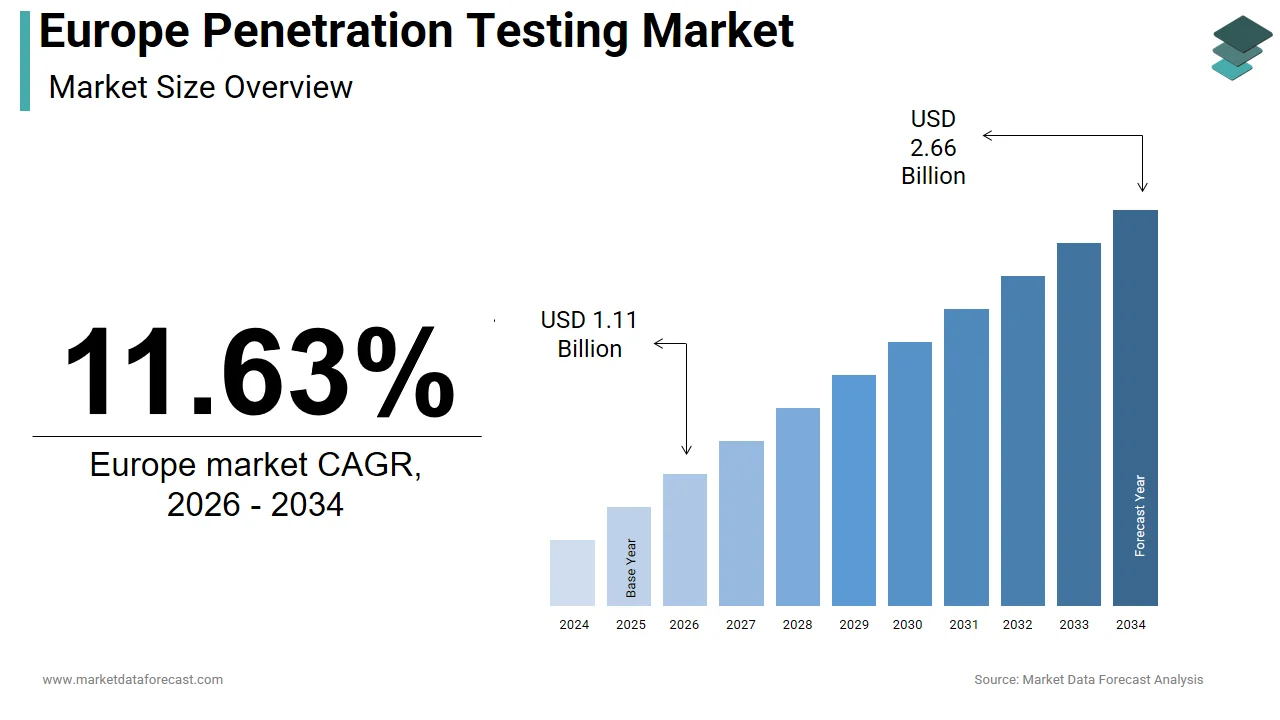
The Europe penetration testing market was valued at USD 0.99 billion in 2025, is estimated to reach USD 1.11 billion in 2026, and is projected to reach USD 2.66 billion by 2034, expanding at a CAGR of 11.63% from 2026 to 2034. Market growth is driven by rising cyber threats, stringent data protection regulations, and increasing digitalization across critical sectors such as finance, healthcare, energy, and government. Organizations are increasingly adopting penetration testing to identify vulnerabilities, ensure regulatory compliance, and strengthen cybersecurity posture amid growing attack surface complexity.
Key Market Trends
- Increasing frequency of advanced cyberattacks and ransomware incidents across Europe.
- Rising demand for regulatory-compliant security testing under GDPR, NIS2, and sector-specific mandates.
- Continued reliance on on-premise security infrastructure in critical industries.
- Growing cybersecurity budgets among large enterprises.
- Integration of penetration testing with continuous security and DevSecOps practices.
Segmental Insights
- Based on deployment mode, he on-premise deployment segment led the Europe penetration testing market in 2025, driven by regulatory requirements, data sovereignty concerns, and the continued use of legacy systems in critical infrastructure and public-sector environments.
- Based on testing type, he network penetration testing segment dominated the market in 2025, as it remains foundational for validating perimeter defenses, internal network segmentation, and resilience of critical infrastructure systems.
- Based on enterprise type, he large enterprises segment accounted for the largest share in 2025, supported by complex IT environments, higher exposure to cyber risks, and mandatory compliance-driven security testing.
Competitive Landscape
The Europe penetration testing market is characterized by the presence of global cybersecurity vendors and specialized security service providers offering advanced testing methodologies. Market participants are focusing on automation, continuous testing platforms, and integration with broader security operations to deliver scalable and proactive vulnerability management. Strong emphasis on compliance readiness, threat intelligence, and industry-specific expertise continues to shape competitive differentiation across the region.
Prominent companies operating in the Europe penetration testing market include CrowdStrike, Rapid7, Synopsys, Inc., NCC Group plc, Secureworks, Inc., Orange Cyberdefense, Forescout Technologies Inc., Invicti, IBM Corporation, ASTRA IT, Inc., Indusface, BreachLock Inc., and THREATSPIKE LABS.
Europe Penetration Testing Market Size
The Europe penetration testing market was valued at USD 0.99 billion in 2025, is estimated to reach USD 1.11 billion in 2026, and is projected to reach USD 2.66 billion by 2034, growing at a CAGR of 11.63% from 2026 to 2034.
Penetration testing refers to the authorized simulated cyberattacks conducted by ethical hackers to identify and remediate security vulnerabilities in digital systems, networks, and applications. These assessments are critical for validating the resilience of IT infrastructure against real-world threat actors and ensuring compliance with stringent regional data protection mandates. In Europe, the practice has evolved from an optional audit into a regulatory necessity driven by the escalating sophistication of cyber threats and the continent’s robust legal framework for digital rights. According to sources, the number of significant cyber incidents reported by EU member states affecting critical sectors such as energy, finance, and healthcare has been on the rise. As per research, the financial and reputational damage from data breaches in the European Union continues to escalate, reflecting a growing average cost globally. The General Data Protection Regulation explicitly requires organizations to implement appropriate technical measures to ensure data security, a provision interpreted by national supervisory authorities as mandating regular penetration testing for high-risk processing activities. Furthermore, the revised Network and Information Security Directive obliges essential and important entities to undergo annual security audits, including adversarial testing. These regulatory and threat-driven imperatives define the strategic relevance of penetration testing in Europe’s cybersecurity ecosystem.
MARKET DRIVERS
Mandatory Compliance with the General Data Protection Regulation
The explicit requirement under the General Data Protection Regulation (GDPR) for organizations is to implement appropriate technical and organizational measures to ensure data security, which is a primary driver of the Europe penetration testing market. National regulators consistently interpret this as necessitating regular adversarial testing. The European Data Protection Board encourages national data protection authorities across EU member states to consider penetration testing as an important technical and organizational measure within their guidance for high-risk processing operations involving sensitive or large-scale personal data. National data protection authorities across Europe, including the French National Commission on Informatics and Liberty, emphasize the importance of robust security testing and often cite insufficient security measures as a contributing factor in General Data Protection Regulation (GDPR) enforcement actions. Similarly, under Article 32 of the GDPR, data protection authorities in Germany and other member states require organizations, including healthcare providers processing patient records, to implement a process for regularly testing and evaluating the effectiveness of their security measures to ensure data security. The regulation’s risk-based approach compels companies to demonstrate proactive identification of vulnerabilities rather than reactive patching. Financial institutions, insurance firms, and digital health platforms now routinely commission third-party penetration tests as evidence of due diligence during regulatory audits. This legal obligation transforms penetration testing from a discretionary best practice into a non-negotiable compliance activity across virtually every data-intensive sector in Europe.
Implementation Requirements Under the Revised Network and Information Security Directive
The revised Network and Information Security Directive has significantly expanded the scope and frequency of mandated security testing across European critical infrastructure and digital service providers, which accelerates the expansion of the Europe penetration testing market. This has thereby accelerated demand for professional penetration testing services. The updated European Union (EU) cybersecurity directive, known as NIS2, substantially widens its regulatory scope compared to the original framework, covering numerous essential and important entities across a diverse range of critical sectors, including energy, transport, water, digital infrastructure, and public administration. The European Union Agency for Cybersecurity (ENISA) and the NIS2 Directive emphasize comprehensive cybersecurity risk management for both essential and important entities, requiring robust security measures validated through methods such as security assessments and various forms of testing. Across Europe, national authorities and sector-specific bodies are increasingly focusing on detailed security protocols for critical infrastructure, including encouraging robust testing like red team exercises and mandating specific cybersecurity measures for vital sectors such as energy and water utilities. The directive’s harmonized cross-border approach eliminates regulatory arbitrage and ensures consistent testing standards across member states. Organizations now treat penetration testing not merely as a technical audit but as a strategic governance requirement tied to director-level accountability. This regulatory expansion creates a structural and recurring demand base that sustains long term market growth independent of isolated breach events.
MARKET RESTRAINTS
Shortage of Certified Ethical Hacking Professionals
The acute shortage of qualified ethical hackers with recognized certifications and hands-on adversarial skills obstructs the growth of the Europe penetration testing market. This is a significant restraint limiting the scalability and responsiveness of the regional market. According to the European Union Agency for Cybersecurity (ENISA), there is a substantial and persistent workforce gap for cybersecurity professionals across the European Union, with particular difficulty in filling roles related to offensive security. The demand for qualified ethical hackers and penetration testing services has experienced significant growth in Europe, consistent with the overall rising need for cybersecurity expertise. This imbalance leads to extended lead times with major consultancies reporting average engagement wait periods of several weeks for onsite assessments. Moreover, there is a recognized need to ensure a consistent and high standard of expertise among cybersecurity practitioners, emphasizing the value of advanced certifications within the industry. Many organizations resort to automated vulnerability scanning as a substitute, which fails to replicate real-world attacker behavior and often produces high false positive rates. The talent gap will keep hindering service delivery capacity and reducing the reliability of security validation in European enterprises unless there is coordinated investment in education, apprenticeships, and standardized accreditation frameworks.
Fragmented National Certification and Methodology Standards
The absence of a harmonized European framework for penetration testing methodologies and certifier accreditation creates inconsistency in assessment quality and regulatory recognition, which undermines market trust and interoperability, constraining the expansion of the Europe penetration testing market. A foundation for product and service certification exists, but there is no unified standard for adversarial testing procedures across member states. National guidelines in one region emphasize red teaming with physical intrusion. Protocols in another region prioritize web application logic flaws. Guidelines in a third region focus on cloud misconfigurations. Approaches to testing vary significantly between different areas. This fragmentation forces multinational corporations to undergo multiple jurisdiction-specific tests to satisfy local regulators, increasing costs and complicating remediation tracking. Furthermore, the accreditation of commercial penetration testing firms is inconsistent across EU countries. This disparity allows firms without specific certification to operate. The European Union Agency for Cybersecurity is addressing this gap with a new initiative. The implementation of this initiative is currently on a voluntary basis. The market will continue to struggle with inconsistent quality and compliance issues until a unified, binding European methodology and certifier registry is implemented.
MARKET OPPORTUNITIES
Integration with DevSecOps and Continuous Testing Frameworks
The shift toward DevSecOps and agile software development in European enterprises is creating a high-value opportunity for the Europe penetration testing market. This allows them to embed continuous adversarial validation into CI/CD pipelines. According to sources, Digital service providers are increasingly deploying code updates with high frequency, a practice that necessitates security validation that matches this rapid development velocity. As per research, Traditional annual penetration tests are being increasingly viewed as insufficient, as cybersecurity leaders prioritize continuous and "shift-left" security testing models integrated earlier in the development lifecycle. This trend enables providers to transition from one-time project engagements to recurring managed services featuring automated reconnaissance, dynamic exploit simulation, and real-time reporting dashboards. Numerous cybersecurity firms offer tools and services, including DAST and SAST solutions, that integrate with modern CI/CD pipelines (e.g., Jenkins, GitLab, Azure DevOps) to provide developers with rapid vulnerability feedback during the development process. European and international cybersecurity bodies, such as ENISA and NIST, advocate for integrating robust security practices and continuous testing throughout the entire software development lifecycle to enhance resilience. This operational alignment transforms penetration testing from a compliance checkpoint into a core engineering function driving predictable recurring revenue and deeper client integration across Europe’s digital economy.
Expansion into Operational Technology and Critical Infrastructure Sectors
The convergence of information technology and operational technology in the region’s energy transport and manufacturing sectors is opening a potential opportunity for the Europe penetration testing market. This frontier is for specialized penetration testing services targeting industrial control systems and legacy machinery. According to studies, A growing number of critical infrastructure operators are integrating operational technology (OT) networks with corporate information technology (IT) systems, which introduces new security challenges that require specialized monitoring approaches. As per research, ransomware attacks impacting industrial facilities appear to be increasing, often resulting in significant operational downtime for affected entities. This vulnerability has triggered mandatory security audits under the revised Network and Information Security Directive, requiring adversarial testing of SCADA PLC and DCS environments. Providers with ICS-specific expertise, such as Airbus Cybersecurity and Forescout, have developed non-disruptive testing protocols that simulate attacks without halting production lines. Regulatory bodies in some regions have begun requiring specific, advanced cybersecurity readiness tests, such as "red team" exercises, for key infrastructure and manufacturing sectors. This regulatory and threat-driven shift establishes OT penetration testing as a high-growth niche with premium pricing and long-term contractual relationships across Europe’s industrial base.
MARKET CHALLENGES
Evolving Sophistication of Adversarial Techniques and Zero-Day Exploits
The accelerating pace of offensive cyber innovation, which renders static testing methodologies obsolete within months of deployment, thereby challenging the growth of the Europe penetration testing market. The average time threats remain undetected within networks is showing a general decrease. A majority of commercial penetration tests continue to primarily utilize known vulnerability databases and standardized exploit methods. A significant portion of security breaches leverage previously unknown or new attack chains. These novel attack methods often bypass detection by standard, industry-aligned security assessments. Modern adversaries employ living off the land techniques, credential theft, and AI-powered phishing that bypass perimeter defenses without triggering traditional indicators. Penetration testers must now simulate multi-stage campaigns involving social engineering, supply chain compromise, and lateral movement, skills that require deep red team experience beyond conventional checklists. However, client budgets often constrain engagements to basic web app scans, limiting the realism of assessments. Continuous investment in offensive research, threat intelligence, and purple teaming is essential to prevent testers from providing false assurance. This asymmetry between attacker innovation and defender validation capability remains a fundamental challenge to the efficacy and credibility of penetration testing in Europe.
Legal and Liability Ambiguities in Cross-Border Testing Engagements
The lack of harmonized legal frameworks governing penetration testing activities across European jurisdictions creates significant liability and compliance risks, which slows down the expansion of the Europe penetration testing market. These risks deter organizations from commissioning thorough assessments. National laws governing computer misuse and the legal boundaries for cybersecurity activities like penetration testing vary significantly among European Union Member States, creating legal uncertainty for security professionals operating across borders. The cybersecurity industry faces challenges regarding potential criminal liability for actions performed during testing, leading to a general trend of including restrictive clauses in contracts to mitigate legal risks under domestic hacking statutes. This legal fragmentation is exacerbated in cloud environments where assets reside across multiple countries, triggering conflicting jurisdictional requirements. A test authorized in Germany may inadvertently violate Ireland’s Criminal Damage Act if it touches an AWS server in Dublin. Furthermore, the absence of EU-wide safe harbor provisions means ethical hackers face potential prosecution if an engagement causes unintended system disruption, even with client consent. The liability shield proposed by the EU Cyber Resilience Act is years away from becoming a reality for certified testers. Organizations will persist in restricting the scope, depth, and frequency of testing, consequently weakening overall cybersecurity resilience, until a clear and uniform legal framework is firmly established across the single market.
REPORT COVERAGE
| REPORT METRIC | DETAILS |
| Market Size Available | 2025 to 2034 |
| Base Year | 2025 |
| Forecast Period | 2026 to 2034 |
| Segments Covered | By Deployment Mode, Testing Type, Enterprise Type, End-Users, and County. |
| Various Analyses Covered | Global, Regional and Country-Level Analysis, Segment-Level Analysis, Drivers, Restraints, Opportunities, Challenges; PESTLE Analysis; Porter’s Five Forces Analysis, Competitive Landscape, Analyst Overview of Investment Opportunities |
| Countries Covered | UK, France, Spain, Germany, Italy, Russia, Sweden, Denmark, Switzerland, Netherlands, Turkey, Czech Republic, and the Rest of Europe. |
| Market Leaders Profiled | CrowdStrike, Rapid7, Synopsys, Inc., NCC Group plc, Secureworks, Inc., Orange Cyberdefense, Forescout Technologies Inc, Invicti, IBM Corporation, ASTRA IT, Inc., Indusface, BreachLock Inc., THREATSPIKE LABS, and Others. |
SEGMENTAL ANALYSIS
By Deployment Mode Insights
The on-premise deployment segment led the Europe penetration testing market and held a 58.7% share in 2024 because of regulatory requirements, data sovereignty concerns, and the prevalence of legacy systems in critical sectors. Many organizations across critical sectors continue to use internal infrastructure for key applications, often due to constraints related to data protection requirements. National data protection authorities frequently require that security assessments involving sensitive data are carried out within specific, controlled boundaries to manage data handling risks. Furthermore, sectors like defense and utilities rely on air-gapped or highly segmented networks that cannot be assessed remotely without physical access. Security guidelines for essential entities emphasize validating internal network resilience through simulation exercises. Major cybersecurity service providers operate specialized facilities to meet these specific operational constraints. The combination of legal compliance, operational necessity, and risk aversion ensuresthat on-premises testing remains the dominant deployment model across Europe’s high-security industries.
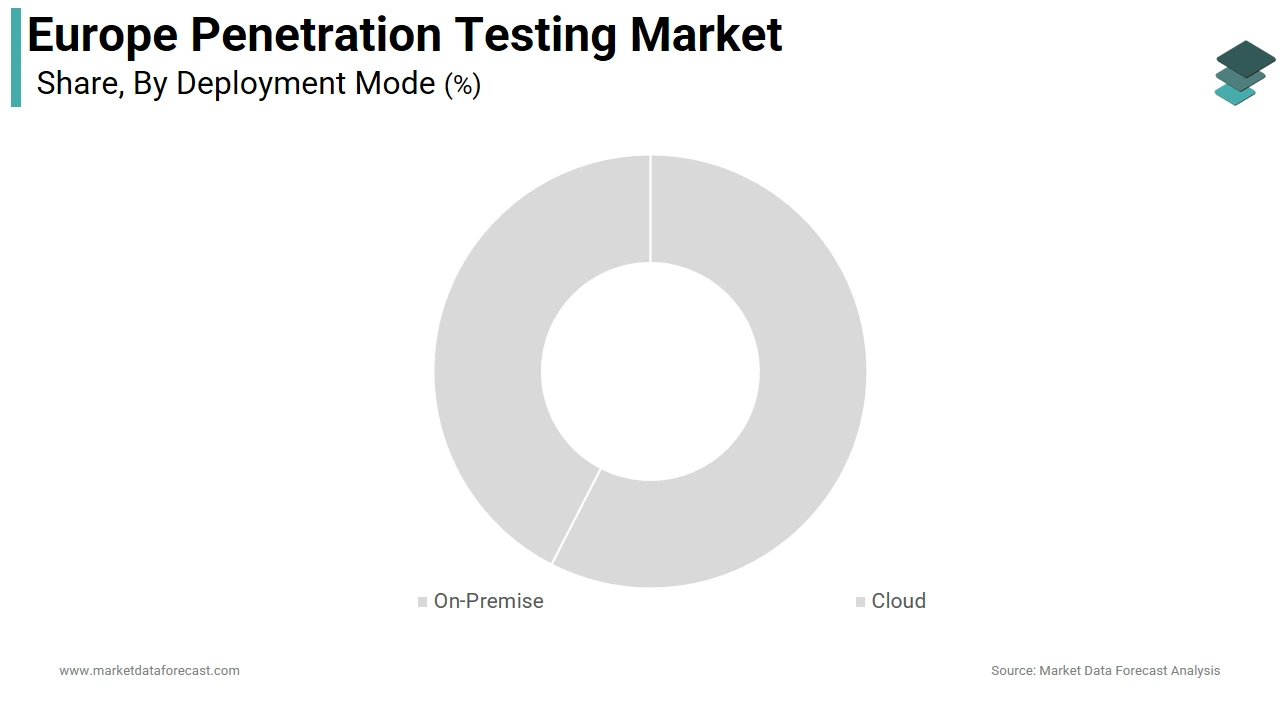
The cloud deployment segment is estimated to register the fastest CAGR of 22.4% over the forecast period. The rapid expansion of the cloud deployment segment is driven by rapid cloud adoption and the emergence of cloud native attack surfaces. Many enterprises are adopting multi-cloud or hybrid cloud architectures, often using multiple providers.
Misconfigurations in common cloud storage components and identity permissions have been associated with a number of reported data breaches. These vulnerabilities are leading to new requirements for cloud security assessments as part of regulatory compliance for technology products. Some providers are developing automated security testing platforms that integrate directly with major cloud environments, helping with continuous validation. Guidance from cybersecurity bodies is beginning to recommend automated cloud penetration testing as a standard part of secure cloud deployment practices. The convergence of regulatory pressure, architectural complexity, and tooling innovation positions cloud-based testing as the fastest-growing deployment mode in Europe.
By Testing Type Insights
The network penetration testing segment dominated the network penetration testing segment and captured a 35.6% share in 2024, as it remains foundational for validating perimeter defenses, internal segmentation, and critical infrastructure resilience. Network-level attacks remain a common method for security breaches, often involving ransomware, lateral movement, and credential theft techniques. Mandates are encouraging organizations in critical sectors, such as energy, transport, and healthcare, to perform regular evaluations of the separation between their operational technology and corporate IT networks. Regulatory bodies provide specific guidelines and testing protocols to help organizations meet compliance requirements for network security assessments. Furthermore, legacy industrial control systems often lack native logging capabilities, making manual network probing the only viable method to detect exploitable services or weak encryption protocols. Specialized security teams conduct non-disruptive network assessments for various industrial systems, including those found in utilities and transportation infrastructure. The enduring centrality of network architecture in cyber defense ensures this segment’s continued dominance across Europe’s regulated sectors.
The cloud penetration testing segment is anticipated to witness the fastest CAGR of 24.1% from 202 to 2034, owing to the explosive shift to cloud native applications and regulatory scrutiny of cloud misconfigurations. Enterprise software adoption trends indicate a shift towards cloud-based deployments, incorporating architectural patterns such as microservices, serverless functions, and containerized workloads. These modern architectures can increase the complexity of the attack surface. Misconfigured identity and access management policies in cloud environments present security challenges, sometimes leading to data exposures or significant access for unauthorized parties. Regulatory changes are emerging that focus on cloud software security validation, potentially involving independent security assessments. In response to these evolving security and regulatory landscapes, some organizations are developing automated testing solutions to validate security configurations. There is a growing emphasis within industry partnerships and compliance frameworks on the importance of ongoing cloud security validation. This regulatory and architectural convergence establishes cloud penetration testing as the highest growth category in Europe’s evolving threat landscape.
By Enterprise Type Insights
The large enterprises segment was the largest in the Europe penetration testing market and captured a substantial share in 2024. The leading position of the large enterprises segment is credited to stringent compliance obligations, complex IT estates, and higher breach exposure thresholds. Entities identified under current information security guidance are required to conduct regular cybersecurity assessments. Financial institutions within the European Union that meet specific asset thresholds are expected to perform rigorous adversarial testing of their payment systems and data environments frequently. These organizations operate across multiple jurisdictions with integrated supply chains, cloud environments,s and industrial systems that collectively present thousands of potential entry points. These organizations typically allocate significant budgets to cybersecurity, ensuring that comprehensive testing remains a consistent and necessary expenditure. Major companies across different sectors routinely commission extensive red team exercises that simulate physical, social, and digital attack scenarios. The combination of regulatory compliancen operational scale, and financial capacity ensures large enterprises remain the primary demand source in Europe’s penetration testing market.
The small and medium enterprises segment is likely to experience the fastest CAGR of 23.7% over the forecast period. The expansion of the small and medium enterprises segment is propelled by supply chain security mandates and affordable managed testing services. Cybersecurity incidents affecting larger organizations frequently originate from vulnerabilities within their small and medium-sized vendors, indicating a notable third-party risk. Regulations now mandate that all software suppliers, including smaller enterprises, provide evidence of security testing to operate in the European market. Subscription-based penetration testing platforms are available at competitive prices to help smaller businesses achieve compliance without internal expertise. Government initiatives further support adoption through financial assistance and free baseline security assessments. A considerable number of European SMEs are expected to require formal penetration testing in the near future to maintain partnerships with larger companies. This supply chain pressure, combined with cost accessible solutions, establishes SMEs as the highest growth enterprise segment.
COMPETITIVE LANDSCAPE
The Europe penetration testing market features a dual-tier competitive structure comprising global consultancies and specialized regional boutiques. Large firms like NCC Group and Orange Cyberdefense dominate regulated sectors through compliance-aligned methodologies and multi-country delivery capabilities. Meanwhile, niche players such as SEC Consult and Pentest Ltd excel in technical depth for web application or industrial control system testing but operate within limited geographies. Competition centers on certification quality, methodology transparency, and regulatory recognition rather than price. The absence of a unified EU testing standard allows differentiation through national accreditations like Germany’s BSI or France’s ANSSI approval. Talent scarcity intensifies rivalry for certified ethical hackers, with firms competing through training academies and offensive research labs. Cloud and OT security have emerged as key battlegrounds with vendors racing to develop validated frameworks for complex hybrid environments. Overall, the market rewards regulatory fluency, technical innovation, and trusted brand reputation.
KEY MARKET PLAYERS
The leading companies operating in the Europe penetration testing market include:
- CrowdStrike
- Rapid7
- Synopsys, Inc.
- NCC Group plc
- Secureworks, Inc.
- Orange Cyberdefense
- Forescout Technologies Inc
- Invicti
- IBM Corporation
- ASTRA IT, Inc.
- Indusface
- BreachLock Inc.
- THREATSPIKE LABS
TOP PLAYERS IN THE MARKET
- NCC Group plc is a leading UK-headquartered cybersecurity firm with extensive penetration testing operations across Europe, serving financial, energy, and public sector clients. The company is globally recognized for its advanced red teaming capabilities and independent validation services aligned with international standards, including ISO 27001 and NIST. It also established a dedicated Operational Technology Security Center in Germany to address the growing demand for ICS and SCADA system assessments. These initiatives reinforce NCC Group’s position as a trusted advisor for complex adversarial simulations in highly regulated European industries.
- Orange Cyberdefense, a subsidiary of Orange SA, is a major European cybersecurity provider offering comprehensive penetration testing services across 18 countries. The company combines offensive security expertise with managed detection and response to deliver integrated resilience solutions. It also enhanced its cloud penetration testing methodology to include identity and entitlement mapping for multi-cloud environments. Through partnerships with national CERTs and participation in EU-funded security initiatives, Orange Cyberdefense strengthens its alignment with European regulatory and threat intelligence frameworks.
- Forescout Technologies Inc maintains a strong presence in the Europe penetration testing market through its device visibility and automated compliance validation solutions that complement manual adversarial assessments. While headquartered in the United States, Forescout operates regional security operations centers in France and the Netherlands, focusing on network and IoT penetration testing for critical infrastructure. It also launched a joint penetration testing service with Airbus Cybersecurity targeting industrial control systems in the energy and transport sectors. These actions demonstrate Forescout’s commitment to blending automation with expert human testing to meet Europe’s evolving security validation needs.
TOP STRATEGIES USED BY THE KEY MARKET PARTICIPANTS
Key participants in the Europe penetration testing market focus on aligning services with EU regulatory mandates such as the Cyber Resilience Act and revised Network and Information Security Directive. They develop specialized offerings for cloud operational technology and supply chain security to address emerging attack surfaces. Companies invest in automation and continuous testing platforms to meet DevSecOps integration demands. Strategic partnerships with national cybersecurity agencies and participation in EU-funded research enhance credibility and access to critical sectors. Additionally, firms are launching tiered service models to make penetration testing accessible to small and medium enterprises while maintaining premium red teaming for large enterprises.
MARKET SEGMENTATION
This research report on the Europe penetration testing market has been segmented and sub-segmented into the following categories.
By Deployment Mode
- On-Premise
- Cloud
By Testing Type
- Network Penetration Testing
- Web Application
- Mobile Application
- Social Engineering
- Cloud Penetration Testing
- Others (IoT and API)
By Enterprise Type
- Large Enterprises
- Small & Medium Enterprises (SMEs)
By End-Users
- BFSI
- IT and Telecommunications
- Healthcare
- Retail and Consumer Goods
- Government and Public
- Others (Media and Entertainment, Education, etc.)
By Country
- United Kingdom
- France
- Spain
- Germany
- Italy
- Russia
- Sweden
- Denmark
- Switzerland
- Netherlands
- Rest of Europe