- Product Description Description
- Table of Contents TOC
- List of Table & Figure LOT
- Get Free Sample PDF Sample PDF
Market Size, 2025
$684 MnMarket Estimate, 2026
$715.46 MnMarket Forecast, 2034
$1,025 MnCAGR, 2026–2034
4.60%Europe Rhodium Market Report Summary
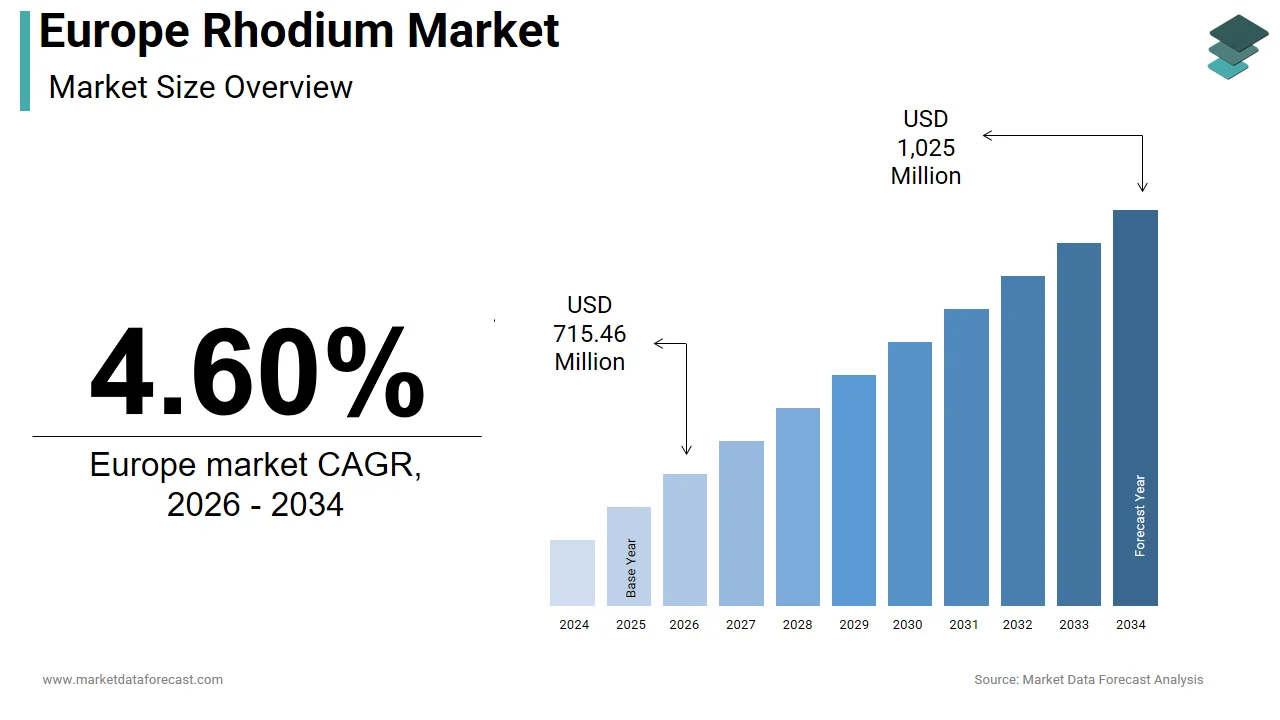
The Europe rhodium market was valued at USD 684 million in 2025, is estimated to reach USD 715.46 million in 2026, and is projected to reach USD 1,025 million by 2034, growing at a CAGR of 4.60% from 2026 to 2034. Market growth is driven by strong demand from the automotive sector, where rhodium is widely used in catalytic converters to reduce harmful emissions. Increasingly stringent emission regulations across Europe and the global shift toward cleaner mobility are key factors supporting demand. Additionally, limited supply availability and high price volatility are influencing market dynamics, encouraging recycling and efficient utilization practices.
Key Market Trends
- Strong demand from automotive catalytic converter applications.
- Increasing focus on emission reduction and environmental regulations.
- Growing importance of recycling and secondary sourcing.
- Supply constraints leading to price volatility.
- Technological advancements in emission control systems.
Segmental Insights
- Based on source, the primary mineral extraction segment dominated the Europe rhodium market by capturing 76.7% share in 2025, driven by reliance on mining-based supply.
- Based on end-use industry, the automotive segment led the market with 77.9% share in 2025, supported by extensive use in catalytic converters for emission control.
Regional Insights
The Europe rhodium market is witnessing steady demand across major economies due to strong industrial and automotive sectors.
- Germany led the market in 2025 with 26.2% share, driven by its robust automotive manufacturing base.
- France ranked second, supported by its strong automotive and chemical industries.
- The United Kingdom holds a significant position due to its automotive manufacturing sector and role as a financial hub influencing precious metal trading.
Competitive Landscape
The Europe rhodium market is characterized by the presence of major mining companies, metal refiners, and recycling firms. Market players are focusing on securing supply chains, enhancing recycling capabilities, and expanding refining operations to mitigate supply risks and price fluctuations. Strategic collaborations and technological advancements in metal recovery are shaping the competitive environment.
Prominent companies operating in the Europe rhodium market include Glencore, Vale SA, Sibanye Gold Limited, Heraeus Holding GmbH, Russian Platinum, Northam Platinum, Umicore SA, Anglo American Platinum, Johnson Matthey Plc, Norilsk Nickel, Sibanye-Stillwater, Sharretts Plating Company, and DF Goldsmith.
 Download Free Sample Report
Europe Rhodium Market Size
The Europe rhodium market reached USD 684 million in 2025, is expected to grow to USD 715.46 million in 2026, and is anticipated to touch USD 1,025 million by 2034, at a CAGR of 4.60% from 2026 to 2034.
Rhodium represents a highly specialized segment of the precious metals industry characterized by the trade, refining, and application of rhodium primarily in automotive catalytic converters and industrial catalysts. Rhodium is a rare silvery white metal belonging to the platinum group metals known for its exceptional resistance to corrosion and high melting point. The European market is heavily influenced by stringent environmental regulations governing vehicle emissions, which mandate the use of efficient catalytic systems. As per the European Automobile Manufacturers Association, the European Union registered approximately 10.8 million new passenger cars in 2025, which is creating a substantial baseline demand for emission control technologies. The region relies almost entirely on imports for primary rhodium supply, as there are no significant mining operations within Europe. According to the United States Geological Survey, global rhodium production is concentrated in South Africa and Russia, with South Africa alone accounting for approximately 81% of global mine production, making the European supply chain vulnerable to geopolitical and logistical disruptions. The European Commission’s Euro 7 emission standards, which enter into force in November 2026, propose even stricter limits on nitrogen oxides and particulate matter, further cementing the role of rhodium in exhaust treatment. According to the data from the International Council on Clean Transportation, diesel and gasoline vehicles require precise amounts of platinum group metals to meet these regulatory thresholds. The market dynamics are also shaped by the growing hydrogen economy, where rhodium catalyzes in fuel cells. This dual demand from traditional automotive sectors and emerging green energy applications defines the strategic importance of rhodium in the European industrial landscape
MARKET DRIVERS
Stringent Emission Regulations and Euro 7 Standards
European emission standards, specifically the upcoming Euro 7 regulations, are primarily driving the growth of the European rhodium market. These regulations aim to drastically reduce nitrogen oxide emissions from internal combustion engines, which require more efficient catalytic converters that rely heavily on rhodium. According to the European Commission, the Euro 7 standards will apply to all light-duty and heavy-duty vehicles, including hybrids and plug-in hybrids, with the first level of requirements for new cars and vans taking effect on 29 November 2026. The regulation mandates lower emission limits under a wider range of driving conditions, which requires advanced catalyst formulations with higher rhodium loading. As per data from the International Council on Clean Transportation, modern three way catalysts use rhodium specifically for its superior ability to reduce nitrogen oxides into harmless nitrogen and oxygen. According to the European Automobile Manufacturers Association, despite the rise of electric vehicles, the existing fleet of internal combustion engines will remain on roads for decades, requiring ongoing maintenance and replacement of catalytic components. Furthermore, the extension of emission testing to real-world driving scenarios increases the durability requirements for catalysts, thereby boosting rhodium demand. The regulatory push extends to heavy-duty vehicles, such as trucks and buses, which contribute significantly to urban pollution. These vehicles require robust catalytic systems that can withstand high temperatures and varying load conditions. The legal framework thus creates a sustained and inelastic demand for rhodium in the automotive sector. This regulatory certainty encourages manufacturers to secure long-term supplies of rhodium to ensure production continuity.
Growth in Hydrogen Fuel Cell Technology
The expanding hydrogen economy in Europe is creating new demand for rhodium due to its application in proton exchange membrane fuel cells, which is further fuelling the regional market expansion. Rhodium is used as a catalyst in various stages of hydrogen production and utilization, including water electrolysis and fuel cell stacks. According to the European Clean Hydrogen Partnership, the EU aims to install 40 gigawatts of renewable hydrogen electrolysers by 2030, which will require substantial amounts of catalytic materials. Rhodium’s unique chemical properties make it an effective catalyst for enhancing the efficiency and durability of fuel cell components. As per the Joint Research Centre of the European Commission, research into advanced catalysts is accelerating to reduce the cost and improve the performance of hydrogen technologies. The transportation sector is increasingly adopting hydrogen fuel cell vehicles for heavy-duty applications, such as trucks and buses, where battery electric solutions face limitations. The European Investment Bank has allocated billions of euros to support hydrogen infrastructure projects, further stimulating demand for related materials. Industrial applications of hydrogen in steel and chemical manufacturing also drive the need for efficient catalytic processes. Rhodium plays a crucial role in these high-temperature and high-pressure environments due to its stability. The strategic focus on decarbonizing hard-to-abate sectors ensures a growing niche market for rhodium beyond traditional automotive uses. This diversification reduces reliance on the cyclical automotive industry and opens new avenues for market growth.
MARKET RESTRAINTS
Extreme Price Volatility and Supply Concentration
The European rhodium market is significantly challenged by intense price fluctuations and a high concentration of global supply. Rhodium prices are known for their erratic fluctuations, driven by speculative trading, supply disruptions, and changes in automotive production rates. According to the London Platinum and Palladium Market, rhodium prices have experienced swings of over 50% within single years, creating uncertainty for downstream manufacturers. The majority of global rhodium production comes from South Africa and Russia, with South Africa alone accounting for approximately 81% of global mine production according to the United States Geological Survey. Any disruption in these key producing regions can lead to immediate shortages and price spikes in the European market. The lack of a liquid futures market for rhodium, compared to other precious metals, makes hedging difficult for industrial users. Automotive manufacturers, who are the primary consumers, struggle to forecast costs and manage inventory levels effectively. The high cost of rhodium also incentivizes the development of substitute materials or technologies that reduce dependency on this metal. Economic downturns that affect car sales directly impact rhodium demand, exacerbating price instability. The financial risk associated with holding large inventories of such a volatile commodity discourages some players from entering the market. This unpredictability hampers long-term planning and investment in rhodium-dependent technologies. The structural imbalance between concentrated supply and dispersed demand remains a persistent challenge.
High Cost of Substitution and Recycling Challenges
The significant expenses related to material substitution and the technical difficulties of recycling currently limit the Europe rhodium market. While manufacturers seek to reduce rhodium usage due to its high price, developing effective substitutes is technically difficult and costly. According to the European Automobile Manufacturers Association, reducing the rhodium content in catalytic converters without compromising emission performance requires extensive research and development. Alternative materials often lack the same durability and efficiency under high-temperature conditions, leading to potential compliance risks. Recycling rhodium from spent catalytic converters is a complex process that requires specialized facilities and technologies. As per waste management reports, the recovery rate for rhodium is lower compared to platinum and palladium, due to its smaller quantity in each unit. The logistics of collecting and transporting end-of-life vehicles for recycling add to the overall cost. Small-scale recyclers may not have the economic viability to process rhodium efficiently, leading to losses in the supply chain. The lack of standardized recycling protocols across European countries further complicates the recovery process. Regulatory hurdles regarding the transport of hazardous waste also impede the flow of scrap materials to refineries. These factors limit the availability of secondary rhodium and keep the market dependent on primary production. The high barrier to entry for recycling infrastructure restricts the growth of a circular economy for rhodium.
MARKET OPPORTUNITIES
Expansion of Aftermarket Catalytic Converter Sales
The secondary market for catalytic converters offers a significant growth opportunity for the European rhodium sector as vehicle fleets age and inspection standards tighten. As vehicles age, their emission control systems degrade, requiring replacement to pass mandatory technical inspections. According to the European Commission, millions of vehicles in the EU are older than 10 years, creating a substantial base for aftermarket parts demand. The enforcement of periodic technical inspections ensures that non-compliant vehicles are either repaired or taken off the road, boosting sales of replacement catalytic converters. As per data from the European Automobile Manufacturers Association, the average age of passenger cars in the European Union reached 12.3 years in 2024, extending the lifecycle of emission control components. Aftermarket manufacturers often use refurbished or newly produced catalytic converters that contain rhodium to meet legal standards. The rise of independent repair shops and online platforms for auto parts facilitates easier access to these components for consumers. The regulatory pressure to maintain low emissions throughout a vehicle’s life, rather than just at the point of sale, supports this market segment. Additionally, the theft of catalytic converters due to their precious metal content has led to increased insurance claims and replacements. This dynamic creates a steady demand for rhodium outside of original equipment manufacturing. Companies that specialize in high-quality aftermarket solutions can capture value from this growing segment.
Development of Advanced Industrial Catalysts
The creation of sophisticated industrial catalysts for the chemical and environmental sectors represents a promising avenue for the European rhodium market. Rhodium is used in various industrial processes, including the production of nitric acid, acetic acid, and silicone polymers. According to the European Chemical Industry Council, the chemical sector is investing in more efficient and sustainable production methods that require high-performance catalysts. Rhodium-based catalysts offer superior activity and selectivity in these reactions, leading to higher yields and reduced waste. As per industry analysis, the shift towards green chemistry drives the adoption of catalysts that operate under milder conditions and produce fewer byproducts. The pharmaceutical industry also utilizes rhodium catalysts in the synthesis of complex molecules for drug production. The growing demand for specialty chemicals in Europe supports the uptake of these advanced catalytic solutions. Furthermore, rhodium is being explored for use in environmental remediation technologies, such as the removal of volatile organic compounds from industrial exhaust streams. The European Union’s Industrial Emissions Directive encourages the use of best available techniques, which often include advanced catalytic systems. Investment in research and development to optimize rhodium catalysts for specific industrial applications can open new revenue streams. This diversification reduces dependence on the automotive sector and leverages rhodium’s unique chemical properties.
MARKET CHALLENGES
Threat from Electric Vehicle Adoption
The rapid transition to electric mobility is a significant long-term challenge for the European rhodium market expansion. As these vehicles do not require internal combustion engines or catalytic converters, the demand for rhodium is significantly impacted. According to the European Automobile Manufacturers Association, battery electric car registrations in the EU reached a 17.4% market share in 2025, continuing their upward trajectory. The European Commission’s fit for 55 package aims to ban the sale of new carbon dioxide-emitting cars by 2035, which threatens the long term demand for rhodium in the automotive sector. As per industrial data, major automakers are shifting their production lines towards battery electric vehicles, reducing their reliance on platinum group metals. This structural shift implies a gradual decline in the primary demand driver for rhodium. While hybrid vehicles still use catalytic converters, their market share is expected to diminish over time. The transition to electric mobility requires a complete rethinking of supply chains for precious metals. Rhodium producers and refiners must adapt to a shrinking automotive market by finding new applications or facing excess capacity. The pace of this transition is accelerated by government incentives and charging infrastructure development. The uncertainty regarding the exact timeline of the phase-out creates investment risks. Companies must diversify their portfolios to mitigate the impact of this technological disruption. The long term viability of the rhodium market depends on its ability to penetrate non-automotive sectors.
Complex Regulatory Compliance for Mining and Refining
The intricate legal and environmental framework governing the sourcing and processing of rhodium creates significant operational hurdles in Europe, which further challenge the growth of the European rhodium market. The European Union’s Conflict Minerals Regulation requires importers to conduct due diligence on their supply chains to ensure that minerals are sourced responsibly. According to the European Commission, companies must verify that their supplies do not contribute to conflict or human rights abuses in high-risk areas. Since rhodium is primarily sourced from regions with potential governance issues, compliance with these regulations is demanding and costly. As per the Organisation for Economic Cooperation and Development, guidelines for responsible supply chains require extensive documentation and third-party audits. The REACH regulation also imposes strict controls on the handling and use of hazardous substances in refining processes. Refineries must invest in advanced pollution control technologies to meet emission standards, which increases operational costs. The lack of transparency in the global rhodium supply chain makes it difficult to trace the origin of the metal. Non-compliance can result in severe penalties and reputational damage for companies. The administrative burden of maintaining compliance diverts resources from core business activities. Small and medium-sized enterprises may struggle to meet these rigorous requirements, leading to market consolidation. The evolving nature of environmental, social, and governance standards adds to the complexity. Navigating this regulatory landscape requires significant expertise and investment.
REPORT COVERAGE
| REPORT METRIC | DETAILS |
| Market Size Available | 2025 to 2034 |
| Base Year | 2025 |
| Forecast Period | 2026 to 2034 |
| Segments Covered | By Source, Product Type, Applications, End-Use Industry, and Country. |
| Various Analyses Covered | Global, Regional, and Country-Level Analysis, Segment-Level Analysis, Drivers, Restraints, Opportunities, Challenges; PESTLE Analysis; Porter’s Five Forces Analysis, Competitive Landscape, Analyst Overview of Investment Opportunities |
| Countries Covered | UK, France, Spain, Germany, Italy, Russia, Sweden, Denmark, Switzerland, Netherlands, Turkey, Czech Republic, and the Rest of Europe. |
| Market Leaders Profiled | China Northern Rare Earth Group, VACUUMSCHMELZE GmbH & Co. KG, Lynas Corporation, MP Materials, Rare Element Resources, Solvay S.A., Alkane Resources, Neo Performance Materials, Arafura Resources, Iluka Resources. |
SEGMENTAL ANALYSIS
By Source Insights
The primary mineral extraction segment remained the leading source for the European rhodium market and occupied 76.7% of the regional market share in 2025. The dominance of the primary mineral extraction segment in the European market is driven by the fact that Europe lacks significant primary rhodium mining operations and relies heavily on imports from major producing nations, such as South Africa and Russia. According to the United States Geological Survey, South Africa accounts for approximately 81% of global rhodium production, making it the primary source for European refiners and manufacturers. The sheer volume of primary metal required to meet the demands of the automotive and chemical industries cannot be met by recycling alone. As per data from the London Platinum and Palladium Market, the annual global mine supply of rhodium remains the backbone of the market, despite fluctuations in output due to operational challenges in mining regions. European refineries process imported concentrates and matte to produce pure rhodium for industrial use. The established trade routes and long-term contracts between European buyers and international mining houses ensure a steady flow of raw materials. Although recycling is growing, it currently serves as a supplementary source rather than a replacement for primary mining. The high purity requirements for certain applications also favor freshly refined metal from mineral sources. The infrastructure for importing and refining primary rhodium is well developed in Europe, supporting this segment's leadership. The dependency on mineral sources reflects the current structural reality of the global platinum group metals supply chain.
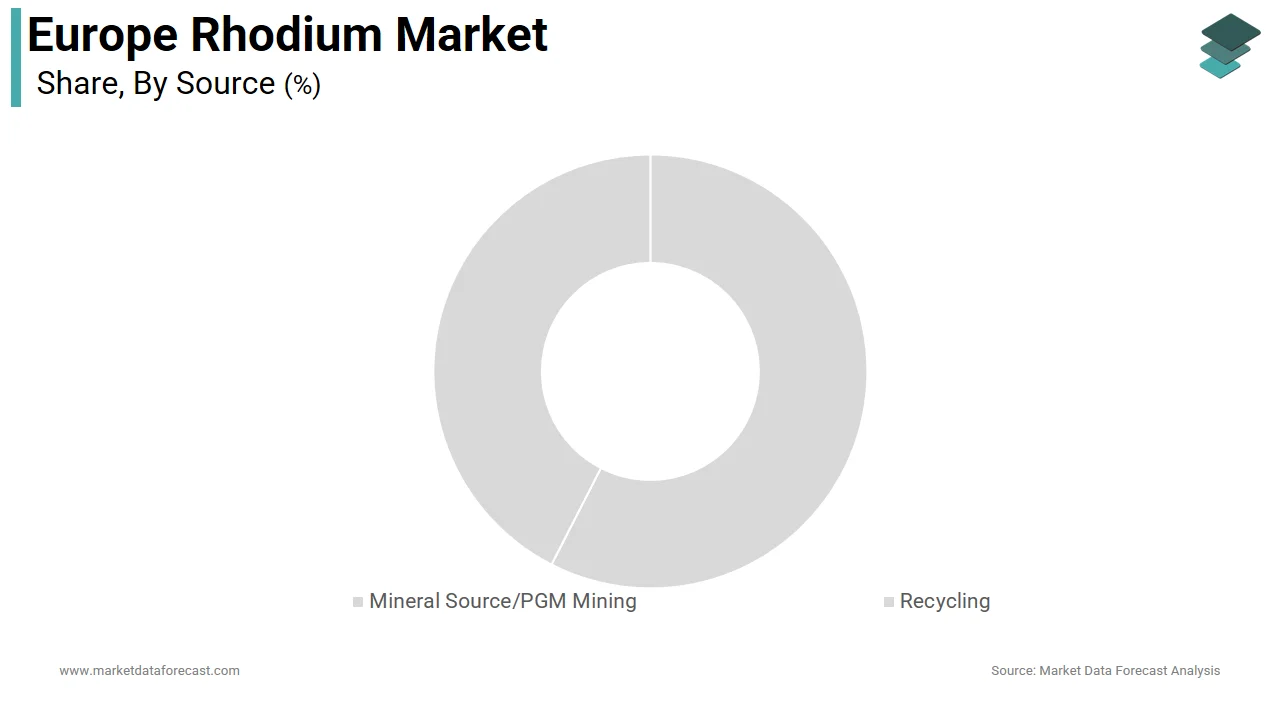
However, the recycling segment is expected to expand rapidly and witness a CAGR of 7.4% over the forecast period, owing to the growing volume of end of life vehicles reaching scrapyards and the rising economic incentive to recover precious metals due to high rhodium prices. According to the European Automobile Manufacturers Association, millions of cars are deregistered annually in Europe, providing a substantial feedstock for catalytic converter recycling. As per the European Waste Management Association, advancements in hydrometallurgical and pyrometallurgical recovery technologies have improved the efficiency and yield of rhodium extraction from spent catalysts. The European Union’s Circular Economy Action Plan encourages the recovery of critical raw materials, reducing reliance on virgin mining. High rhodium prices make recycling economically viable even with complex processing costs. Automotive manufacturers are increasingly engaging in closed-loop systems to secure secondary supplies. The regulatory push for sustainable resource management supports the expansion of recycling infrastructure. Companies are investing in specialized facilities to handle the hazardous materials associated with catalyst processing. The growing awareness of supply chain risks associated with primary mining further drives interest in recycled sources. This segment benefits from both environmental mandates and economic drivers, ensuring sustained growth. The ability to reduce the carbon footprint of rhodium production also appeals to environmentally conscious consumers and regulators.
By Product Type and Application Insights
The rhodium metal used in the catalytic segment held the largest share of the European rhodium market in 2025. This domination is driven by the indispensable role of rhodium metal in three-way catalytic converters used in gasoline and diesel vehicles to reduce nitrogen oxide emissions. According to the European Automobile Manufacturers Association, the vast majority of internal combustion engine vehicles produced and sold in Europe are equipped with catalytic converters containing rhodium. As per data from the International Council on Clean Transportation, rhodium is uniquely effective at reducing nitrogen oxides under stoichiometric conditions, making it irreplaceable in current emission control systems. The stringent Euro 6 and upcoming Euro 7 emission standards mandate low emission levels, requiring efficient catalysts with adequate rhodium loading. The automotive industry’s scale ensures that catalysis remains the primary application for rhodium metal. While other forms, such as alloys and compounds, exist, their volumes are negligible compared to the automotive sector. The metal form is preferred for its stability and catalytic activity at high temperatures. Refineries supply rhodium in powder or sponge form, which is then coated onto ceramic substrates. The consistent demand from vehicle manufacturing and the aftermarket for replacement converters sustains this segment's leadership. The lack of commercially viable substitutes for rhodium in this specific application cements its dominance.
On the other hand, the use of rhodium compounds in the chemical synthesis segment is the most rapidly expanding segment and is estimated to grow at a CAGR of 6.2% over the forecast period, owing to the expanding use of rhodium-based complexes in homogeneous catalysis for the production of fine chemicals, pharmaceuticals, and agrochemicals. According to the European Chemical Industry Council, the shift towards greener and more efficient chemical processes increases the demand for highly selective catalysts. Rhodium compounds, such as rhodium carbonyls and phosphine complexes, offer superior selectivity and activity in hydroformylation and hydrogenation reactions. As per industry analysis, the pharmaceutical sector in Europe is investing in advanced synthesis methods to reduce waste and improve yields. Rhodium catalysts enable reactions under milder conditions, reducing energy consumption and byproduct formation. The development of new drug molecules often requires precise stereochemical control, which rhodium compounds can provide. The growth of the specialty chemicals sector in Europe supports this trend. Research and development efforts are focusing on optimizing rhodium ligands to enhance performance and reduce metal loading. The high value-added nature of these applications justifies the cost of rhodium compounds. This segment benefits from innovation in organic synthesis and the need for sustainable chemical manufacturing. The diversification of rhodium use beyond automotive applications contributes to its rapid growth.
By End Use Industry Insights
The automotive segment remained the primary consumer of rhodium in Europe and occupied 77.9% of the European market share in 2025. The leading position of the automotive segment in the European market is attributed to the mandatory use of rhodium in exhaust emission control systems for internal combustion engine vehicles. According to data from the European Automobile Manufacturers Association, new EU car registrations rose by 1.8% in 2025 to 10.82 million units, which is maintaining a strong baseline for catalytic converter demand. As per the European Commission’s emission regulations, all gasoline and diesel vehicles must meet strict limits on nitrogen oxides, particulate matter, and carbon monoxide. Rhodium is the most effective metal for reducing nitrogen oxides in three-way catalysts. The existing fleet of vehicles also contributes to demand through the aftermarket for replacement catalytic converters. The longevity of internal combustion engines in hybrid vehicles ensures continued relevance for the metal. The scale of the automotive industry dwarfs other sectors in terms of rhodium consumption, with manufacturing plants across Germany, France, and Spain driving significant demand. The regulatory framework ensures that rhodium remains a critical component regardless of cost fluctuations, as compliance is non-negotiable for manufacturers. Any change in automotive production volumes directly impacts rhodium demand, making the sector’s size and regulatory constraints the primary anchors of the market.
However, the electrical and electronics segment is the most rapidly expanding end-use category and is predicted to register a CAGR of 7.25 over the forecast period owing to the increasing use of rhodium in the production of high-performance electrical contacts, connectors, and semiconductor components. According to industry reports, the demand for reliable and durable electronic components is rising due to the expansion of digital infrastructure and consumer electronics. Rhodium’s excellent electrical conductivity and resistance to corrosion make it ideal for plating contacts in harsh environments. As per technical assessments, the miniaturization of electronic devices requires materials that can maintain performance at smaller scales, and rhodium plating provides the necessary wear resistance and low contact resistance for these applications. The growth of the electric vehicle sector also contributes to this segment, as EVs require sophisticated electronic control units and power electronics that utilize precious metal plating. The expansion of 5G networks and data centers in Europe further drives demand for high-reliability connectors. Additionally, rhodium is used in the manufacturing of mirrors and reflectors for optical instruments and lasers. The aerospace and defense sectors also utilize rhodium-plated components for their extreme durability. This diversification into high-tech applications supports rapid growth, benefiting from continuous technological advancements and the increasing complexity of modern electronic systems.
COUNTRY-LEVEL ANALYSIS
Germany Rhodium Market Analysis
Germany maintains a leading position in the European rhodium sector by accounting for 26.2% of the European market share in 2025. The country’s robust automotive industry is the primary driver of rhodium demand, given its status as a major vehicle manufacturer. According to the German Federal Ministry for Economic Affairs and Climate Action, the automotive sector is a cornerstone of the economy, with approximately 4.1 million passenger cars produced in 2024. Germany is home to major automakers, such as Volkswagen, BMW, and Mercedes-Benz, which utilize large quantities of rhodium for catalytic converters. As per the German Association of the Automotive Industry, the transition to cleaner combustion engines and hybrid vehicles maintains demand for emission control technologies. The country’s strong chemical industry also contributes to rhodium consumption in catalytic processes. Germany’s advanced refining capabilities allow it to process imported rhodium concentrates efficiently. The government’s strict environmental regulations enforce high emission standards, driving the use of efficient catalysts. The presence of specialized suppliers and research institutions supports innovation in rhodium applications. The market status is characterized by high technological standards and regulatory compliance. Investment in sustainable mobility solutions influences future demand patterns. Germany’s central role in European automotive production ensures its market leadership.
France Rhodium Market Analysis
France serves as the second-largest market for rhodium in Europe. The country’s automotive and chemical industries are the key drivers of rhodium consumption. According to the French Ministry of Economy, the automotive sector remains a vital part of the manufacturing base, with major plants operated by Renault and Stellantis. These manufacturers require rhodium for catalytic converters to meet European emission standards. As per the French Chemical Industry Federation, the chemical sector utilizes rhodium compounds in various synthesis processes for pharmaceuticals and specialty chemicals. France’s commitment to environmental protection drives the adoption of advanced emission control technologies. According to registration data, approximately 1.7 million new passenger cars were registered in France in 2024, maintaining a steady demand for PGM-based exhaust systems. The country’s nuclear energy profile supports stable industrial operations. The presence of refineries and precious metal traders facilitates the supply chain. The government’s support for green chemistry initiatives encourages the use of efficient catalysts. The market status is defined by a balance between automotive and industrial demand. Regulatory frameworks promote sustainability and innovation. France’s strategic location and industrial base sustain its significant market position. Investment in recycling infrastructure is growing to support circular economy goals.
United Kingdom Rhodium Market Analysis
The United Kingdom holds a significant position in the regional rhodium market. The country’s automotive manufacturing and financial services sectors drive rhodium demand. According to the UK Office for National Statistics, the automotive industry produced 717,371 cars in 2025, which, although a historical low, continues to require catalytic converters for internal combustion and hybrid models. Major manufacturers, such as Nissan and Jaguar Land Rover, operate plants in the UK. As per the Society of Motor Manufacturers and Traders, the industry is adapting to electrification, but still relies on internal combustion engines for hybrids and commercial vehicles. The UK’s role as a global financial hub includes significant trading of precious metals, including rhodium. The London Platinum and Palladium Market influences global pricing and supply dynamics. The chemical and pharmaceutical industries also consume rhodium for catalytic applications. The government’s net-zero targets influence the transition to cleaner technologies. The market status is characterized by strong trading activity and manufacturing demand. Post-Brexit trade arrangements have adjusted supply chains, but demand remains robust. The UK’s expertise in precious metal refining and trading supports its market position.
Italy Rhodium Market Analysis
Italy maintains a robust industrial presence in the rhodium sector. The country’s automotive and luxury goods industries are the main drivers of rhodium demand. According to the Italian National Institute of Statistics, the automotive sector produces significant volumes of vehicles and components. Manufacturers, such as Fiat Chrysler, now part of Stellantis, utilize rhodium for emission control systems. As per the Italian Chemical Industry Federation, the chemical sector uses rhodium catalysts in various industrial processes. The luxury jewelry sector in Italy also consumes rhodium for plating white gold and silver items to enhance brightness and durability. Italy’s strong design and manufacturing heritage supports high-value applications. The government’s environmental regulations align with EU standards, driving catalytic converter usage. The market status is defined by diverse industrial and consumer applications. The presence of skilled artisans and industrial manufacturers creates a unique demand profile. Italy’s strategic location facilitates trade within the Mediterranean region. Investment in sustainable practices is increasing among Italian companies.
Spain Rhodium Market Analysis
Spain represents a key strategic market for rhodium in Europe. The country’s growing automotive industry is the primary driver of rhodium consumption. According to the Spanish Ministry of Industry, Trade, and Tourism, Spain is a major vehicle producer in Europe, with 18 manufacturing plants. These facilities require rhodium for catalytic converters to meet emission standards. As per the Spanish Association of Automobile and Truck Manufacturers, Spanish plants manufactured 2.38 million vehicles in 2024, with 89% of these units destined for export. The chemical industry in Spain also utilizes rhodium in specific catalytic applications. The country’s strategic location facilitates logistics and trade with North Africa and the rest of Europe. The government’s support for industrial modernization and sustainability encourages efficient production methods. The market status is characterized by strong manufacturing activity and export orientation. Investment in electric vehicle production is increasing, but internal combustion engine vehicles remain significant. Spain’s integration into the European supply chain ensures steady rhodium demand. The focus on green mobility influences future market trends.
COMPETITIVE LANDSCAPE
The Europe rhodium market exhibits a highly consolidated competitive landscape characterized by the presence of a few dominant precious metal refiners and catalyst manufacturers. Competition is primarily driven by technological expertise, supply chain reliability, and adherence to stringent environmental regulations rather than price alone. Major players leverage their established recycling infrastructure and long-term contracts with mining companies to maintain market leadership. The market sees intense rivalry in developing efficient catalytic solutions that minimize rhodium usage while meeting strict emission standards. New entrants face high barriers due to capital-intensive requirements and complex technical knowledge needed for refining. Strategic collaborations with automotive OEMs are common tactics to secure long term supply agreements. The shift towards sustainable sourcing has intensified competition in recycling capabilities. Companies differentiate themselves through innovation in catalyst design and transparent supply chain practices. This dynamic environment fosters continuous improvement and investment in green technologies among participants striving to maintain competitive edges in a resource-constrained market influenced by geopolitical factors and regulatory changes.
KEY MARKET PLAYERS
The leading companies operating in the Europe rhodium market include:
- Glencore
- Vale SA
- Sibanye Gold Limited
- Heraeus Holding GmbH
- Russian Platinum
- Northam Platinum
- Umicore SA
- Anglo American Platinum
- Johnson Matthey Plc
- Norilsk Nickel
- Sibanye-Stillwater
- Sharretts Plating Company
- DF Goldsmith
TOP PLAYERS IN THE MARKET
- Heraeus Holding GmbH is a leading German technology group with significant expertise in precious metal processing and recycling. The company plays a crucial role in the Europe rhodium market by providing high-purity rhodium products for automotive catalytic converters and industrial applications. Heraeus recently expanded its recycling capabilities to recover rhodium from spent catalysts more efficiently. This initiative strengthens its position as a sustainable supplier in the circular economy. The company invests heavily in research and development to optimize refining processes and reduce environmental impact. Heraeus collaborates with automotive manufacturers to develop advanced emission control solutions. Its global network ensures reliable supply chains for critical raw materials. The company’s commitment to innovation and sustainability drives long-term growth. Heraeus continues to enhance its service offerings to meet evolving customer needs. These efforts solidify its reputation as a trusted partner in the precious metals industry.
- Umicore SA is a Belgian materials technology and recycling group with a strong presence in the Europe rhodium market. The company specializes in the production of autocatalysts and the recycling of precious metals, including rhodium. Umicore recently invested in expanding its precious metals refining capacity in Antwerp to handle increasing volumes of end-of-life vehicles. This expansion enhances its ability to supply recycled rhodium to the automotive industry. The company focuses on closed-loop systems to minimize waste and maximize resource efficiency. Umicore partners with major car manufacturers to provide integrated catalyst solutions. Its advanced technologies ensure high recovery rates and product purity. The company’s strategic focus on sustainability aligns with European regulatory requirements. Umicore continues to innovate in catalyst design to improve emission performance. These actions strengthen its competitive position in the global market. The company remains a key player in driving the transition towards cleaner mobility.
- Johnson Matthey Plc is a British multinational sustainable technologies company with extensive operations in the Europe rhodium market. The company is a leading supplier of platinum group metals and catalytic converters for the automotive industry. Johnson Matthey recently focused on developing next-generation catalyst technologies that optimize rhodium usage while maintaining high efficiency. The company invested in digital tools to enhance supply chain transparency and traceability. These initiatives support responsible sourcing practices and comply with strict regulatory standards. Johnson Matthey collaborates with governments and industry bodies to shape future emission regulations. Its robust recycling infrastructure recovers rhodium from various industrial sources. The company’s expertise in chemical synthesis also drives demand for rhodium compounds in pharmaceutical applications. Johnson Matthey continues to diversify its portfolio to reduce dependency on traditional automotive markets. These strategies ensure resilience and long-term competitiveness. The company remains at the forefront of sustainable materials innovation.
TOP STRATEGIES USED BY THE KEY MARKET PARTICIPANTS
Key players in the Europe rhodium market predominantly focus on vertical integration to secure raw material supplies and optimize recycling processes. Companies invest heavily in advanced refining technologies to improve recovery rates and product purity. Strategic partnerships with automotive manufacturers ensure stable demand and collaborative development of emission control systems. Participants also prioritize sustainability initiatives by adopting circular economy principles and reducing environmental footprints. Expansion into emerging applications such as hydrogen fuel cells offers new growth avenues. Continuous research and development efforts aim to optimize rhodium usage and develop substitute materials. Manufacturers leverage digital technologies for supply chain transparency and risk management. These strategies collectively strengthen market positions by improving competitiveness, ensuring regulatory compliance, and meeting evolving customer needs in a dynamic industrial landscape.
MARKET SEGMENTATION
This research report on the Europe rhodium market has been segmented and sub-segmented into the following categories.
By Source
- Mineral Source/PGM Mining
- Recycling
By Product Type
- Alloys
- Metals and Compounds
By Applications
- Catalysis
- Jewelry Making
- Platinum and Palladium Alloying
- Others
By End Use Industry
- Automotive
- Chemical
- Glass
- Electricals and Electronics
- Others
By Country
- United Kingdom
- France
- Spain
- Germany
- Italy
- Russia
- Sweden
- Denmark
- Switzerland
- Netherlands
- Rest of Europe