- Product Description Description
- Table of Contents TOC
- List of Table & Figure LOT
- Get Free Sample PDF Sample PDF
Market Size, 2025
$34.07 BnMarket Estimate, 2026
$38.4 BnMarket Forecast, 2034
$99.94 BnCAGR, 2026–2034
12.7%Executive Summary: Global Hard Seltzer Market
- Market Scope: Comprehensive global hard seltzer market analysis covering ABV content tiers, packaging formats, distribution channels, regional leadership frameworks, and consumer wellness adoption metrics.
- Market Valuation: Valued at USD 34.07 billion (2025), estimated at USD 38.40 billion (2026), and projected to reach USD 99.94 billion by 2034, registering a robust CAGR of 12.70% (2026–2034).
- Primary Growth Drivers: High consumer health and wellness adoption trends, including 62% of consumers checking nutrition labels on alcoholic drinks, alcohol consumption among U.S. adults aged 18–34 declining 15% over the past decade, and over 300 hard seltzer brands entering the U.S. market. Key demand is heavily supported by a preference for low-sugar, lower-calorie alcoholic options among Millennials and Gen Z.
Key Market Segment Metrics (2026–2034)
| Category | Leading Segment (2025 Position) | Fastest-Growing Segment |
|---|---|---|
| By ABV Content | Less than 5% ABV (held a prominent market share in 2025) | More than 5% ABV (projected to grow at an 11.2% CAGR) |
| By Packaging | Metal cans (were the largest segment in 2025) | Glass bottles (forecast to expand at a 9.4% CAGR) |
| By Distribution Channel | Off-trade (held a significant share, with 85% of U.S. ready-to-drink alcohol purchases made off-premise) | On-trade (projected to grow at a 10.7% CAGR) |
| By Region | North America (dominated with 54.3% of the global market in 2025) | Europe (projected to record high expansion driven by rising popularity of low-calorie alcoholic beverages and flavor innovation) |
Major Market Players & Market Structure
Market Structure: Highly competitive global hard seltzer landscape featuring leading alcoholic beverage brands and specialized producers competing intensely on flavor innovation, low-sugar formulations, premium and craft positioning, recyclable packaging, regional flavor localization, functional ingredients, digital engagement, and expansion through retail, hospitality, and experiential channels.
Key Companies: White Claw, Truly, Future Proof Brands LLC, Lift Bridge Brewing Co., Barefoot Cellars, Ficks & Co., Bon & Viv, Kona Brewing Co., Nude, and Bud Light Seltzer.
Global Hard Seltzer Market Size
The global hard seltzer market size was calculated to be USD 34.07 billion in 2025 and is anticipated to be worth USD 99.94 billion by 2034 from USD 38.40 billion in 2026, growing at a CAGR of 12.70% during the forecast period.
The Hard Seltzer is the category of alcoholic beverages composed primarily of carbonated water, ethanol derived from fermented sugars or malted grains, and flavoring agents. These products have emerged as a disruptive force in the broader alcoholic beverage industry, appealing to health-conscious consumers seeking lighter, refreshingly flavored options without the heaviness or high caloric load of conventional drinks. According to the World Health Organization, global per capita alcohol consumption reached 5.8 liters of pure alcohol annually in 2022, with a noticeable shift toward ready-to-drink (RTD) formats among younger demographics.
MARKET DRIVERS
The growing consumer preference for low-sugar and calorie-conscious alcoholic beverages among Millennials and Gen Z is accelerating the growth of the Hard Seltzer Market. According to the U.S. Department of Agriculture, the average American consumes 17 teaspoons of added sugar daily, far exceeding the recommended limit by prompting increased scrutiny of beverage ingredients. As per 2023 survey by the International Food Information Council, 62% of consumers check nutrition labels on alcoholic drinks, with sugar content being the second most considered factor after alcohol percentage. Brands like White Claw and Truly have capitalized on this trend by emphasizing “clean” ingredient lists and gluten-free formulations.
The shifting social consumption culture with the decline of heavy drinking rituals in favor of mindful, functional, and socially integrated drinking occasions is additionally to elevate the growth of the Hard Seltzer Market. As per a 2023 study published in Addiction, alcohol consumption among adults aged 18–34 in the U.S. has declined by 15% over the past decade, but when they do drink, they prefer beverages that fit seamlessly into active lifestyles such as beach outings, fitness events, or casual gatherings. Hard seltzers with their light body, fruit-forward profiles, and portability, are increasingly consumed during daytime activities, replacing beer coolers and mixed drinks. This behavioral shift is further amplified by aggressive branding that positions hard seltzers as modern, inclusive, and gender-neutral, breaking away from the male-dominated image of traditional beer marketing.
MARKET RESTRAINTS
The persistent perception of artificiality and synthetic flavoring, which undermines credibility among clean-label advocates and health-focused consumers is restraining the growth of the Hard Seltzer Market. According to the Environmental Working Group, over 70% of leading hard seltzers contain erythritol, maltodextrin, or artificial sweeteners like sucralose, ingredients increasingly scrutinized for potential metabolic side effects. A 2023 consumer sentiment analysis by the Food and Brand Lab at Cornell University revealed that 49% of health-conscious buyers distrust the “natural” labeling on hard seltzers due to vague ingredient disclosures. This disconnect between marketing narratives and actual formulation limits long-term loyalty as consumers demand greater transparency and authenticity in their food and beverage choices.
The high degree of market saturation and brand homogeneity, which has led to diminishing consumer differentiation and declining trial rates is also to hamper the growth of the Hard Seltzer Market. Since the category’s explosive growth in 2019–2021, over 300 hard seltzer brands have entered the U.S. market alone, as documented by the Alcohol and Tobacco Tax and Trade Bureau. Most products offer similar flavor profiles such as black cherry, mango, and lime and comparable nutritional metrics, making it difficult for consumers to distinguish between offerings.
MARKET OPPORTUNITIES
The integration of functional ingredients such as probiotics, adaptogens, nootropics, and botanical extracts into hard seltzer formulations by aligning with the rising demand for beverages that deliver both pleasure and physiological benefit is augmented in leveraging new opportunities for the growth of the Hard Seltzer Market. Brands like Flying Embers and Social Elixir have introduced kombucha-based hard seltzers with live probiotics, targeting gut health, while others are experimenting with ashwagandha and L-theanine to promote relaxation without sedation. Additionally, electrolyte-enhanced seltzers are gaining traction among active consumers who consume alcohol post-workout or during outdoor activities.
The expansion of hard seltzers into non-traditional retail and experiential channels, such as fitness centers, music festivals, and travel hubs, where their portability and lifestyle appeal resonate strongly is additionally to enhance the growth of the Hard Seltzer Market. According to the International Council of Shopping Centers, 42% of gyms and yoga studios in the U.S. now host post-class social events featuring low-alcohol beverages with hard seltzers being the preferred option. Airlines including JetBlue and Alaska Air have introduced hard seltzers in premium cabin service, citing passenger demand for lighter in-flight options. Additionally, brands are sponsoring wellness festivals and marathons once alcohol-free zones by offering non-intoxicating or low-dose variants. This spatial repositioning transforms hard seltzers from backyard coolers to lifestyle accessories by enabling access to previously untapped consumption occasions and reinforcing their identity as socially acceptable, context-appropriate choices.
MARKET CHALLENGES
The regulatory ambiguity surrounding ingredient labeling and health claims as brands incorporate functional additives is to limit the growth of Hard Seltzer Market. The U.S. Food and Drug Administration does not uniformly regulate terms like “natural,” “probiotic,” or “adaptogenic,” allowing for inconsistent or misleading marketing. According to a 2023 Government Accountability Office review, 31% of functional alcoholic beverages made unsubstantiated health claims without clinical backing. This lack of oversight risks consumer disillusionment and potential regulatory crackdowns. The Federal Trade Commission has already issued warning letters to several brands for implying medical benefits from ingredients like CBD or ashwagandha.
The environmental impact of single-use aluminum cans and the associated carbon footprint of flavor-intensive production processes is additionally to impede the growth of the Hard Seltzer Market. While aluminum is recyclable, the Environmental Protection Agency reports that only 46% of aluminum beverage containers in the U.S. are actually recycled, with the rest ending up in landfills or ecosystems. Additionally, the surge in hard seltzer production has strained supply chains for cane sugar and malt base, contributing to agricultural overuse.
REPORT COVERAGE
| REPORT METRIC | DETAILS |
| Market Size Available | 2025 to 2034 |
| Base Year | 2025 |
| Forecast Period | 2026 to 2034 |
| CAGR | 12.7% |
| Segments Covered | By ABV Content, Packaging, Distribution Channel, And Region |
| Various Analyses Covered | Global, Regional and Country Level Analysis; Segment-Level Analysis; DROC; PESTLE Analysis; Porter’s Five Forces Analysis; Competitive Landscape; Analyst Overview of Investment Opportunities |
| Regions Covered | North America, Europe, APAC, Latin America, Middle East & Africa |
| Market Leaders Profiled | White Claw, Truly, Future Proof Brands LLC, Lift Bridge Brewing Co, Barefoot Cellars, Ficks & Co, Bon & Viv, Kona Brewing Co, Nude, Bud Light Seltzer. |
SEGMENTAL ANALYSIS
By ABV Content Insights
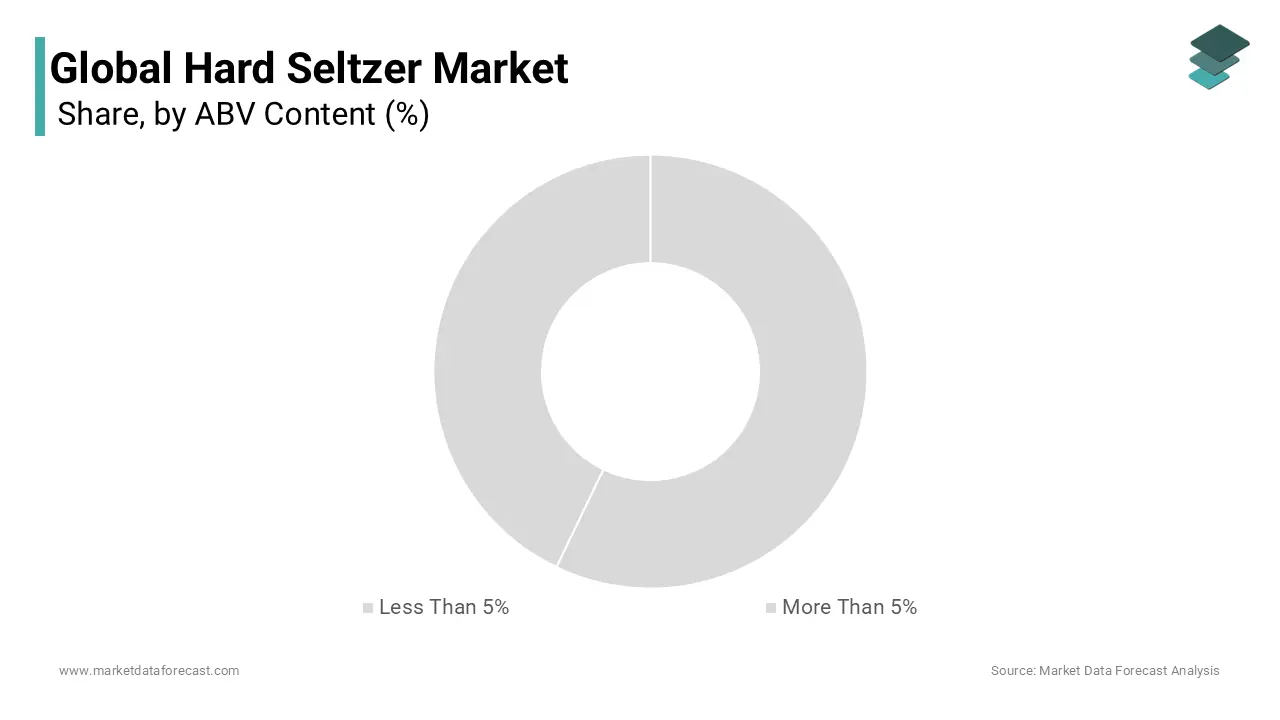
The less than 5% ABV segment was accounted in holding a prominent share of the Hard Seltzer Market share in 2025 with the consumer demand for moderation, low-calorie intake, and prolonged social drinking sessions without impairment. According to the U.S. Dietary Guidelines Advisory Committee, moderate alcohol consumption is defined as up to one drink per day for women and two for men, making sub-5% ABV products ideal for staying within limits. The National Institute on Alcohol Abuse and Alcoholism notes that 54% of young adult drinkers prefer beverages that allow them to remain alert and functional during social events. Brands like Bon & Viv and High Noon Seltzer have capitalized on this trend by emphasizing “easy drinking” and “refreshment without heaviness.”
The more than 5% ABV segment is projected to expand at a CAGR of 11.2% throughout the forecast period with the rising popularity of flavored malt beverages with elevated alcohol content that appeal to consumers seeking stronger effects without the caloric load of beer or spirits. Products like White Claw 8% and Truly Extra, which contain 6–8% ABV, deliver a quicker intoxication onset while maintaining low sugar and carbohydrate profiles.
By Packaging Insights
The metal cans segment was the largest and held a significant share of the hard seltzer market in 2025 with the format’s alignment with the product’s core consumption contexts outdoor, portable, and socially active environments. Cans are lightweight, shatterproof, and easily chilled, making them ideal for beach outings, picnics, and sporting events. Additionally, aluminum cans offer superior recyclability compared to plastic; the Environmental Protection Agency states that aluminum retains 95% of its energy value when recycled, incentivizing eco-conscious branding. Major producers like White Claw and Truly exclusively use 12-ounce slim cans to enhance grip and aesthetic appeal.
The glass bottle segment is lucratively to grow with a projected CAGR of 9.4% during the forecast period with the premiumization trends and the strategic repositioning of hard seltzers as craft or artisanal beverages. Brands seeking differentiation are shifting to glass to convey higher quality, improved flavor preservation, and visual sophistication. Breweries such as Boston Beer Company have introduced limited-edition Twisted Tea Hard Seltzer in glass bottles to target on-premise venues and upscale retail outlets. Additionally, glass allows for embossed branding and unique shapes, enhancing shelf appeal in competitive environments.
By Distribution Channel Insights
The off-trade channel segment accounted in holding a significant share of the Hard Seltzer Market in 2025 with the product’s inherent portability, bulk purchasing behavior, and integration into home-based and outdoor consumption routines. Off-trade includes supermarkets, convenience stores, liquor retailers, and e-commerce platforms, where consumers buy multi-packs for planned social events or personal use. According to the U.S. Bureau of Labor Statistics, American households spent an average of $480 annually on ready-to-drink alcoholic beverages in 2023, with 85% of purchases made off-premise. Retailers like Walmart and Kroger have dedicated hard seltzer endcaps, reflecting the category’s role as a volume driver. The convenience of stockpiling, combined with aggressive promotional pricing that ensures that off-trade remains the primary gateway for trial and repeat consumption.
The on-trade channel segment is likely to grow with an expected CAGR of 10.7% in the coming years with the repositioning of hard seltzers in bars, restaurants, and hospitality venues as a modern, gender-inclusive alternative to beer and cocktails. Craft breweries and gastropubs are also launching proprietary hard seltzer lines to diversify offerings and capture margin. According to a 2023 Technomic report, 67% of full-service restaurants observed higher table turnover when promoting seltzer flights during happy hour.
REGIONAL ANALYSIS
North America Hard Seltzer Market Insights
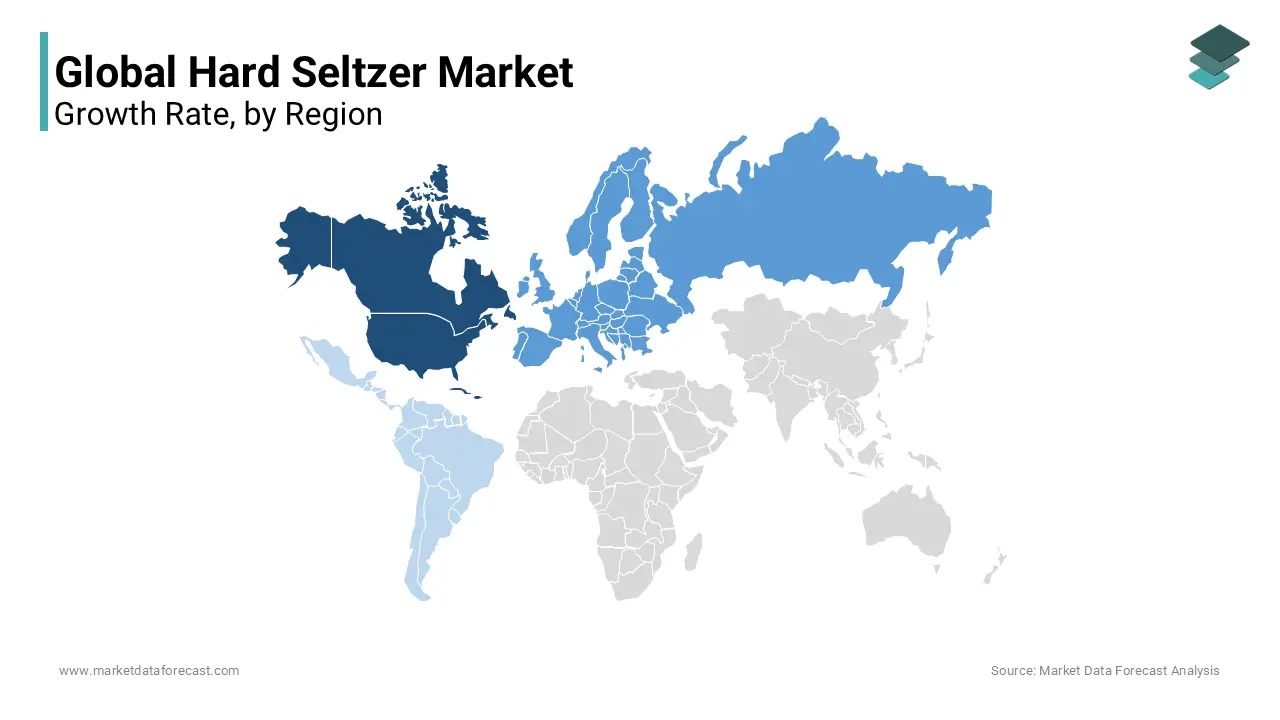
North America was the top performer of the global hard seltzer market by occupying 54.3% of the share in 2025 with the category’s origin and rapid cultural adoption in the United States, where hard seltzer became a mainstream phenomenon following White Claw’s 2019 breakout. Canada has followed suit, with LCBO reporting a 38% year-on-year increase in seltzer sales in Ontario. The Alcohol and Tobacco Tax and Trade Bureau has streamlined approval for flavored malt beverages, encouraging innovation.
Europe Hard Seltzer Market Insights
Europe Hard Seltzer Market growth is likely to grow with prominent CAGR in the coming years. Germany and Sweden are witnessing rising adoption due to strong environmental consciousness and high can recycling rates 83% and 89% respectively, as per Eurostat by aligning with seltzer’s aluminum packaging.
Asia Pacific Hard Seltzer Market Insights
The Asia-Pacific Hard Seltzer Market growth is likely to grow with the urbanization and shifting youth preferences. Japan has emerged as a key innovator, with Suntory launching non-alcoholic and low-sugar seltzer variants tailored to aging demographics and health regulations. In India, startups like BAC (Brewed Alcoholic Cocktail) are introducing flavored seltzers in response to rising disposable income and Western lifestyle influence. While cultural norms around alcohol vary widely, the region’s young, digitally connected consumers are increasingly open to low-intensity, flavored alcoholic options by making APAC a high-growth frontier for strategic market entry.
Latin America Hard Seltzer Market Insights
Latin America Hard Seltzer Market growth is expected to grow steadily in the coming years. Brazilian consumers, particularly in São Paulo and Rio de Janeiro, are embracing hard seltzers as a modern alternative to traditional cachaça-based drinks and lagers. The National Institute of Public Health of Mexico notes that sugary drink consumption declined by 12% between 2014 and 2022 by creating space for seltzer alternatives. Local brewers like Cervecería Cuauhtémoc Moctezuma have launched seltzer lines under established brands.
Middle East and Africa Hard Seltzer Market Insights
The Middle East and Africa Hard Seltzer Market growth is lucratively growing with the development largely confined to expatriate hubs and duty-free zones. The UAE leads the region, where Dubai Duty Free recorded a 40% increase in hard seltzer sales at airports in 2023, according to the Dubai Airports Company. South Africa is the only African nation with a nascent domestic seltzer market, driven by urban millennials in Johannesburg and Cape Town.
LEADING PLAYERS IN THE HARD SELTZER MARKET
Boston Beer Company (Truly Hard Seltzer)
Boston Beer Company has intensified its engagement in the Asia Pacific hard seltzer market by leveraging its Truly brand to introduce regionally tailored flavor profiles and packaging formats. In 2023, the company launched a limited-edition lychee and yuzu variant in Japan and South Korea, designed to align with local taste preferences and seasonal beverage culture. It established distribution partnerships with premium grocery chains in Australia and Singapore, emphasizing chilled availability and lifestyle branding. The company also invested in digital marketing campaigns featuring local influencers to build awareness among urban millennials. In 2025, Boston Beer collaborated with a Tokyo-based design agency to revamp its can aesthetics, incorporating minimalist Japanese visuals to enhance shelf appeal.
Anheuser-Busch (Bon & Viv Spiked Seltzer)
Anheuser-Busch has strategically expanded its Bon & Viv Spiked Seltzer presence in Asia Pacific by focusing on expatriate communities, duty-free channels, and international retail hubs. In 2023, the company introduced a low-sugar, 4% ABV version of Bon & Viv in select markets, including Hong Kong and the Philippines, responding to regional health regulations and consumer demand for moderation. It partnered with airline caterers and luxury resorts in Thailand and the Maldives to feature the brand in premium hospitality settings. Anheuser-Busch also launched a sustainability initiative in 2025, using recyclable aluminum and promoting eco-conscious messaging in urban markets like Sydney and Auckland.
Suntory Holdings (Strong Zero & Zon’i)
Suntory Holdings has played a pioneering role in shaping the hard seltzer landscape in Asia Pacific by adapting its existing chūhai (carbonated fruit-flavored alcoholic drink) expertise to modern consumer expectations. The company’s Strong Zero, though technically a pre-seltzer category product, has evolved into a dominant low-calorie, flavored alcoholic beverage in Japan, South Korea, and Southeast Asia, with over 300 million cans sold annually as reported by the Japan External Trade Organization. In 2023, Suntory reformulated several Strong Zero variants to reduce sugar content and introduced sleeker can designs to appeal to younger demographics. It also launched Zon’i, a premium seltzer line with natural fruit extracts, targeting health-conscious urban professionals. Suntory leveraged its deep retail integration and vending machine network to ensure widespread availability.
TOP STRATEGIES USED BY THE KEY MARKET PARTICIPANTS
Key players in the hard seltzer market are deploying flavor localization, packaging innovation, strategic distribution partnerships, digital engagement, and functional enhancement to strengthen their market position. Companies are reformulating products to suit regional palates, such as introducing tropical or citrus blends in warm climates and botanical infusions in premium markets. Investment in lightweight, recyclable cans and eye-catching designs enhances shelf impact and sustainability appeal. Expansion into on-trade venues, e-commerce, and travel retail broadens consumer access. Brands are leveraging social media and influencer marketing to build lifestyle associations.
KEY MARKET PLAYERS AND COMPETITION OVERVIEW
Major Players of the global hard seltzer market include White Claw, Truly, Future Proof Brands LLC, Lift Bridge Brewing Co, Barefoot Cellars, Ficks & Co, Bon & Viv, Kona Brewing Co, Nude, Bud Light Seltzer.
The competitive landscape of the hard seltzer market is marked by rapid innovation, aggressive branding, and a struggle for differentiation in an increasingly crowded space. While early entrants capitalized on novelty, the current phase is defined by strategic refinement, with players vying for loyalty through flavor diversity, health positioning, and experiential marketing. Incumbent brewers leverage distribution strength, while craft and startup brands emphasize authenticity and niche appeal. The convergence of wellness, sustainability, and convenience has elevated consumer expectations, forcing companies to balance taste, transparency, and ethics. Regional dynamics further fragment the market, requiring localized approaches rather than global uniformity.
RECENT HAPPENINGS IN THE MARKET
- In June 2023, Boston Beer Company launched a limited-edition yuzu and lychee flavor of Truly Hard Seltzer in Japan and South Korea, tailored to regional taste preferences and supported by influencer-driven digital campaigns.
- In September 2023, Anheuser-Busch introduced a low-sugar, 4% ABV version of Bon & Viv Spiked Seltzer in Hong Kong and the Philippines by aligning with regional health regulations and consumer demand for moderation.
- In November 2023, Suntory Holdings reformulated multiple Strong Zero variants to reduce sugar content and enhance natural flavor profiles, which is strengthening its appeal among health-conscious consumers in Japan and Southeast Asia.
- In February 2025, Boston Beer Company collaborated with a Tokyo design agency to revamp Truly’s can aesthetics, incorporating minimalist Japanese visuals to improve premium shelf positioning in urban retail environments.
- In May 2025, Anheuser-Busch partnered with luxury resorts in Thailand and airline caterers in Southeast Asia to feature Bon & Viv in high-visibility hospitality and travel retail settings by expanding its presence in lifestyle-driven consumption channels.
DETAILED SEGMENTATION OF GLOBAL HARD SELTZER MARKET INCLUDED IN THIS REPORT
This research report on the global hard seltzer market has been segmented and sub-segmented based on ABV content, packaging, distribution channel, & region.
By ABV Content
- Less Than 5%
- More Than 5%
By Packaging
- Glass Bottles
- Metal Cans
- Plastic Bottles
By Distribution Channel
- Off-trade
- On-trade
By Region
- North America
- Europe
- Asia Pacific
- Latin America
- Middle East & Africa