- Product Description Description
- Table of Contents TOC
- List of Table & Figure LOT
- Get Free Sample PDF Sample PDF
Market Size, 2025
$7.28 BnMarket Estimate, 2026
$7.83 BnMarket Forecast, 2034
$14.04 BnCAGR, 2026–2034
7.57%Executive Summary: Latin America Smart Wearables Market
- Market Scope: Comprehensive regional market evaluation of smart wearables in Latin America covering diverse product variations, hardware/software components, key healthcare and industrial applications, and country-level distribution metrics.
- Market Valuation: Valued at USD 7.28 billion (2025), estimated at USD 7.83 billion (2026), and projected to reach USD 14.04 billion by 2034, registering a solid CAGR of 7.57% (2026–2034).
- Primary Growth Drivers: Growing fitness and health awareness, declining component costs making devices increasingly economical, and seamless smartphone/tablet integration. Key operational factors include rising demand for remote health monitoring, workplace safety applications, and the transition of smartwatches into medical-grade diagnostic tools.
Key Market Segment Metrics (2026–2034)
| Category | Leading Segment (2025 Position) | Fastest-Growing Segment |
|---|---|---|
| By Product | Wristwear / Smartwatches (held a large market share and continue to lead due to mobile integration) | Medical Devices (emerging rapidly as companies transition products from luxury gadgets to health monitoring tools) |
| By Component | Hardware (accounted for foundational device manufacturing and sensor infrastructure) | Software and Cloud Analytics Services |
| By Country | Brazil (gaining traction in leading the dominant share driven by e-commerce expansion and IoT developments) | Mexico and Brazil (accounting for the largest combined share with rising tech-savvy urban populations) |
Major Market Players & Market Structure
Market Structure: Highly competitive and evolving consumer electronics and health-tech landscape featuring global tech giants and specialized medical device manufacturers competing on price localization, advanced biometric sensors, battery efficiency, and fitness-to-medical ecosystem integration.
Key Companies: Apple, Covidien Plc, Philips Electronics, Fitbit Inc., LifeWatch AG, Polar Electro, Jawbone, Sotera Wireless, Pebble Technology Corp., Drägerwerk AG & Co. KGaA, Omron Corp., Samsung, Huawei, Lifesense Group, Adidas Group, Qualcomm Technologies, Inc., Sony Corporation, Garmin, Nokia Technologies, Vital Connect, and Everist Genomics.
Latin America Smart Wearables Market Size
The size of the Latin America smart wearables market was valued at USD 7.28 billion in 2025. This market is expected to grow at a CAGR of 7.57% from 2026 to 2034 and be worth USD 14.04 billion by 2034 from USD 7.83 billion in 2026.
MARKET DRIVERS
The growing fitness and health awareness drives the Latin America smart wearables market. These devices are becoming increasingly economical due to the declining cost of the components used in manufacturing. Growing demand for wearable technology in various applications, including security, healthcare, and fitness, propels the market's growth.
Thanks to the growing demand for tablets and smartphones, wearables are currently integrated with cell phones. With its large market share, the wristwear sector is expected to continue to lead the market during the projection period. The Latin American market has benefited from the release of smartwatches from Samsung, Sony, and Nike.
Launching innovative products with advanced features using advanced technology is also important to fuel the market growth rate. There will be a shift towards mass production and a drop in the average price in Latin America due to market consolidation and manufacturers' investments in premium and entry-level appliances.
Workplace applications, smart home integration, and health and fitness tracking are ascribed to boost the growth rate of the Latin America smart wearables market. The demand for smart wearables may increase as individuals become more health-conscious and search for wearables that measure health-related data such as heart rate, physical activity, and sleep habits. Wearable smart devices can increase safety and productivity at work. For instance, the gadget may monitor worker activities, measure equipment utilization, and give workers real-time data to enhance productivity and reduce accidents.
MARKET RESTRAINTS
High cost, short battery life, and restricted functionality constrain the Latin American smart wearables market. Wearable technology, including smartwatches, is becoming more expensive. That could be pricey for certain customers. Smart wearables' short battery life and limited performance may hinder extended usage and health issue identification, unlike specialized devices that offer superior performance and functionality. Also, the regional market is impacted by the lack of control over the personal information generated by their smart wearable gadgets.
Smart wearables can be costly, especially the more sophisticated models with many capabilities. The high cost of the product range is a major obstacle for Latin American communities with limited incomes. When buying smart wearables, credit options and installment plans might not be easily accessible or within everyone's budget. There are notable regional differences in smartphone penetration and internet availability. Potential consumers may lack the infrastructure to make the most of smart wearables.
SEGMENTAL ANALYSIS
By Product Insights
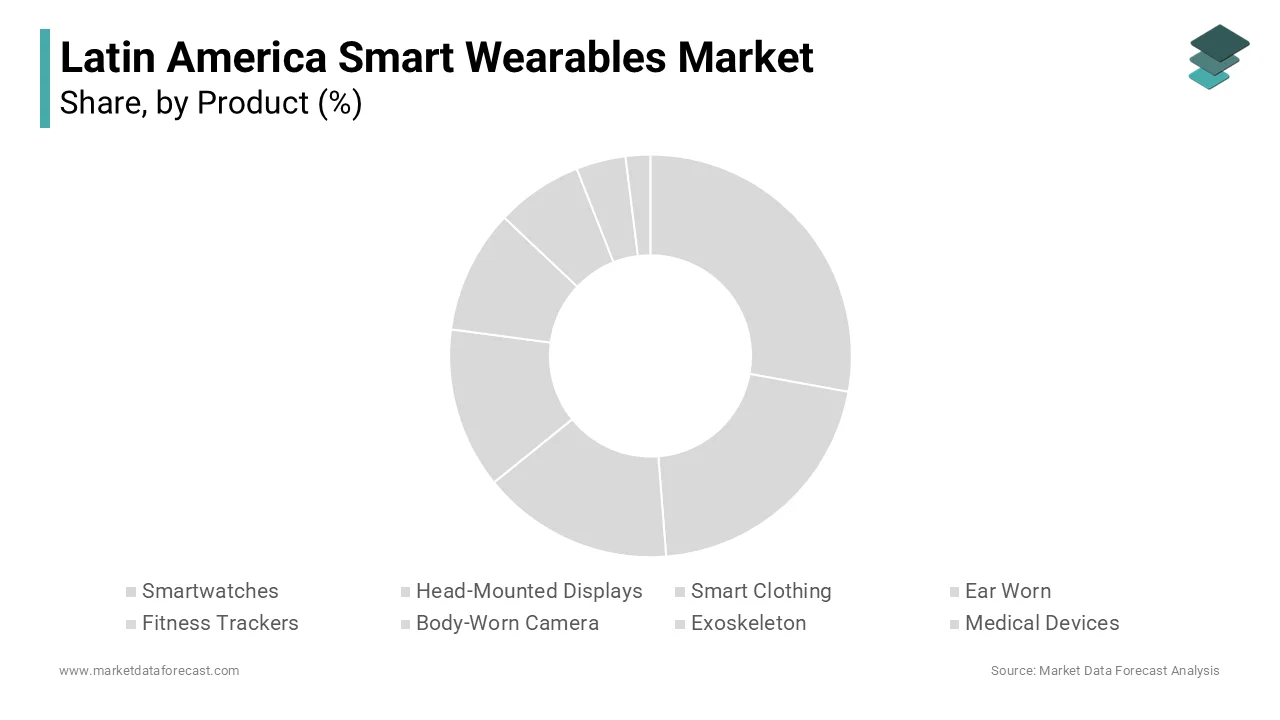
The medical devices segment is the leading market under this category. Emerging economies like Mexico, Brazil, and Argentina offer the potential for smartwatch companies to transition from luxury gadgets to medical equipment. In addition to helping with problem-solving, drug impact analysis, and patient recovery monitoring, smartwatches also save time and resources by giving medical practitioners access to complex information.
GEOGRAPHICAL ANALYSIS
Brazil's Latin America Smart Wearables Market is gaining traction in leading the dominant share. The expansion of the e-commerce sector has increased the use of smart technology. The increasing prevalence of diabetes, heart disease, and obesity is predicted to lead to a need for health status monitoring and wearable technology. In addition, the nation's rising smartphone penetration and IoT sector development will continue to support regional market expansion.
Mexico is expected to grow further with a considerable market share. The tech-savvy population's increased disposable wealth and increasing emphasis on health are expected to accelerate the market growth rate. The growing popularity of internet and cell network coverage makes smart wearables more accessible in urban areas.
Argentina will likely propel steadily despite the economic crisis in the coming years. Argentina's fluctuating economy can have a big effect on affordability and consumer purchasing, especially when it comes to luxury cars. This allows companies to offer cost-effective products according to regional tastes and habits.
KEY MARKET PLAYERS
Some of the notable companies operating in the Latin American smart wearables market profiled in this report are Apple, Covidien Plc, Philips Electronics, Fitbit Inc., LifeWatch AG, Polar Electro, Jawbone, Sotera Wireless, Pebble Technology Corp., Drägerwerk AG & Co. KGaA, Omron Corp., Samsung, Huawei, Lifesense Group, Adidas Group, Qualcomm Technologies, Inc, Sony Corporation, Garmin, Nokia Technologies, Vital Connect, and Everist Genomics.
MARKET SEGMENTATION
This Latin America smart wearables market research report is segmented and sub-segmented into the following categories.
By Product
- Smartwatches
- Head-Mounted Displays
- Smart Clothing
- Ear Worn
- Fitness Trackers
- Body-Worn Camera
- Exoskeleton
- Medical Devices
By Component
- Hardware
- Software
- Service
By Country
- Brazil
- Mexico
- Argentina
- Chile
- Rest of Latin America