- Product Description Description
- Table of Contents TOC
- List of Table & Figure LOT
- Get Free Sample PDF Sample PDF
Market Size, 2025
$90.70 BnMarket Estimate, 2026
$93.06 BnMarket Forecast, 2034
$114.37 BnCAGR, 2026–2034
2.6%North America Warehousing and Storage Market Size, Growth, Trends & Forecast (2026–2034)
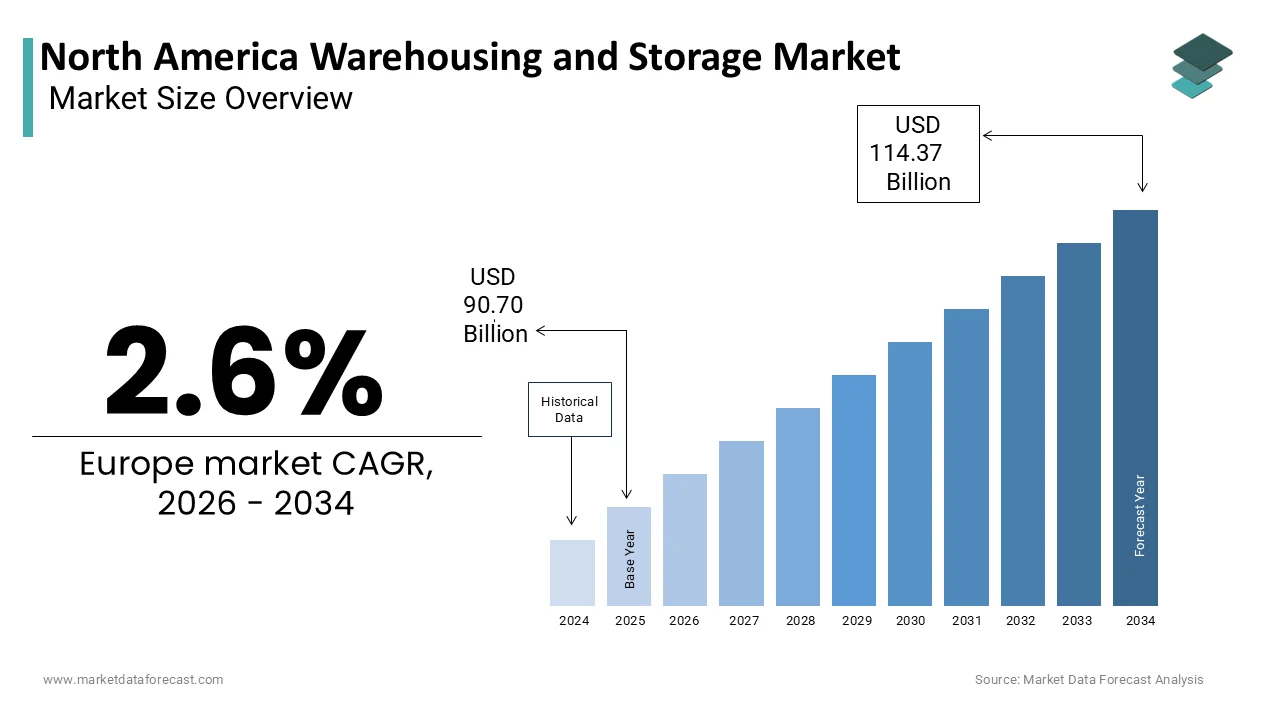
The North America warehousing and storage market size was valued at USD 90.70 billion in 2025, is estimated to reach USD 93.06 billion in 2026, and is projected to scale up to USD 114.37 billion by 2034, growing at a compound annual growth rate (CAGR) of 2.6% from 2026 to 2034. Propelled by the rapid expansion of e-commerce last-mile fulfillment, supply chain nearshoring, and rising adoption of warehouse automation technologies, the regional market continues to evolve steadily across general and temperature-controlled storage sectors.
Key Executive Metrics (At-a-Glance)
- 2025 Base Valuation: USD 90.70 Billion
- 2026 Current Valuation: USD 93.06 Billion
- 2034 Forecast Valuation: USD 114.37 Billion
- Compound Annual Growth Rate (CAGR): 2.6% (2026–2034)
- Top Performing Country: United States (Holds a dominant regional share of 89.3% in 2025, driven by a vast logistics infrastructure, high e-commerce volume, and advanced technology adoption).
Core Market Drivers
- E-commerce & Last-Mile Fulfillment: Exponential digital retail growth requiring micro-fulfillment networks, urban warehousing, and high-throughput distribution hubs.
- Supply Chain Resilience & Nearshoring: Regionalization of supply chains, driving cross-border logistics infrastructure and buffer inventory requirements in Mexico and U.S. border zones.
Primary Market Restraints & Challenges
- Labor Shortages & Workforce Retention: High physical demands and tight labor markets causing structural hiring deficits and escalating wage competition.
- Rising Real Estate Costs & Environmental Pressures: Surging industrial lease rates, land scarcity in key hubs, and stringent decarbonization mandates (e.g., zero-emission fleet rules).
North America Warehousing and Storage Market Segmentation Highlights
| Segment Category | Largest Segment | Fastest-Growing / Key Segment |
|---|---|---|
| By Type | General Warehousing and Storage | Refrigerated Warehousing and Storage (9.4% CAGR) |
| By Ownership | Private Warehouses (54.3% share in 2025) | Public Warehouses (8.7% CAGR) |
| By End-User Industry | Consumer Goods (37.4% share in 2025) | Food and Beverage Sector (9.1% CAGR) |
| By Country | United States (89.3% share in 2025) | Canada (Logistics gateways and cross-border trade) |
Major Industry Players Profiled
Key logistics real estate and supply chain leaders shaping the North American warehousing market include Prologis, Inc., Lineage Logistics, XPO Logistics, Inc., Ryder System, Inc., FedEx Corp, DHL International GmbH, and NFI Industries, Inc.
North America Warehousing and Storage Market Size
The North America warehousing and storage market was valued at USD 90.70 billion in 2025, is estimated to reach USD 93.06 billion in 2026, and is projected to reach USD 114.37 billion by 2034, growing at a CAGR of 2.6% from 2026 to 2034.
The warehousing and storage is a vast network of facilities dedicated to the short- and long-term holding of goods across the supply chain, which ranges from temperature-controlled units for perishables to automated distribution centers for e-commerce fulfillment. Labor dynamics also play a pivotal role, with the warehousing and storage sector employing over 1.5 million workers in the U.S., a figure that has grown by 67% since 2010, as reported by the U.S. Bureau of Labor Statistics. Regulatory frameworks around safety, emissions, and building codes further shape facility design and location decisions, particularly in densely populated regions such as the Northeast Corridor and the Inland Empire of Southern California.
MARKET DRIVERS
E-commerce Expansion and Last-Mile Fulfillment Demand
The exponential growth of e-commerce has fundamentally reshaped the North American warehousing landscape, necessitating a strategic pivot toward last-mile fulfillment infrastructure. The Inland Empire in California, for instance, saw warehouse vacancy rates dip to 2.8% in early 2023, the lowest in the nation, as per CBRE Group, Inc., with intense competition for proximity-based logistics real estate. Additionally, Amazon alone operated over 1,100 fulfillment and sortation centers across North America by 2023, many of which are tailored for rapid dispatch, according to company disclosures. This proliferation of micro-fulfillment centers in cities like Chicago, Dallas, and Toronto reflects a broader industry realignment where speed-to-consumer outweighs traditional economies of scale. The need for inventory decentralization has also prompted third-party logistics (3PL) providers to expand their urban warehouse portfolios, with Prologis reporting a 34% year-over-year increase in urban last-mile facility acquisitions in 2022.
Supply Chain Resilience and Nearshoring Initiatives
The reconfiguration of global supply chains toward regionalization and nearshoring has significantly amplified warehousing requirements across North America. This surge has led to a boom in cross-border logistics infrastructure, especially in northern Mexican states like Nuevo León and Chihuahua, where industrial real estate absorption hit 45 million square feet in 2023, as reported by JLL. Warehouses in U.S. border regions such as Laredo, Texas, have seen vacancy rates fall below 3%, with average lease rates climbing 18% year-on-year, according to Colliers International. These facilities serve as nodes for transloading, customs clearance, and inventory buffering by enabling just-in-time delivery to U.S. distribution networks.
MARKET RESTRAINTS
Labor Shortages and Workforce Retention Challenges
The lack of labor and skilled technical professionals is limiting the growth of the North America warehousing and storage market. High physical demands, repetitive tasks, and fluctuating shift schedules contribute to employee dissatisfaction in regions with tight labor markets, such as the Pacific Northwest and Colorado. In 2023, the warehousing industry reported 185,000 unfilled jobs nationwide, as per the National Association of Manufacturers, indicating a structural mismatch between workforce availability and industry needs. However, higher wages alone have not resolved retention issues as competition intensifies with retail, transportation, and construction sectors offering comparable compensation. The scarcity of bilingual workers in border regions further complicates operations, particularly in cross-border logistics hubs. These labor dynamics force companies to delay expansions, operate below capacity, or invest heavily in automation, with an option often prohibitive for small and mid-sized operators.
Rising Real Estate Costs and Land Scarcity
Escalating land prices and diminishing availability of developable space in high-demand logistics corridors are also restricting the growth of the North America warehousing and storage market. In major distribution hubs such as Southern California, Northern New Jersey, and the Chicago metro area, the cost of industrial real estate has surged, with average asking lease rates reaching $18.50 per square foot in 2023, a 27% increase from 2020, as per CBRE Group, Inc. Zoning restrictions and environmental regulations further limit expansion, particularly in states like California and New York, where greenbelt protections and urban growth boundaries restrict industrial development. As of 2023, only 42% of proposed warehouse projects in the San Gabriel Valley received approval due to community opposition and air quality concerns, according to the Southern California Association of Governments. The average time to secure permits for new warehouse construction has increased to 14 months in Ontario, as reported by the Canadian Urban Institute, delaying project timelines and increasing carrying costs. These spatial and regulatory constraints force logistics operators to adopt vertical warehousing solutions or repurpose underutilized urban buildings, both of which entail higher construction and operational costs.
MARKET OPPORTUNITIES
Adoption of Automation and Smart Warehouse Technologies
The integration of automation and intelligent systems is creating new opportunities for the North American warehousing and storage market. Warehouse automation technologies, including autonomous mobile robots (AMRs), automated storage and retrieval systems (AS/RS), and AI-driven inventory management, are being deployed at an accelerating pace. As of 2023, over 40% of large distribution centers in the U.S. had implemented some form of robotics, according to the Material Handling Institute, a significant increase from 22% in 2020. Companies like DHL and FedEx have reported up to 60% improvements in order fulfillment speed after deploying AMRs, as noted in internal operational reviews shared during the 2023 Council of Supply Chain Management Professionals conference. The market for warehouse automation in North America is projected to grow at a compound annual rate of 12.4% through 2027, as per Statista, driven by the need to offset labor shortages and meet rising e-commerce volumes. Cloud-based warehouse management systems (WMS) are also gaining traction, with adoption rates among mid-sized logistics firms rising from 35% in 2021 to 58% in 2023, as reported by Gartner. These platforms enable real-time visibility, predictive analytics, and seamless integration with transportation management systems. Federal incentives under the CHIPS and Science Act are also encouraging domestic manufacturers to invest in automated warehousing as part of broader supply chain modernization.
Growth of Cold Chain Infrastructure for Perishable Goods
The expanding demand for temperature-controlled storage is additionally to leverage the growth of the North American warehousing and storage market. The cold chain logistics market in North America was valued at $82 billion in 2023, with refrigerated warehouse capacity increasing by 8.3% year-on-year, as per the International Association of Refrigerated Warehouses. This growth is fueled by shifting consumer preferences toward fresh, frozen, and ready-to-eat meals, with U.S. grocery e-commerce sales for perishables surpassing $45 billion in 2023, according to the Food Marketing Institute. Additionally, the biopharmaceutical sector requires stringent cold storage for vaccines and biologics, with the U.S. accounting for over 40% of global pharmaceutical cold chain demand, as reported by the Pharmaceutical Research and Manufacturers of America.
MARKET CHALLENGES
Environmental Regulations and Decarbonization Pressures
Warehousing operators are escalating regulatory and societal pressures to reduce carbon emissions and adopt sustainable practices, which is restraining the growth of the North America warehousing and storage market. Industrial facilities, particularly large-scale distribution centers, are significant consumers of energy, with the U.S. Energy Information Administration reporting that the industrial sector accounted for 24% of total U.S. energy consumption in 2023, much of it attributed to lighting, HVAC, and material handling systems in warehouses. California’s Advanced Clean Fleets Rule, effective 2025, mandates that all drayage trucks and warehouse carriers operating in the state transition to zero-emission vehicles by 2035, imposing substantial compliance costs on logistics firms. In Canada, the federal carbon pricing system increased to CAD 170 per ton by 2030, as outlined by Environment and Climate Change Canada, incentivizing energy-efficient retrofits. While some firms like Prologis have committed to net-zero operations by 2040, smaller operators lack the financial and technical resources to comply.
Cybersecurity Vulnerabilities in Digitized Logistics Networks
The integration of IoT devices, cloud-based WMS, and automated control systems has expanded the attack surface for cybercriminals is inhibiting the growth of the North America warehousing and storage market. According to the U.S. Cybersecurity and Infrastructure Security Agency, the transportation and logistics sector experienced a 78% increase in reported cyber incidents between 2021 and 2023, with ransomware attacks targeting warehouse management platforms becoming more frequent. In 2022, a cyberattack on a major 3PL provider disrupted operations across 14 distribution centers, resulting in shipment delays affecting over 200 retail clients, as detailed in a Federal Motor Carrier Safety Administration case study. Many mid-sized warehouse operators lack dedicated cybersecurity teams, relying instead on third-party vendors with inconsistent security protocols.
REPORT COVERAGE
| REPORT METRIC | DETAILS |
| Market Size Available | 2025 to 2034 |
| Base Year | 2025 |
| Forecast Period | 2026 to 2034 |
| Segments Covered | By Type, Ownership, End-User Industry, and Country. |
| Various Analyses Covered | Global, Regional and Country-Level Analysis, Segment-Level Analysis, Drivers, Restraints, Opportunities, Challenges; PESTLE Analysis; Porter’s Five Forces Analysis, Competitive Landscape, Analyst Overview of Investment Opportunities |
| Countries Covered | The U.S., Canada and Rest of North America |
| Market Leaders Profiled | XPO Logistics, Inc., Ryder System, Inc., FedEx Corp, DHL International GmbH, and NFI Industries, Inc. |
SEGMENTAL ANALYSIS
By Type Insights
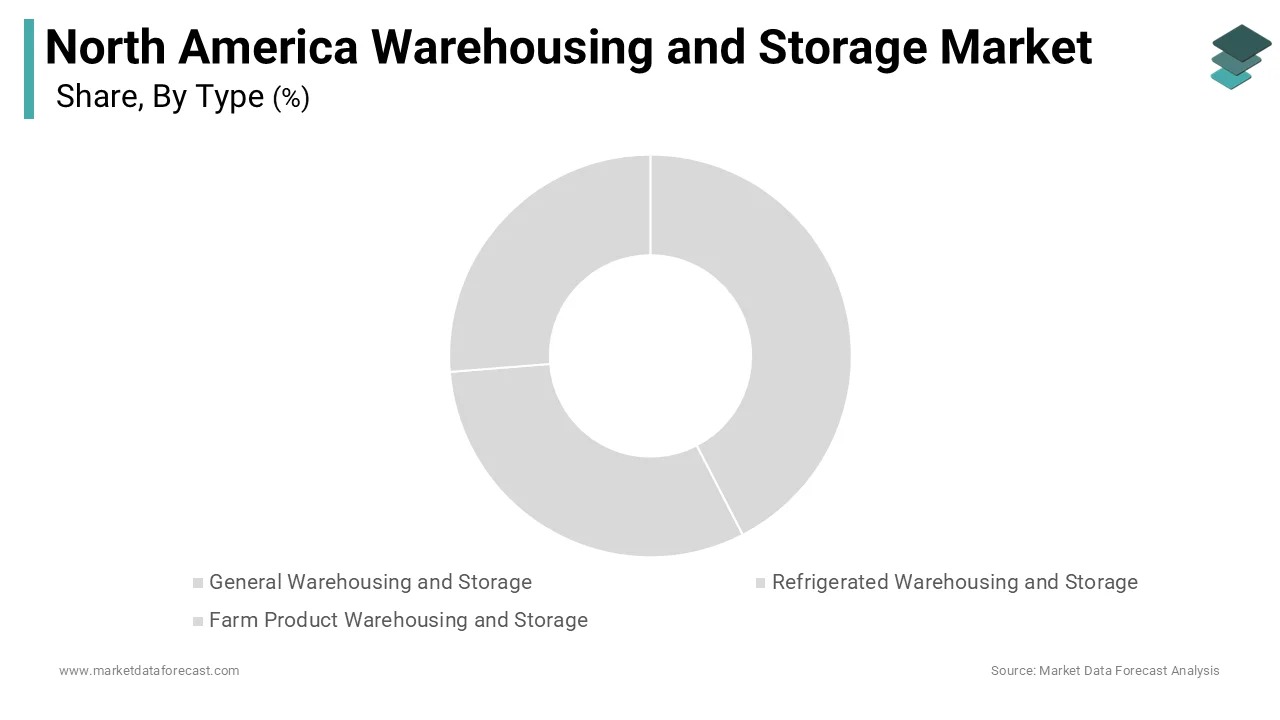
The general warehousing and storage segment accounted in holding a prominent share of the North America warehousing and storage market in 2025. The proliferation of online retail has directly fueled demand for general-purpose warehouse space optimized for rapid order processing and last-mile dispatch. This shift has led to the construction of high-throughput, automated distribution centers, particularly in logistics corridors such as the Inland Empire, Atlanta, and Central Pennsylvania. Additionally, third-party logistics (3PL) providers have expanded their general warehousing portfolios, with Prologis reporting that 76% of its new developments in 2022 were dedicated to e-commerce fulfillment. The average size of new general warehouses has decreased to 150,000 square feet, reflecting a strategic pivot toward urban proximity rather than rural scale, as noted by CBRE Group, Inc. This decentralization of inventory necessitates a larger number of general storage units closer to consumers, which is reinforcing the segment’s dominance. The integration of robotics and warehouse management systems in these facilities further enhances their operational appeal by making general warehousing the default infrastructure for modern retail logistics.
The Refrigerated Warehousing and Storage segment is growing lucratively with an expected CAGR of 9.4% from 2025 to 2033. Consumers are increasingly purchasing fresh and frozen groceries online, necessitating a parallel expansion in cold storage infrastructure. In 2023, U.S. online grocery sales reached $147 billion, with perishable items accounting for 78% of transactions, according to the Food Marketing Institute. This shift has prompted retailers like Walmart, Kroger, and Instacart to invest in refrigerated fulfillment centers capable of maintaining precise temperature zones for dairy, meat, and produce. The need for urban cold storage is particularly acute, with last-mile refrigerated lockers and micro-fulfillment units becoming common in cities like Toronto and Chicago.
By Ownership Insights
The private segment accounted in holding 54.3% of the North America warehousing and storage market share in 2025. Large corporations are increasingly insourcing logistics to maintain end-to-end control over their supply chains, reducing dependency on third parties. In 2023, Amazon operated over 400 million square feet of private warehouse space across North America, more than any single 3PL provider, according to company filings with the Securities and Exchange Commission. This vertical integration allows Amazon to synchronize inventory flow with its e-commerce platform, enabling same-day delivery in 40 metropolitan areas
The Public Warehouses segment is projected to expand at a CAGR of 8.7% from 2025 to 2033.
SMEs, which constitute over 99% of U.S. businesses is lack the capital to build or lease large private facilities by making public warehouses a cost-effective alternative. According to the U.S. Small Business Administration, over 60% of SMEs in retail and manufacturing now outsource their warehousing needs, up from 42% in 2020. Public warehouses allow these firms to scale storage capacity based on seasonal demand, avoiding long-term lease commitments. The average lease term in public warehouses is 18 months, compared to 7 years for private facilities, as reported by JLL. Public warehouse operators like XPO Logistics and Ryder System have responded by offering modular, pay-per-use storage models, enabling clients to access advanced WMS and transportation networks without upfront investment.
By End-User Industry Insights
The consumer goods sector was the largest and held 37.4% of the North America warehousing and storage market share in 2025. Retailers must now manage inventory across physical stores, e-commerce platforms, and direct-to-consumer channels, increasing storage requirements. Companies like Target and Best Buy have adopted ship-from-store models, requiring warehouses to maintain higher safety stocks to support both in-store availability and online fulfillment. The average retailer now operates three times as many stock-keeping units (SKUs) as in 2015, according to the National Retail Federation, necessitating larger and more segmented storage space. Additionally, fast fashion and electronics brands face short product lifecycles, requiring agile warehousing to manage rapid turnover. Zara, for example, restocks stores twice weekly, relying on highly automated warehouses in California and New Jersey to maintain speed, as noted in internal logistics audits. The need for inventory visibility across channels has also driven investment in warehouse management systems, with 80% of major retailers now using real-time tracking, as per McKinsey & Company.
The Food and Beverage sector segment is expected to grow with a CAGR of 9.1% from 2025 to 2033.
The rise of convenience foods, meal kits, and ghost kitchens has increased the need for specialized storage and rapid distribution. In 2023, U.S. consumers spent $136 billion on prepared meals, a 42% increase from 2020, according to the Food Marketing Institute. Companies like HelloFresh and Blue Apron require temperature-controlled warehousing to store perishable ingredients before assembly and delivery. The average meal kit warehouse handles over 10,000 SKUs of fresh produce, proteins, and sauces, requiring advanced WMS and quality control systems.
COUNTRY-LEVEL ANALYSIS
United States Warehousing and Storage Market Insights
United States was the top performer in the North American warehousing and storage market by occupying 89.3% of share in 2025. The country’s vast geographic size, advanced transportation infrastructure, and status as the world’s second-largest economy create an unparalleled demand for logistics real estate. The U.S. also leads in technological adoption, with over 40% of large warehouses utilizing robotics and AI-driven systems, as per the Material Handling Institute. The rise of e-commerce, nearshoring from Mexico, and federal infrastructure investments under the Bipartisan Infrastructure Law are further accelerating warehouse development.
Canada Warehousing and Storage Market Insights
Canada was ranked second with 11.2% of the North America warehousing and storage market share in 2025. Canada’s warehousing sector is characterized by high efficiency and strategic integration with U.S. supply chains. The Greater Toronto Area, Montreal, and Vancouver serve as primary logistics gateways, with cross-border trade accounting for over 75% of Canada’s warehousing activity, as reported by the Canadian Chamber of Commerce. The country has seen a 9.3% annual increase in industrial real estate absorption since 2021, driven by e-commerce growth and nearshoring trends, according to JLL Canada. However, land scarcity in urban centers and stringent environmental regulations in provinces like British Columbia and Quebec constrain expansion. To address this, operators are adopting vertical warehousing and retrofitting older facilities. Canada’s commitment to decarbonization, with a federal carbon price rising to CAD 170 per ton by 2030, as outlined by Environment and Climate Change Canada, is also pushing investment in energy-efficient logistics infrastructure.
KEY MARKET PLAYERS
Companies playing a prominent role in the North America warehousing and storage market are
- XPO Logistics, Inc.,
- Ryder System, Inc.,
- FedEx Corp,
- DHL International GmbH,
- NFI Industries, Inc.
TOP LEADING PLAYERS IN THE MARKET
Prologis, Inc.
Prologis stands as a top player in the North American warehousing landscape, recognized for its vast portfolio of logistics real estate and forward-thinking approach to supply chain infrastructure. The company specializes in developing, owning, and operating high-tech distribution facilities strategically located near major transportation hubs and urban centers. Prologis integrates sustainability into its core operations, constructing energy-efficient warehouses with solar installations and smart building technologies. Its client-centric model emphasizes long-term partnerships with global e-commerce, retail, and manufacturing firms, enabling seamless scalability and operational resilience.
Lineage Logistics
Lineage Logistics has emerged as a leader in temperature-controlled warehousing, transforming the cold chain logistics sector with its highly automated and technologically advanced facilities. The company operates an extensive network of refrigerated warehouses across North America, serving food producers, retailers, and pharmaceutical companies. Lineage differentiates itself through deep expertise in cold chain integrity, precision inventory management, and sustainable refrigeration technologies. Its commitment to automation and digital visibility has redefined efficiency in perishable goods handling. Through strategic acquisitions and greenfield developments, Lineage has built a cohesive, scalable infrastructure that supports complex supply chains. Its operational excellence and focus on innovation have made it a preferred partner for global clients requiring reliable, compliant, and future-ready cold storage solutions.
Ryder System, Inc.
Ryder System plays a pivotal role in integrated logistics, offering a comprehensive suite of warehousing, transportation, and supply chain management services. The company operates a vast network of public and dedicated distribution centers, supporting clients across diverse industries including retail, automotive, and healthcare. Ryder’s strength lies in its ability to combine physical infrastructure with advanced logistics technology, providing end-to-end visibility and flexibility. Its focus on scalable, outsourced logistics solutions enables businesses to adapt quickly to market fluctuations.
TOP STRATEGIES USED BY KEY MARKET PARTICIPANTS
One major strategy employed by leading players is the integration of automation and digital technologies into warehouse operations. Companies are deploying robotics, artificial intelligence, and cloud-based warehouse management systems to enhance efficiency, accuracy, and scalability. These technologies enable real-time inventory tracking, predictive analytics, and optimized labor utilization, allowing firms to meet rising customer expectations for speed and reliability.
Another key approach is strategic geographic expansion into high-demand logistics corridors. Firms are prioritizing locations near urban centers, intermodal terminals, and cross-border trade routes to support last-mile delivery and supply chain resilience. Establishing facilities in proximity to end markets reduces transit times and transportation costs while improving responsiveness.
COMPETITION OVERVIEW
The competitive landscape of the North America warehousing and storage market is characterized by a dynamic interplay between large-scale real estate developers, specialized logistics operators, and integrated supply chain providers. Incumbent leaders maintain strong positions through extensive networks, technological sophistication, and long-term client relationships, while emerging players leverage niche expertise in automation, cold chain, or regional logistics to gain traction. The market is witnessing a shift from pure storage provision to value-added services, including inventory optimization, cross-docking, and omnichannel fulfillment support. Differentiation increasingly hinges on operational agility, sustainability credentials, and digital integration rather than just square footage availability. Companies are under pressure to innovate continuously, as clients demand faster turnaround, greater transparency, and resilient infrastructure amid supply chain volatility. Strategic partnerships, vertical integration, and customer-centric design are becoming essential to retain market relevance.
RECENT MARKET DEVELOPMENTS
- In March 2023, Prologis acquired a portfolio of logistics facilities in the Inland Empire region, enhancing its presence in one of the busiest freight corridors in the United States. This move strengthened its ability to serve e-commerce and retail clients requiring rapid distribution to major urban markets.
- In June 2023, Lineage Logistics launched a new automated cold storage facility in Atlanta, integrating robotic pallet handling and AI-driven inventory systems. The development reinforced its leadership in temperature-controlled warehousing and expanded capacity for food and pharmaceutical clients.
- In September 2023, Ryder System expanded its dedicated contract logistics network by opening a technologically advanced distribution center in Central Pennsylvania. The facility supports omnichannel fulfillment and strengthens Ryder’s service offering for retail and consumer goods companies.
- In January 2025, Prologis partnered with a clean energy firm to install solar panel arrays across 50 of its warehouse properties in California and Texas. This initiative advanced its sustainability goals and attracted environmentally focused tenants.
- In May 2025, Lineage Logistics announced the integration of a proprietary digital platform across its North American network, enabling real-time temperature monitoring, predictive maintenance, and enhanced client visibility into cold chain operations.
MARKET SEGMENTATION
This research on the North America warehousing and storage market has been segmented and sub-segmented into the following.
By Type
- General Warehousing and Storage
- Refrigerated Warehousing and Storage
- Farm Product Warehousing and Storage
By Ownership
- Private Warehouses
- Public Warehouses
- Bonded Warehouses
By End-user Industry
- Manufacturing
- Consumer Goods
- Food and Beverage
- Retail
- Healthcare
- Other End-user Industries
By Country
- The U.S.
- Canada
- Rest of North America