- Product Description Description
- Table of Contents TOC
- List of Table & Figure LOT
- Get Free Sample PDF Sample PDF
Market Size, 2025
$8.28 BnMarket Estimate, 2026
$9.68 BnMarket Forecast, 2034
$33.73 BnCAGR, 2026–2034
16.89%Global Single Cell Genomics Market Size
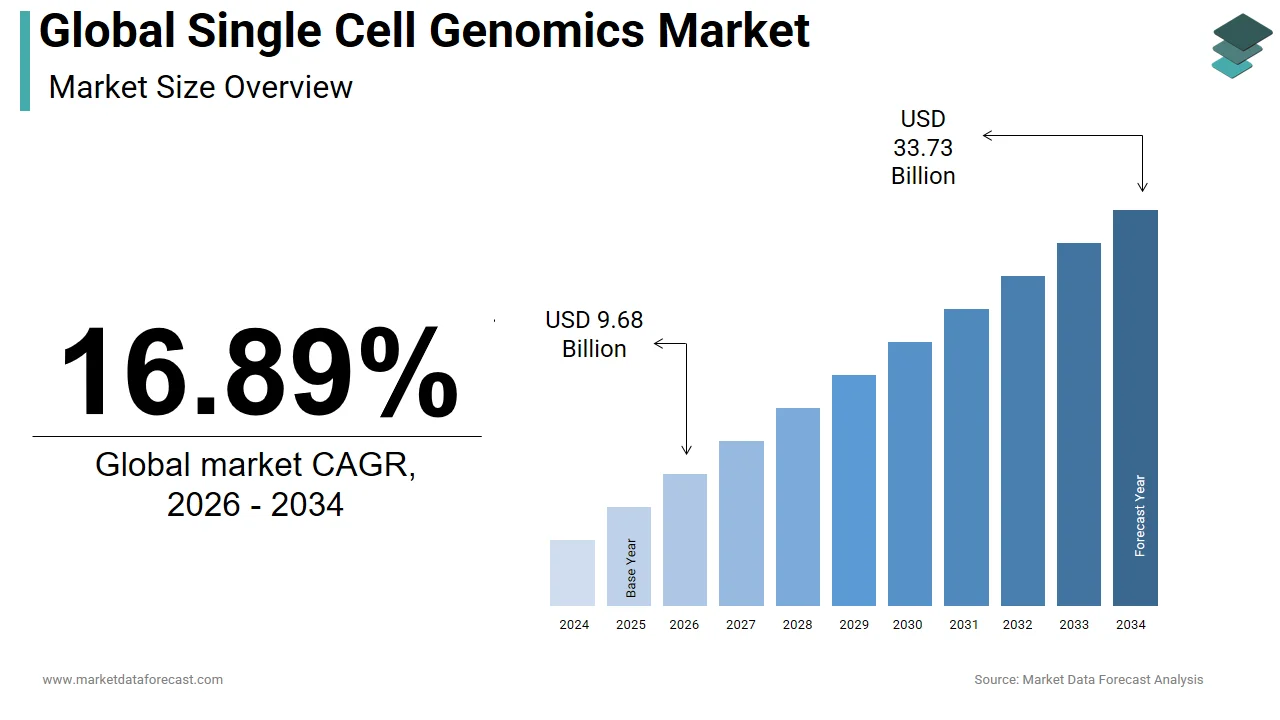
The size of the global single cell genomics market was worth USD 8.28 billion in 2025. The market is anticipated to grow at a CAGR of 16.89% from 2026 to 2034, reaching USD 33.73 billion by 2034, up from USD 9.68 billion in 2026.
Single-cell genomics is a method for studying a variety of cells and discovering new molecular traits linked to clinical outcomes. This technique allows for identifying the complexity of cell diversity in a sample without the data loss that occurs when analyzing multicellular or bulk tissue samples.
MARKET DRIVERS
Due to new emerging techniques in which genomic technologies are applied at the single-cell level rather than to all cells collectively, the market for single-cell genomics is growing rapidly.
By distinguishing the contributions of single cells to the diversity of ecosystems and species, single-cell genomic technologies are breaking new ground. Single-cell genomics also provides new insights into a variety of biological systems, ranging from the richness of microbial ecosystems to human cancer genetics. Furthermore, single-cell genome sequencing technology provides cell-specific genetic information unavailable through typical genome sequencing methods.
The rise in pharmaceutical and biotechnology R&D expenses and increased funding for proteomics by various governments are further promoting the growth rate of the single-cell genomics market.
Other significant factors driving the single-cell genomics and proteomics market include the development of new protocols and reagents used for downstream evaluation to maximize DNA / RNA distortion from single cells and technological advancement. Furthermore, an increase in market development efforts and technological developments, and modernization in healthcare procedures would generate additional opportunities for the single-cell genomics and proteomics market in the anticipated period. Furthermore, the market for single-cell genomics will eventually grow due to the introduction of new platforms that streamline arduous approaches with limited throughput.
MARKET RESTRAINTS
The high cost of proteomics instruments and a scarcity of competent and educated personnel are two key restrictions on the growth of the single-cell genomics market in the forecast period. In addition, the ability to examine a single DNA molecule from single isolated cells is possible with single-cell genomics; however, the technique is technically challenging. Furthermore, there are numerous reimbursement problems associated with single-cell genome sequencing methods in genetics. In addition, several regulatory limitations connected with the development of single-cell genome sequencing technology are projected to limit further the entry of new firms, which is also expected to restrict the market growth.
REPORT COVERAGE
| REPORT METRIC | DETAILS |
| Market Size Available | 2025 to 2034 |
| Base Year | 2025 |
| Forecast Period | 2026 to 2034 |
| Segments Covered | By Product, Application, End-User & Region. |
| Various Analyses Covered | Global, Regional and Country-Level Analysis, Segment-Level Analysis, Drivers, Restraints, Opportunities, Challenges; PESTLE Analysis; Porter’s Five Forces Analysis, Competitive Landscape, Analyst Overview of Investment Opportunities |
| Regions Covered | North America, Europe, Asia Pacific, Latin America, Middle East & Africa |
| Market Leaders Profiled | 10x Genomics, Inc., Novogene Corporation, Illumina Inc., Bio-Rad Laboratories Inc., Thermo Fisher Scientific Inc., Becton Dickinson and Company, QIAGEN NV, Fluidigm Corporation, BGI, and Merck Millipore |
SEGMENTAL ANALYSIS
By Product Insights
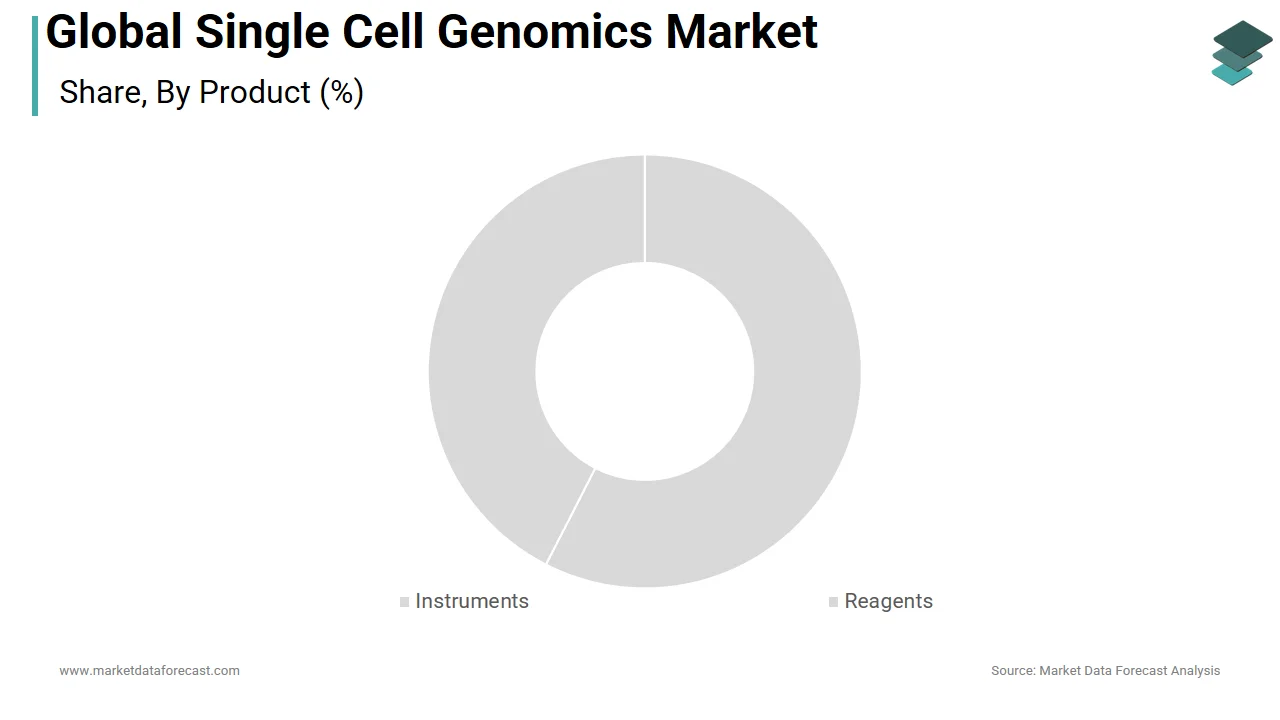
Based on the product, the instruments segment is expected to hold the largest market share throughout the forecast period, owing to the high availability of single-cell sequencing kits.
By Technology Insights
The NGS segment dominated the single-cell genomics market in 2022. It is expected to continue its supremacy. Over the last few years, the introduction of next-generation sequencing (NGS) has helped the sector acquire enormous traction. The rapid development of single-cell sequencing methods such as single-cell whole-genome sequencing, single-cell whole-exome sequencing, single-cell whole-transcriptome sequencing, and single-cell epigenetic sequencing has been accelerated by recent advancements in Next Generation Sequencing (NGS) technology, which has had a positive impact on the single genome sequencing market.
By Application Insights
Circulating cells dominated the market in terms of revenue in 2022. Due to their enormous potential in identifying and treating cancer, circulating tumor cells (CTCs) have gained much momentum among oncologists. The availability of CTCs in limited volumes is a significant constraint linked with its isolation. As a result, numerous approaches, such as single-cell sequencing, have been created and continually improved to improve CTC isolation effectiveness. Furthermore, the importance of CTCs in the diagnosis of the most common types of malignancies, such as breast cancer, lung cancer, prostate cancer, and colorectal cancer, is accelerating market growth.
By End-User Insights
The single-cell genomics market was dominated by the clinical research institutes segment based on the end-user. The growth of this end-user segment is being fueled by factors such as increased funding for life science research and an increase in the number of medical institutions and universities.
REGIONAL ANALYSIS
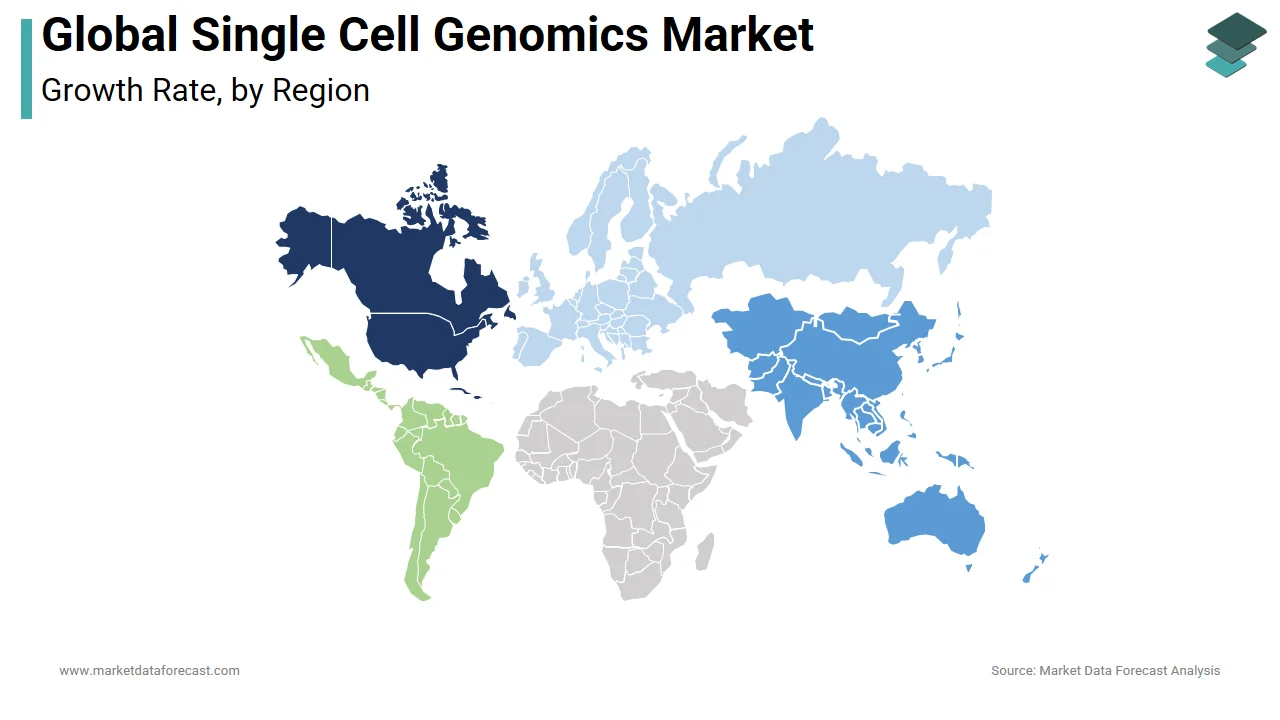
Because of the advancing biopharmaceutical, biotechnology, and genomics fields in this region and the adoption of genomic platforms and high-content screening technology by research laboratories in North American countries, North America is the leading region in the single-cell genomics market. The single-cell genomics market has also been boosted by increased awareness about single-cell genomics. In North America, the United States dominates the single-cell genomics market.
By 2027, Europe is predicted to be the second-largest in the global market. With the emergence of innovative technologies for genomics investigations, there has been an increase in demand in the region for effective goods and solutions for accurate whole genome sequencing.
Due to high unmet needs, growing public awareness, improving healthcare infrastructure, the presence of a large population base affected by infectious diseases and chronic disorders, lower costs of products and tests, and increased investment by major companies in developing countries, the Asia Pacific region is expected to grow at the fastest rate.
KEY MARKET PLAYERS
Some of the companies that are playing a dominating role in the global silicon carbide market include
- 10x Genomics, Inc.
- Novogene Corporation
- Illumina Inc.
- Bio-Rad Laboratories Inc.
- Thermo Fisher Scientific Inc.
- Becton Dickinson and Company
- QIAGEN NV
- Fluidigm Corporation
- BGI
- Merck Millipore
GLOBAL SINGLE-CELL GENOMICS MARKET NEWS
- The CytoFLEX SRT Benchtop Cell Sorter from Beckman Coulter Life Sciences is available from 2021.
- Mission Bio and Agilent Technologies have agreed to collaborate on marketing the Tapestri Platform for Single-Cell Multiomics in 2020.
MARKET SEGMENTATION
This research report on the global single-cell genomics market has been segmented and sub-segmented based on product, application, end-user, and region.
By Product
- Instruments
- Reagents
By Technology
- NGS
- PCR
- qPCR
- Microarray
- MDA
By Application
- Genomic Variation
- Subpopulation Characterization
- Circulating Tumor Cells
- Cell Differentiation / Reprogramming, Method
By End-User
- Academic institutes
- Biopharmaceutical companies
- Clinical research institutes
By Region:
- North America
- Europe
- Asia-Pacific
- Latin America
- Middle East and Africa