- Product Description Description
- Table of Contents TOC
- List of Table & Figure LOT
- Get Free Sample PDF Sample PDF
Market Size, 2025
$7.93 BnMarket Estimate, 2026
$8.65 BnMarket Forecast, 2034
$17.46 BnCAGR, 2026–2034
9.17%Global Smart Camera Market Report: Size, Share, Trends & Forecast (2026–2034)
- Market Scope: Comprehensive global smart camera industry analysis covering product types, connectivity options, application verticals, user industries, sensor and scanning technologies, and regional market distribution.
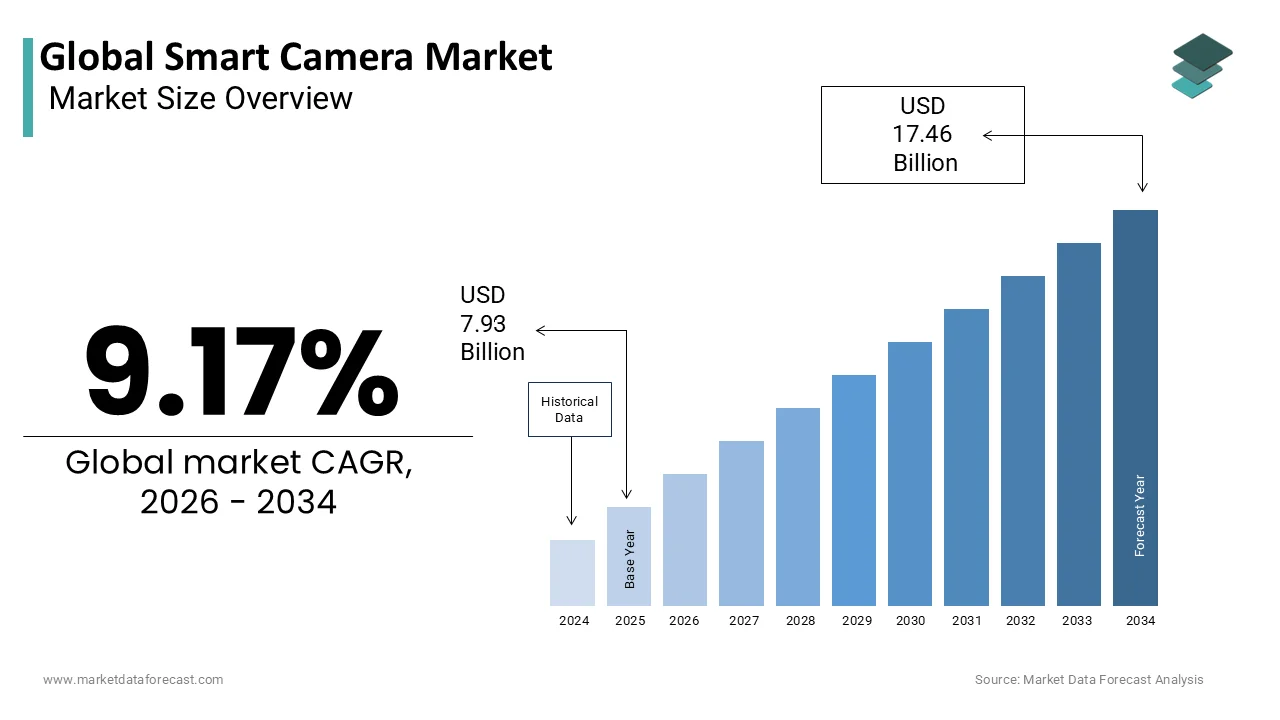
- Market Valuation: Valued at USD 7.93 billion in 2025, estimated at USD 8.65 billion in 2026, and projected to reach USD 17.46 billion by 2034, registering a robust CAGR of 9.17% from 2026 to 2034.
- Primary Growth Drivers: Expanding industrial applications for machine vision systems, rising deployment of security and surveillance in public spaces, technological breakthroughs in embedded design, smart lenses, and image sensors, and consumer demand for advanced smartphone-like digital camera features.
Key Smart Camera Market Segment Metrics (2026–2034)
| Category | Leading Segment (2025 Position) | Fastest-Growing Segment |
|---|---|---|
| By Product Type | Embedded and Standalone smart camera systems (widespread machine vision adoption) | Single-chip and advanced embedded smart camera platforms |
| By Application | Security & Surveillance (leading application vertical across public and commercial spaces) | Robotics, Medical, and Automated Industrial Inspection |
| By Sensor Technology | CMOS Sensors (dominant due to high performance and efficiency) | High-resolution specialized sensor architectures |
| By Region | Asia-Pacific (dominated with 32.7% global market share, driven by regional manufacturing hubs) | Latin America (projected to witness the highest regional market growth) |
Major Smart Camera Companies & Competitive Landscape
Market Structure: Highly competitive global electronics and vision systems landscape featuring major multinational tech conglomerates and specialized imaging pioneers competing intensely on intelligent edge processing, open-source Android OS integration, cloud connectivity, interchangeable lenses, and advanced sensor innovations (such as 600MP sensors).
Key Companies: Samsung Electronics Co. Ltd., Sony Corporation, Bosch Security Systems, Inc., Canon Inc., Nikon Corporation, Flir Systems, Inc., Panasonic Corporation, Raptor Photonics Ltd., Olympus Corporation, Polaroid Corporation, Watec Cameras Inc., IntelliVision, VIVOTEK Inc., VMukti Solutions Pvt. Ltd., Axis Communications AB, Zmodo, and Vivint, Inc.
Global Smart Camera Market Size
The size of the global smart camera market was worth USD 7.93 billion in 2025. The global market is anticipated to grow at a CAGR of 9.17% from 2026 to 2034 and be worth USD 17.46 billion by 2034 from USD 8.65 billion in 2026.
MARKET SCENARIO
Smart cameras, also known as intelligent cameras, are machine vision systems that can extract application-specific information from a captured image and generate an event description or make a decision that is employed in intelligent & automated systems. Smart cameras are trending nowadays because of the built-in functionalities that they offer to the user like LTE, accessibility with an open-source Android operating system for users, professional properties with interchangeable lenses, and various network services that can be distinct from telecommunication providers.
MARKET DRIVERS
The growing usage of smart cameras in various industries is primarily driving the global market growth.
The growth of the global smart cameras market is further driven by the growing number of applications of smart cameras for security & surveillance and an increasing number of technological developments in quality imaging and getting improved. Also, demands for digital cameras with extra features from consumers, which can resemble smartphones, are the other major factors that are fuelling the growth of the smart cameras market over the forecast period. Furthermore, intensifying norms by various governments around the world, for setting up security & surveillance systems in public places are boosting the adoption of these smart cameras. Nonetheless, developments and transformation of embedded system designs, smart lenses, & image sensors are creating lucrative growth opportunities for the expansion of the Global Smart Camera Market among key players.
MARKET RESTRAINTS
However, factors such as the growing adoption of smartphones that have better camera quality, the absence of standardization for the installation of these smart cameras, and the high costs that are involved in the business of these smart cameras are hampering the adoption of these smart cameras and turning into challenges of the target market globally.
REPORT COVERAGE
| REPORT METRIC | DETAILS |
| Market Size Available | 2025 to 2034 |
| Base Year | 2025 |
| Forecast Period | 2026 to 2034 |
| Segments Covered | By Product Type, Connectivity Type, Application, Vertical, Technology and Region |
| Various Analyses Covered | Global, Regional & Country Level Analysis, Segment-Level Analysis, DROC, PESTLE Analysis, Porter’s Five Forces Analysis, Competitive Landscape, Analyst Overview of Investment Opportunities |
| Regions Covered | North America, Europe, APAC, Latin America, Middle East & Africa |
| Market Leaders Profiled | Samsung Electronics Co. Ltd. (South Korea), Sony Corporation (Japan), Bosch Security Systems, Inc. (Germany), Canon Inc. (Japan), Nikon Corporation (Japan), Flir Systems, Inc. (U.S.), Panasonic Corporation (Japan), Raptor Photonics Ltd. (U.K.), Olympus Corporation (Japan), Polaroid Corporation (U.S.), Watec Cameras Inc. (Japan), IntelliVision (U.S.), VIVOTEK Inc. (Taiwan), VMukti Solutions Pvt. Ltd. (India), Axis Communications AB (Sweden), Zmodo (U.S.), and Vivint, Inc. (U.S.). |
REGIONAL ANALYSIS
In 2023, Asia-Pacific was the major region in the global market, accounting for 32.7% of the global market share.
The technological advancements in these smart cameras, majorly for the security & surveillance in the Asia-Pacific region, are the significant driver for the growth of the target market in this locale. In addition, the Asia-Pacific region is emerging as a manufacturing hub of these smart cameras, which is fuelling the revenue of the Smart Camera Market, in this locale. The key application verticals of these smart cameras of Asia-Pacific are the public spaces, military & defense, and transit facilities, which are also estimated to register rapid development over the prediction period. And the major contributors of the Asia-Pacific regional smart camera market are the regional markets in China, Japan, and South Korea. It is also expected that this regional market in the Asia-Pacific region is going to continue its dominance over the projection period, too, when compared to other regional markets around the world.
The Latin America regional smart camera market is anticipated to witness the highest growth during the evaluated period. It is the second-largest regional market, worldwide, with a share of around 31.7%. The major driving factors for the growth of the target market in this area are the growing concern regarding safety & security and the rapid growth of the bio-metric market in Latin America.
KEY PLAYERS IN THE GLOBAL SMART CAMERA MARKET
The key players of the global smart camera market include Samsung Electronics Co. Ltd. (South Korea), Sony Corporation (Japan), Bosch Security Systems, Inc. (Germany), Canon Inc. (Japan), Nikon Corporation (Japan), Flir Systems, Inc. (U.S.), Panasonic Corporation (Japan), Raptor Photonics Ltd. (U.K.), Olympus Corporation (Japan), Polaroid Corporation (U.S.), Watec Cameras Inc. (Japan), IntelliVision (U.S.), VIVOTEK Inc. (Taiwan), VMukti Solutions Pvt. Ltd. (India), Axis Communications AB (Sweden), Zmodo (U.S.), and Vivint, Inc. (U.S.).
RECENT HAPPENINGS IN THE GLOBAL SMART CAMERA MARKET
- Bosch Security Systems Inc., one of the key players in the smart camera market, has announced that they are going to launch INTEOX, which is a new camera platform designed to modernize security and safety and provide more comfort to its users, system integrators, and application developers in terms of innovation & personalization.
- Samsung, a Korean technology company and a major security camera developer, announced that it is developing an image sensor that might work better than a human eye with a resolution of 600MP other types of sensors that can register smells or tastes.
MARKET SEGMENTATION
This research report on the global smart camera market has been segmented and sub-segmented based on the product type, connectivity type, application, vertical, sensor technology, scanning technology, and region.
By Product Type
- Standalone
- Single-Chip
- Embedded
By Connectivity
- Wi-Fi
- Bluetooth
- Wireless HART
- Others
By Application
- Robotics
- Automobile
- Security
- Medical
- Consumer Electronics
- Industrial
- Others
By Vertical
- Public Spaces
- Military & Defence
- Transit Facilities
- Commercial Facilities
- Enterprise & Government Infrastructure
- Residential Infrastructure
By Sensor Technology
- CMOS
- CCD
By Scanning Technology
- Area Scan
- Line Scan
By Region
- North America
- Europe
- Asia-Pacific
- Latin America
- Middle East and Africa