- Product Description Description
- Table of Contents TOC
- List of Table & Figure LOT
- Get Free Sample PDF Sample PDF
Market Size, 2025
$2.69 BnMarket Estimate, 2026
$3 BnMarket Forecast, 2034
$7.21 BnCAGR, 2026–2034
11.57%Europe Neuroprosthetics Market Report Summary
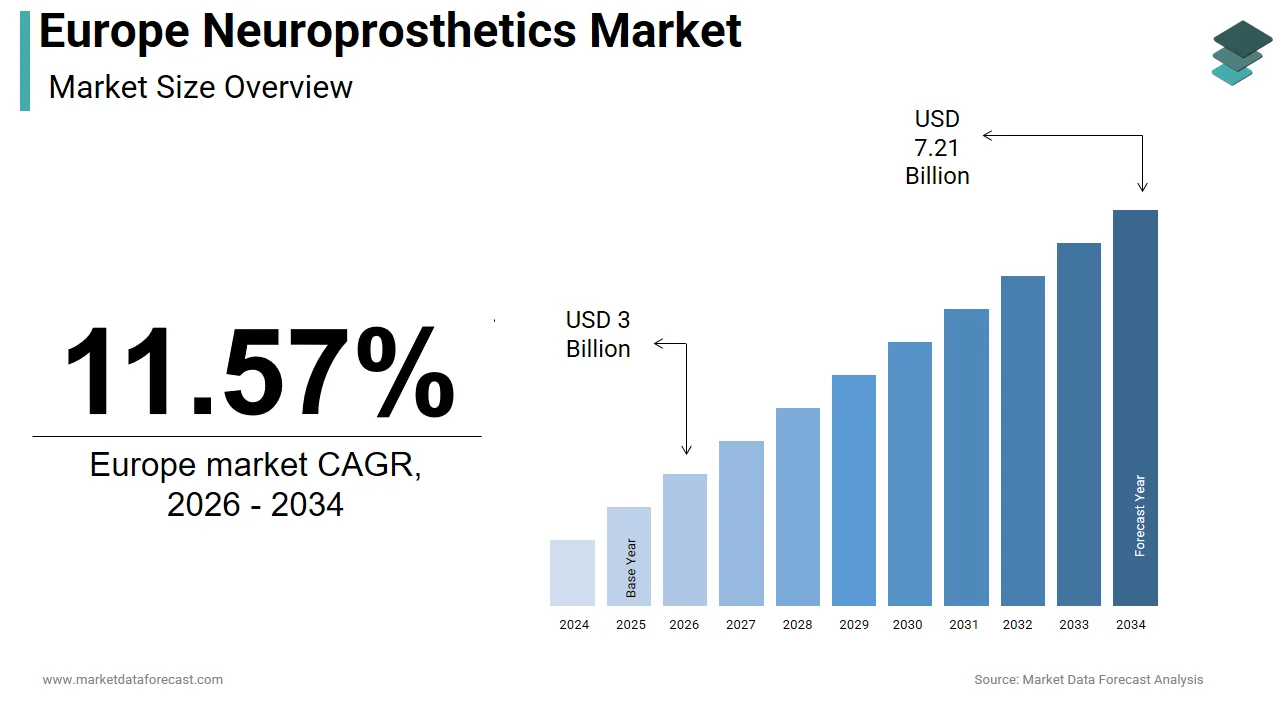
The Europe neuroprosthetics market was valued at USD 2.69 billion in 2025, is anticipated to reach USD 3 billion in 2026, and is projected to reach USD 7.21 billion by 2034, growing at a strong CAGR of 11.57% from 2026 to 2034. Market growth is driven by the rising prevalence of neurological disorders, increasing adoption of implantable medical devices, and continuous advancements in neural interface technologies. Healthcare providers across Europe are leveraging neuroprosthetic systems to restore sensory, motor, and cognitive functions in patients affected by hearing loss, Parkinson’s disease, epilepsy, and paralysis. Expanding investments in neurotechnology research, favorable reimbursement policies, and improved surgical techniques are further supporting market expansion.
Key Market Trends
- Rising adoption of implantable and wearable neuroprosthetic devices for neurological rehabilitation.
- Increasing demand for deep-brain stimulation (DBS) and cochlear implants.
- Growing focus on brain–computer interface (BCI) research and neural modulation therapies.
- Expansion of minimally invasive neurosurgical procedures.
- Strengthening emphasis on personalized neurorehabilitation and digital health integration.
Segmental Insights
- Based on type, the auditory prosthetics segment dominated the market in 2025 by accounting for 42.4% market share, driven by the high prevalence of hearing impairment and widespread adoption of cochlear implants.
- Based on technology, the deep brain stimulation segment led the market by capturing 38.7% share in 2025, supported by its proven effectiveness in treating Parkinson’s disease, dystonia, and essential tremors.
- Based on application, the physiological disorders segment held the majority share of 58.3% in 2025, driven by increasing cases of neurodegenerative diseases, spinal cord injuries, and movement disorders.
Regional Insights
The Europe neuroprosthetics market is witnessing strong growth across major economies, supported by advanced healthcare infrastructure, strong clinical research ecosystems, and rising investments in neuroscience.
- Germany accounted for the largest share in 2025, driven by strong hospital networks, high adoption of implantable devices, and robust medical device manufacturing capabilities.
- The United Kingdom is expected to witness rapid growth over the forecast period, supported by strong academic research, government-backed innovation programs, and expanding neurology care services.
Competitive Landscape
The Europe neuroprosthetics market is characterized by strong competition among global medical device manufacturers and specialized neurotechnology firms. Market players are focusing on developing next-generation implants, improving device miniaturization, and enhancing long-term safety and performance. Strategic collaborations with research institutions, investments in clinical trials, and expansion of product portfolios are shaping competitive dynamics across the region.
Prominent companies operating in the Europe neuroprosthetics market include Cochlear Ltd., Boston Scientific Corporation, Cyberonics Inc., Medtronic plc, NDI Medical LLC, NeuroPace Inc., St. Jude Medical, Nervo Corp., Retina Implant AG, Biomet Inc., and Sonova.
Europe Neuroprosthetics Market Size
The size of the Europe neuroprosthetics market was valued at USD 2.69 billion in 2025. This market is expected to grow at a CAGR of 11.57% from 2026 to 2034 and be worth USD 7.21 billion by 2034 from USD 3 billion in 2026.
Neuroprosthetics is a multidisciplinary field at the intersection of neuroscience and biomedical engineering that develops artificial devices to replace or enhance the function of an impaired nervous system. In Europe, these technologies include cochlear implants, deep brain stimulators, retinal prostheses, spinal cord stimulators, and emerging brain computer interfaces designed for conditions such as Parkinson’s disease, sensorineural hearing loss, epilepsy, and paralysis. The market operates under the stringent oversight of the European Union Medical Device Regulation 2017/745, which classifies most neuroprosthetics as Class III implants requiring robust clinical evidence and post-market surveillance. According to the European Brain Council, a significant portion of the European population suffers from a neurological or mental disorder, with the prevalence of these conditions increasing alongside the aging demographic. Data from Eurostat indicates that over one-fifth of the European Union population is aged 65 or older, representing a demographic cohort that faces a disproportionately high risk of developing neurodegenerative conditions. The World Health Organization reports that stroke remains a leading cause of death and disability in the European region, with the total number of affected individuals increasing due to the combined impact of aging populations and increased survival rates. These epidemiological realities create a sustained clinical imperative for neuromodulation solutions. Despite adoption barriers like cost and complexity, neuroprosthetics are a crucial frontier in European precision medicine and rehabilitation.
MARKET DRIVERS
Rising Prevalence of Neurodegenerative and Age-Related Neurological Disorders
The escalating burden of neurodegenerative diseases, driven by the region’s aging population, is a primary driver of the Europe neuroprosthetics market. Europe is experiencing a significant rise in the proportion of older citizens, which is substantially expanding the population eligible for age-related chronic disease treatments, including neurostimulation therapies. Parkinson’s disease remains a major, widespread neurodegenerative condition in Europe, creating sustained demand for advanced treatment interventions like deep brain stimulation, which are proven to drastically reduce, rather than completely cure, motor symptoms in advanced cases. Similarly, as the European population ages, there is an increased, lasting demand for advanced hearing rehabilitation devices, specifically cochlear implants, which successfully restore functional hearing for severe to profound, age-related hearing loss. A high, consistent incidence of new strokes annually across Europe produces a large number of survivors suffering from chronic, long-term paralysis, driving the urgent need for advanced brain-computer interfaces and neuroprosthetic rehabilitation technologies. National health systems are increasingly approving broader reimbursement for neuroprosthetic devices in treating chronic, intractable pain, because they are recognized as long-term, cost-effective interventions that reduce reliance on long-term opioid use and decrease hospital readmissions. This convergence of demographic pressure, clinical efficacy, and health economic validation anchors growing investment in neuroprosthetic solutions across Europe.
Advancements in Minimally Invasive Implantation and Neural Interface Technologies
Technological refinements enabling safer, less invasive neuroprosthetic procedures are accelerating clinical adoption across the region, which is among the key accelerators of the Europe neuroprosthetics market. Next-generation devices feature smaller form factors, wireless power transfer, and closed-loop systems that adjust stimulation in real time based on neural feedback. Medtronic received European approval for its latest rechargeable deep brain stimulation system featuring advanced BrainSense technology, which enables clinicians to record brain signals and deliver personalized, adaptive therapy to improve symptom management for neurological disorders. Similarly, cochlear implants now utilize soft surgical techniques that preserve residual hearing, enabling hybrid electro-acoustic stimulation. Recent advancements in minimally invasive, wireless retinal prosthetic technology are improving surgical efficiency and safety profiles in clinical trials, offering potential for improved vision restoration in patients with degenerative eye diseases. These advances reduce surgical risk, hospital stays, and recovery time, making neuroprosthetics viable for older and comorbid patients previously deemed ineligible. Collaborations between training programs in interventional neurology/neurosurgery and the European Board of Neurosurgery are reducing procedural barriers, thereby increasing access to restorative neuromodulation for a wider patient population.
MARKET RESTRAINTS
Stringent Regulatory Requirements and Lengthy Clinical Validation Processes
The rigorous regulatory pathway under the EU Medical Device Regulation 2017/745 significantly delays market entry and increases development costs for neuroprosthetic manufacturers. This, in turn, hampers the growth of the Europe neuroprosthetics market. Classified as Class III implants, these devices require comprehensive clinical investigations demonstrating both safety and performance over extended periods. European regulatory bodies indicate that securing market approval for high-risk, innovative neuroprosthetics involves lengthy assessment processes compared to lower-risk devices. Furthermore, notified bodies now demand extensive, long-term post-market monitoring for implants targeting the central nervous system, with a particular focus on ensuring long-term biocompatibility and safety of electrode-tissue interactions. These hurdles disproportionately affect small innovators who lack resources for large-scale trials. Consequently, promising technologies like peripheral nerve cuffs for bladder control remain confined to research labs despite strong preclinical results. The regulatory caution, while justified for patient safety, creates a bottleneck that slows therapeutic innovation and limits patient access to next-generation neuroprosthetics in a region with urgent unmet neurological needs.
Limited Reimbursement Coverage and High Out-of-Pocket Costs
Inconsistent and often inadequate reimbursement policies across the regional healthcare systems restrict patient access to neuroprosthetic therapies despite their clinical benefits, which further hinders the growth of the Europe neuroprosthetics market. Germany and France cover established, approved devices like cochlear implants and DBS, but often exclude newer or expanded indications. In Spain, public healthcare coverage for spinal cord stimulators is often restricted to specific, cancer-related pain, forcing many patients with chronic, non-malignant pain to seek private funding for the procedure. In Poland, the National Health Fund frequently excludes retinal prostheses from public coverage, often treating them as experimental rather than standard care, regardless of European safety certifications. A survey by the European Federation of Neurological Associations indicates that a high proportion of eligible patients in Central and Eastern Europe decline neuroprosthetic treatment, with cost being the major barrier. In Italy, strict prior authorization requirements and complex administrative procedures commonly lead to significant delays in securing public funding for neuroprosthetics. Neuroprosthetics remain out of reach for many because current reimbursement frameworks fail to account for long-term benefits like reduced opioid dependency and lower caregiver burden.
MARKET OPPORTUNITIES
Integration of Artificial Intelligence for Adaptive Neuromodulation
The incorporation of artificial intelligence into neuroprosthetic systems offers a high-potential area to enhance therapeutic precision and patient outcomes, which is predicted to fuel the growth of the Europe neuroprosthetics market. Closed-loop devices equipped with machine learning algorithms can now detect pathological neural patterns in real time and deliver responsive stimulation only when needed. Modern deep brain stimulation systems are increasingly integrating advanced software and visualization tools to provide more personalized therapy for movement disorders. Neuromodulation technology is evolving to include more precise targeting capabilities, aimed at improving the management of Parkinson's disease and essential tremor. Contemporary sound processors are utilizing smarter environmental sensing technology to help users better understand speech in difficult listening situations. Advanced hearing solutions are now incorporating more sophisticated automated algorithms to help distinguish voices from background noise. European funding bodies are actively supporting research into neurotechnologies that aim to restore mobility in patients with spinal cord injuries. These intelligent systems not only improve efficacy but also extend battery life and reduce side effects, key factors in patient adherence. EU AI Act maturity is transforming neuroprosthetics from static implants to interactive, dynamic, and intelligent neural interfaces.
Expansion of Indications Through Cross-Disciplinary Clinical Research
Emerging clinical evidence supporting novel applications of neuroprosthetics is providing significant growth opportunities beyond traditional uses, and is anticipated to contribute to the expansion of the Europe neuroprosthetics market. Deep brain stimulation, originally approved for Parkinson’s, is now being investigated for treatment-resistant depression, obsessive-compulsive disorder, and even Alzheimer’s disease. Non-invasive vagus nerve stimulation is recognized as a beneficial, non-surgical treatment option for managing cluster headaches, with ongoing research validating its effectiveness in reducing headache frequency. Similarly, retinal prostheses are being adapted for optic nerve stimulation in glaucoma patients with promising early results from a pilot at Moorfields Eye Hospital. European research initiatives are investing heavily in advanced brain-computer interfaces to restore communication and mobility for individuals with severe neurological disorders, including locked-in syndrome. These expansions are supported by multidisciplinary consortia linking neurologists, engineers, and ethicists to ensure responsible translation. The adaptation of regulatory pathways to facilitate indication expansion, epitomized by EU MDR’s approach to incremental innovation, is accelerating the shift of neuroprosthetics from specialized applications to flexible, long-term solutions for neurological dysfunction.
MARKET CHALLENGES
Biocompatibility and Long-Term Stability of Neural Interfaces
Ensuring the long-term biocompatibility and functional stability of implanted electrodes and neural interfaces is a persistent challenge in the Europe neuroprosthetics market. Chronic implantation often triggers glial scarring, fibrosis, and material degradation that degrade signal quality over time. Long-term, deep-brain stimulator leads frequently experience gradual changes in electrical impedance, particularly in the months following implantation, which can fluctuate over several years. These changes are common and can influence the effectiveness of stimulation, often requiring clinicians to adjust device programming to maintain optimal therapeutic results. Cochlear implant recipients may experience, in some cases, complications related to the positioning of the electrode array or tissue changes within the ear over time. These issues, such as migration or new tissue growth (ossification), can cause a reduction in auditory performance and may require further corrective surgery to ensure long-term, effective hearing restoration. Retinal prostheses face additional hurdles with photodiode arrays losing sensitivity due to moisture ingress despite hermetic packaging. These issues are exacerbated in elderly patients with compromised tissue healing. Regulatory approval for novel bioresorbable coatings and soft polymer substrates is lagging under the EU MDR, largely due to the absence of standardized, long-term testing protocols. Broader adoption of next-generation neuroprosthetics is currently hindered by limitations in device longevity, which are contingent upon the synchronized advancement of materials science and biological integration.
Shortage of Specialized Surgical and Programming Expertise
The scarcity of clinicians trained in neuroprosthetic implantation and post-operative management significantly impedes the expansion of the Europe neuroprosthetics market. This affects the market growth and equitable access across the region. Procedures such as deep brain stimulation require highly specialized neurosurgeons, electrophysiologists, and programming specialists whose numbers are concentrated in academic centers. A limited number of highly specialized functional neurosurgeons serve the vast European population, resulting in significant, uneven access to advanced neurosurgical care across different nations. Significant disparities exist in BCI infrastructure, with fewer advanced research trials for brain-computer interfaces taking place in certain Southeast European nations compared to other regions, partly due to specialized infrastructure constraints. Audits suggest that a significant proportion of implanted spinal cord stimulation patients experience reduced therapeutic outcomes due to challenges with long-term device programming and follow-up care. Training programs remain fragmented with no EU-wide certification for neuroprosthetic programming. This human capital gap means that even with regulatory approval and reimbursement, many patients cannot access timely, high-quality care, undermining the real-world impact of otherwise promising technologies.
REPORT COVERAGE
| REPORT METRIC | DETAILS |
| Market Size Available | 2025 to 2034 |
| Base Year | 2025 |
| Forecast Period | 2026 to 2034 |
| Segments Covered | By Type, Technology, Application, End User, and country. |
| Various Analyses Covered | Global, Regional, and Country-Level Analysis, Segment-Level Analysis, Drivers, Restraints, Opportunities, Challenges; PESTLE Analysis; Porter’s Five Forces Analysis, Competitive Landscape, Analyst Overview of Investment Opportunities |
| Countries Covered | UK, France, Spain, Germany, Italy, Russia, Sweden, Denmark, Switzerland, Netherlands, Turkey, Czech Republic, and the Rest of Europe. |
| Market Leaders Profiled | Cochlear Ltd., Boston Scientific Corporation, Cyberonics Inc., Medtronic plc, NDI Medical LLC, NeuroPace Inc., St. Jude Medical Inc., Nervo Corp., Retina Implant AG, Biomet Inc., and Sonova. |
SEGMENTAL ANALYSIS
By Type Insights
The auditory prosthetics segment dominated the Europe neuroprosthetics market by accounting for a 42.4% share in 2025. The dominance of the auditory prosthetics segment is driven by the high prevalence of sensorineural hearing loss and the well-established efficacy, safety, and reimbursement pathways for cochlear implants. Disabling hearing loss is a significant and growing public health concern across Europe, particularly impacting a substantial portion of the aging population. Auditory prosthetics are established medical interventions with a long history of clinical success, consistently outperforming traditional hearing aids in improving speech understanding for adults who lost their hearing later in life. European national health systems generally provide robust financial support for these procedures, often covering the substantial costs of the device and associated medical care for both pediatric and adult patients. Continuous innovation, including improvements in device compatibility and the integration of acoustic and electrical stimulation, has allowed a broader range of patients to qualify for these implants. The high volume of procedures performed annually across the continent underscores the position of cochlear implants as the most reliable and widely integrated form of neural prosthetic technology currently available.
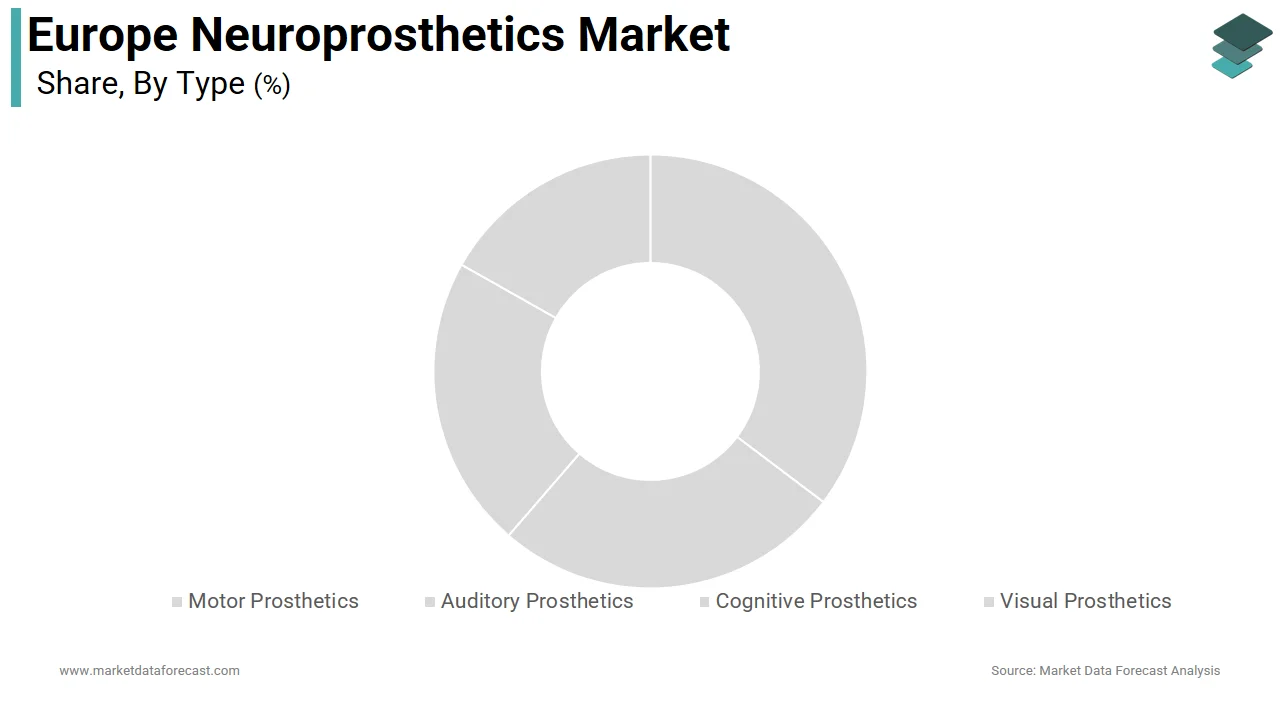
The motor prosthetics segment is on the rise and is expected to be the fastest-growing segment in the market by witnessing a CAGR of 12.4% between 2026 and 2034 due to breakthroughs in brain-computer interfaces and upper limb neuroprostheses for stroke and spinal cord injury patients. The Swiss Federal Institute of Technology Lausanne continues to advance neurorehabilitation by refining non-invasive, brain-controlled exoskeletons that allow individuals with mobility impairments to perform daily activities. European researchers are demonstrating that implanted cortical technology can restore precise hand functionality, allowing paralyzed individuals to successfully manipulate objects in home environments. Data from international stroke studies emphasize a substantial annual increase in stroke incidence, underscoring the growing, urgent need for advanced rehabilitation and assistive technology for survivors. European research initiatives are heavily investing in motor restoration technologies, acknowledging the potential of advanced robotics to improve patient autonomy and reduce long-term care burdens. The convergence of supportive regulatory frameworks, AI innovation, and new reimbursement models in Germany and the Netherlands is accelerating the transition of motor prosthetics from experimental curiosities to viable, market-ready clinical solutions.
By Technology Insights
The deep brain stimulation segment was the largest segment in the Europe neuroprosthetics market by capturing a 38.7% share in 2025. Its supremacy is attributed to established use in Parkinson’s disease, essential tremor, and dystonia, conditions affecting significant million Europeans. DBS is endorsed in national guidelines across Germany, France, and the UK as a standard of care for advanced Parkinson’s when medications fail. Deep brain stimulation is established as a standard, reimbursed neurosurgical procedure within German hospitals, with high-volume centers managing substantial caseloads annually. Technological maturity also plays a role; modern systems like Medtronic’s Percept and Boston Scientific’s Vercise offer directional leads and sensing capabilities that optimize therapy while reducing side effects. Recent research in movement disorder studies indicates that personalized, adaptive deep brain stimulation provides superior motor symptom management compared to standard continuous stimulation, particularly for patients experiencing medication fluctuations. DBS holds its position as the premier, clinically verified neuromodulation modality in Western Europe, reinforced by widespread certification and increasing usage for psychiatric indications, including OCD.
The spinal cord stimulation segment is expected to exhibit a noteworthy CAGR of 11.7% over the forecast period, owing to expanding indications beyond traditional failed back surgery syndrome to include chronic limb ischemia, diabetic neuropathy, and even motor recovery after spinal injury. Innovations in spinal cord stimulation (SCS) using burst waveforms are increasingly recognized for reducing refractory angina pain, with evidence suggesting successful reduction in anginal episodes following specialized clinical studies. Moreover, modern closed-loop SCS devices that dynamically adjust to patient posture and activity have proven effective in improving pain management, with studies indicating high rates of success in treating complex regional pain syndrome. European national health systems are recognizing the economic advantages of SCS, with evidence of reduced opioid consumption in patients leading to expanded reimbursement options. SCS technology is shifting from pain management to rehabilitation, supported by thousands of annual implants and growing adoption in Eastern Europe.
By Application Insights
The physiological disorders segment held the majority share of 58 .3% of the Europe neuroprosthetics market in 2025. This category includes hearing loss, chronic pain, epilepsy, and bladder dysfunction, conditions with high prevalence and well-defined device pathways. A substantial number of Europeans suffer from inner ear hearing damage, while a significant portion of the adult population in Europe is affected by chronic pain. Unlike cognitive or motor neuron disorders, which often involve experimental interventions, physiological applications benefit from CE Marked devices with robust reimbursement. Sacral nerve stimulation technology for treating urinary incontinence is a recognized, covered treatment across many European Union nations, with a notable annual volume of procedures performed. Similarly, vagus nerve stimulation for drug-resistant epilepsy is standard care in pediatric neurology centers across France and Italy. The clinical clarity of these indications, paired with measurable outcomes like pain reduction or hearing thresholds, facilitates regulatory approval and payer acceptance. This foundation of evidence-based utility ensures physiological disorders remain the core commercial and clinical anchor of the European neuroprosthetics ecosystem.
The cognitive disorders segment is predicted to witness the highest CAGR of 13.2% between 2026 and 2034. The swift expansion of this segment is fuelled by pioneering work in deep brain stimulation for Alzheimer’s disease, treatment-resistant depression, and memory restoration. Research, including studies with ties to Nordic institutions, suggests that deep brain stimulation of memory circuits shows promise in stabilizing cognitive function and improving brain metabolism in specific, older, early-stage Alzheimer’s patients. In cases of severe, treatment-resistant depression, neurostimulation techniques targeting specific white matter tracts in the brain, such as the subcallosal cingulate region, have demonstrated potential for achieving remission, particularly over long-term follow-up. The European Medicines Agency has updated its PRIME designation scheme to provide enhanced, proactive regulatory support for novel, high-potential medical devices and treatments that address significant, unmet mental health needs. The rising prevalence of dementia and related mental health conditions in Europe's aging population necessitates the development of new, non-drug interventions. Cognitive neuroprosthetics are shifting from specialized psychiatry to mainstream neurology as ethical frameworks and surgical protocols mature, offering new hope for treatment-resistant cases.
COUNTRY LEVEL ANALYSIS
Geographically, the European market is one of the largest regions globally, with a significant marketplace. Europe held the second-largest share of the worldwide neuroprosthetics market in 2020, which is anticipated to record a substantial share during the forecast period. The region's market growth is attributed to well-established healthcare infrastructure, increasing problems of nerve damage and neurological disorders in the area, and favorable reimbursement policies. Germany, the UK, France, Italy, and Spain are the major growth contributors in the region.
Germany accounted for the largest share of the Neuroprosthetics market, which is expected to grow significantly over the forecast period. The increasing prevalence of neurological disorders and diabetes, rising healthcare spending, and technological advancements in the healthcare sector are propelling market growth. However, the market has also been experiencing increased hearing loss and amputations due to road accidents. Therefore, road accidents in the region have also increased in recent years, increasing market growth.
The UK is expected to witness exponential growth in the market. The major factors driving the market growth are the growing geriatric population, government initiatives to promote research and development, increasing road accidents, and hearing loss and amputations.
On the other hand, Italy, France, and Spain have experienced an increase in neurological disorders among individuals for various reasons. In addition, the causes of hearing loss and amputations have also increased over the period. Also, the recent technological developments in the market have proven to be a significant growth contributor to the neuroprosthetics market.
COMPETITIVE LANDSCAPE
The Europe neuroprosthetics market is characterized by intense competition among a handful of multinational medtech leaders operating under one of the world’s most stringent regulatory regimes. While companies like Medtronic, Boston Scientific, and Cochlear dominate through established portfolios and clinical validation, smaller innovators are emerging with next-generation brain computer interfaces and bioelectronic medicines. Competition is not price-driven but centers on technological differentiation, clinical evidence, and ecosystem integration, including surgical training, digital platforms, and reimbursement support. The EU Medical Device Regulation 2017/745 has raised barriers to entry, requiring extensive post-market surveillance and long-term safety data, which favors incumbents with legacy infrastructure. However, breakthrough designation pathways and Horizon Europe funding are enabling agile startups to advance novel applications in cognitive and motor restoration. Geographic disparities persist, with Western Europe hosting most implant centers while Eastern regions lag in expertise and coverage. Ultimately, success depends on balancing innovation with regulatory diligence and building multidisciplinary partnerships that bridge engineering, neuroscience, and healthcare delivery to address Europe’s growing burden of neurological disability.
KEY MARKET PLAYERS
The leading companies operating in the Europe neuroprosthetics market include:
- Cochlear Ltd.
- Boston Scientific Corporation
- Cyberonics Inc.
- Medtronic plc
- NDI Medical LLC
- NeuroPace Inc.
- Jude Medical Inc.
- Nervo Corp.
- Retina Implant AG
- Biomet Inc.
- Sonova
TOP PLAYERS IN THE MARKET
- Medtronic plc is a global leader in neuroprosthetics with a strong presence in Europe through its deep brain stimulation, cochlear implant, and spinal cord stimulation portfolios. The company leverages its extensive clinical evidence base and regulatory expertise to maintain compliance withthe EU Medical Device Regulation 2017/745 across all Class III neuroprosthetic systems. It also expanded its neurosurgical training academy in Dublin, offering hands-on certification in directional lead placement and closed-loop programming. These initiatives reinforce Medtronic’s commitment to precision neuromodulation and clinician enablement while strengthening its position as a trusted partner in Europe’s advanced neurological care ecosystem.
- Cochlear Limited plays a pivotal role in the Europe neuroprosthetics market as the leading provider of auditory prosthetics for severe to profound hearing loss. The company supplies its Nucleus and Baha systems to numerous implant centers across the EU, supported by dedicated clinical and audiologist networks. It also partnered with national health services to streamline pre-implantation pathways, reducing wait times in pilot regions. Cochlear is broadening access to life-changing hearing restoration by merging engineering innovation with health system integration, all while maintaining rigorous EU MDR quality standards.
- Boston Scientific Corporation contributes significantly to the Europe neuroprosthetics market through its Vercise Genus deep brain stimulation and WaveWriter Alpha spinal cord stimulation platforms. The company focuses on adaptive neuromodulation technologies that personalize therapy based on neural feedback and patient activity. It also launched a digital therapy management portal enabling remote programming and patient-reported outcome tracking compliant with EU data privacy regulations. Boston Scientific is strengthening its reputation as a proactive partner in Europe's evolving restorative neurology and chronic pain sector through relentless innovation in digital health and closed-loop technologies.
TOP STRATEGIES USED BY THE KEY MARKET PARTICIPANTS
Key players in the Europe neuroprosthetics market employ four core strategies to navigate regulatory complexity and clinical adoption barriers. First, they invest in closed-loop and AI-driven systems that deliver adaptive stimulation based on real-time neural feedback, enhancing efficacy and reducing side effects. Second, they expand indications through robust clinical trials in collaboration with academic medical centers to generate health technology assessment-ready evidence. Third, they develop comprehensive clinician training and certification programs to address the shortage of specialized surgical and programming expertise across the region. Fourth, they integrate digital health platforms for remote monitoring, programming, and patient engagement, ensuring continuity of care while complying with EU data protection laws. These strategies collectively aim to improve real-world outcomes, accelerate reimbursement, and broaden access to advanced neuromodulation therapies in a highly scrutinized and fragmented healthcare environment.
MARKET SEGMENTATION
This Europe neuroprosthetics market research report is segmented and sub-segmented into the following categories.
By Type
- Motor Prosthetics
- Auditory Prosthetics
- Cognitive Prosthetics
- Visual Prosthetics
By Technology
- Deep Brain Stimulation
- Vagus Nerve Stimulation
- Spinal Cord Stimulation
- Sacral Nerve Stimulation
By Application
- Motor Neuron Disorders
- Physiological Disorders
- Cognitive Disorders
By End-user
- Hospitals
- Clinics
By Country
- UK
- France
- Spain
- Germany
- Italy
- Russia
- Sweden
- Denmark
- Switzerland
- Netherlands
- Turkey
- Czech Republic
- Rest of Europe