- Product Description Description
- Table of Contents TOC
- List of Table & Figure LOT
- Get Free Sample PDF Sample PDF
Market Size, 2025
$30 BnMarket Estimate, 2026
$31.86 BnMarket Forecast, 2034
$51.55 BnCAGR, 2026–2034
6.20%Europe Physical Security Market Report Summary
The Europe physical security market was valued at USD 30 billion in 2025, is estimated to reach USD 31.86 billion in 2026, and is projected to reach USD 51.55 billion by 2034, growing at a CAGR of 6.20% from 2026 to 2034. Market growth is driven by rising concerns over public safety, increasing investments in critical infrastructure protection, and growing adoption of smart surveillance and access control technologies. Governments and enterprises across Europe are strengthening physical security systems to protect transportation hubs, commercial facilities, and public spaces. The integration of AI-powered video analytics, cloud-based monitoring platforms, and IoT-enabled security devices is further accelerating market expansion.
Key Market Trends
- Rising adoption of AI-enabled video surveillance and facial recognition systems.
- Increasing deployment of cloud-based security management platforms and VSaaS solutions.
- Growing demand for integrated security systems combining video, access control, and alarms.
- Expansion of smart city and critical infrastructure security initiatives.
- Strengthening focus on cyber-physical security convergence and regulatory compliance.
Segmental Insights
- Based on service type, the Video Surveillance as a Service (VSaaS) segment dominated the Europe physical security market in 2025 by accounting for 62.6% market share. The segment’s leadership is attributed to centralized monitoring, cost efficiency, scalability, and ease of deployment.
- Based on organization size, the large enterprises segment held a significant share in 2025, driven by high security budgets, complex facility networks, and increasing adoption of enterprise-wide surveillance systems.
Regional Insights
The Europe physical security market is witnessing steady growth across major economies, supported by strong government involvement, rising urbanization, and expanding investments in public safety infrastructure.
- Germany led the regional market in 2025 with 22.5% share, driven by advanced industrial security systems and strong public-private security partnerships.
- The United Kingdom followed closely with 17.4% share, supported by extensive deployment of surveillance systems across transportation, retail, and public venues.
- France holds a significant position, supported by strong state coordination with national agencies such as ANSSI and the Ministry of Interior, ensuring uniform security standards across airports, hospitals, and transport hubs.
Competitive Landscape
The Europe physical security market is characterized by strong competition among global security service providers, surveillance technology manufacturers, and integrated solution vendors. Market players are focusing on enhancing AI-powered monitoring, expanding cloud-based platforms, and strengthening end-to-end security offerings. Strategic partnerships, technology upgrades, and investments in smart surveillance infrastructure are shaping competitive dynamics across the region.
Prominent companies operating in the Europe physical security market include Securitas AB, Axis Communications AB, Bosch Security Systems GmbH, Dahua Technology Co., Ltd., Thales Group, Hanwha Vision Co., Ltd., and Secom Co., Ltd.
Europe Physical Security Market Size
The Europe physical security market was valued at USD 30 billion in 2025, is estimated to reach USD 31.86 billion in 2026, and is projected to reach USD 51.55 billion by 2034, growing at a CAGR of 6.20% from 2026 to 2034.

Physical security is the protection of personnel, hardware, software, networks, and data from real-world actions and events that could cause serious loss or damage. Unlike cybersecurity, which addresses digital threats, physical security operates in the tangible domain, enforcing spatial boundaries and monitoring real-world activities. The market is shaped by a confluence of regulatory mandates, technological convergence, and evolving threat landscapes across public and private sectors. Mandatory security planning among critical infrastructure operators is increasing across the European Union due to the implementation of new cybersecurity and physical resilience directives. According to sources, there continues to be significant reliance on human security personnel throughout the European Union, complementing the use of technology in security solutions. Urbanization further intensifies demand. Europe's population is increasingly concentrated in urban areas, intensifying the demand for scalable security systems in mass transit, commercial buildings, and smart city infrastructure. This ecosystem increasingly blends legacy hardware with artificial intelligence, edge computing, and cloud connectivity, creating a dynamic landscape where resilience, interoperability, and privacy coexist as core imperatives.
MARKET DRIVERS
Mandatory Security Requirements for Critical Infrastructure Drive System Upgrades
The European Union’s NIS2 Directive imposes stringent physical and organizational security measures on entities across energy, water, transport, health, and digital infrastructure sectors, which significantly contribute to the growth of the European physical security market. Regulatory bodies are increasingly requiring critical infrastructure operators to adopt multi-layered physical security measures, which include advanced access control, continuous surveillance with long-term data retention, and systems connected to national security networks. Energy grid operators are upgrading their perimeter defenses by implementing hardened barriers, thermal imaging, and anti-drone technology to meet updated security compliance standards. Critical infrastructure, such as major hospital systems, is incorporating controlled access points and emergency alert systems to enhance security against potential disruptions. These regulatory interventions transform physical security from a discretionary expense into a compliance necessity, generating sustained demand for certified equipment and professional installation services. The directive’s extraterritorial reach also compels multinational firms to harmonize site security across member states, accelerating standardization and technology refresh cycles continent-wide.
Rising Urban Crime and Retail Shrinkage Intensify Commercial Security Investment
Persistent increases in organized retail crime and urban petty theft have compelled businesses across the region to fortify premises with advanced physical security measures, which further boost the expansion of the Europe physical security market. Retailers across Europe are experiencing a notable rise in recorded incidents of inventory loss. Certain types of consumer goods, particularly in the categories of personal care, technology, and health products, appear to be targeted more frequently. Research indicates that financial losses stemming from retail theft have increased significantly compared to previous periods. In response to these challenges, retail businesses are increasingly implementing technology-driven security systems. These advanced systems utilize automated video analysis to identify potentially suspicious activities in store environments. Supermarkets in Spain and Italy now routinely integrate electronic article surveillance tags with access control turnstiles to prevent exit fraud. Additionally, city centers in Sweden and the Netherlands have established public-private security partnerships, installing networked CCTV with facial blurring to balance deterrence and GDPR compliance. Rising insurance premiums for insecure locations have redefined robust security from a mere cost-saving measure to a critical requirement for business continuity and reputation management.
MARKET RESTRAINTS
Stringent Data Privacy Regulations Limit Surveillance Capabilities
The General Data Protection Regulation imposes strict constraints on the collection, storage, and processing of personal data captured by physical security systems, particularly video and biometric technologies, which restricts the growth of the Europe physical security market. As per the European Data Protection Board, any use of facial recognition or gait analysis in public or workplace settings requires explicit legal justification, data protection impact assessments, and often prior consultation with national supervisory authorities. Regulatory authorities are penalizing organizations for implementing emotion recognition technologies in retail settings due to insufficient user consent procedures, reflecting a strict enforcement trend. Data protection commissioners are restricting companies from utilizing continuous biometric access logging, as such practices are viewed as excessive surveillance of personnel. These enforcement actions generate ambiguity for security providers, who are tasked with interpreting varying national restrictions on the deployment of facial recognition in public areas. National interpretations regarding the legality of live facial recognition range from total prohibitions to permitted, limited use for law enforcement purposes, creating a complex compliance landscape. Consequently, many organizations opt for anonymized analytics such as crowd density heat maps or object detection, which reduce identification risk but also limit investigative utility. This regulatory friction slows the adoption of next-generation surveillance tools despite their technical readiness.
Fragmented Standards and Interoperability Barriers Increase Integration Costs
The absence of universal communication protocols across physical security hardware results in siloed systems that hinder seamless data exchange and centralized management, and the growth of the Europe physical security market. Despite ONVIF providing a standardized framework for IP cameras, the reliance on closed, proprietary software for access control and detection systems frequently restricts seamless, plug-and-play interoperability. Many installed security systems in commercial buildings rely on intermediate software to enable communication between devices from different manufacturers. A significant portion of security systems in commercial buildings cannot directly execute commands across different vendors. Security platforms in airport environments often require custom programming to connect metal detectors with video management systems. The reliance on custom integration for airport security technology can impact the speed of incident response. Moreover, legacy analog infrastructure is still prevalent in Eastern Europe and resists cost-effective migration to IP-based architectures. This fragmentation forces end users to either commit to single vendor ecosystems, reducing competitive pricing, or absorb high integration expenses for heterogeneous deployments. The market will continue to suffer from inefficiency, duplication, and poor situational awareness until Europe enforces binding interoperability, similar to the telecommunications sector.
MARKET OPPORTUNITIES
Convergence with Smart Building and IoT Ecosystems Creates Integrated Security Platforms
Physical security systems are increasingly embedded within broader smart building management frameworks, which enable coordinated responses across lighting, HVAC, and occupancy systems, and thereby provide new opportunities for the Europe physical security market. In modern office complexes, access control events can trigger personalized environmental settings while intrusion alarms automatically lock doors, adjust lighting to disorient intruders, and notify emergency services. The Netherlands and Germany are leading a widespread adoption of integrated building operating systems in new commercial construction, driven by the need for combined security, energy efficiency, and intelligent space management. The EU’s Level(s) framework for sustainable buildings explicitly encourages such convergence by awarding credits for systems that enhance both safety and resource efficiency. Companies like Schneider Electric and Siemens offer unified platforms where a single dashboard manages fire alarms, video feeds, and elevator recalls during crises. This synergy reduces capital expenditure, avoids redundant cabling, and generates holistic operational insights. 5G private networks are enabling real-time coordination among drones, ground sensors, and access points, upgrading static security to a dynamic, intelligent infrastructure.
Public Sector Modernization Funds Accelerate Adoption of Advanced Technologies
National recovery plans under the EU’s NextGenerationEU initiative have allocated substantial funding for upgrading public safety infrastructure, which offers fresh prospects for the expansion of the Europe physical security market. These investments include upgrading physical security systems in transportation, schools, and government facilities. European nations are increasingly investing in national recovery funds to modernize security infrastructure within urban environments. These initiatives show a growing reliance on advanced technology, such as artificial intelligence-powered surveillance and specialized detection systems, to monitor high-risk areas. There is a notable shift toward enhancing security measures in public institutions, including universities and healthcare facilities. Government funding is being directed toward integrated systems, combining access control with emergency communication to improve public safety. Both Italian and Spanish strategies demonstrate a trend of leveraging digital infrastructure funding to upgrade urban security apparatuses. These programs prioritize solutions compliant with European cybersecurity certification schemes, ensuring alignment with both functionality and sovereignty goals. In Sweden, local authorities used green bond proceeds to retrofit subway stations with thermal imaging and automated lockdown capabilities following terror threat assessments. These public investments not only stimulate demand but also serve as validation for emerging technologies, encouraging private sector replication. These funds bolster market development and reinforce societal resilience to hybrid threats by de-risking innovation through procurement.
MARKET CHALLENGES
Shortage of Certified Security Installation and Maintenance Technicians
A significant labor shortage in specialized security, cybersecurity, and compliance is hindering the deployment of advanced physical security systems in the region, which slows down the expansion of the Europe physical security market. The demand for qualified security system installers is outpacing the number of professionals graduating from training programs. Small security firms are increasingly using subcontractors to manage capacity, which can lead to challenges in maintaining consistent work quality and potential impacts on warranties. Moreover, the shift toward IP-based systems demands knowledge of IT protocols, VLAN segmentation, and firewall rules, skills traditionally outside the scope of electrical or locksmith trades. Certification bodies like ECS in the UK and BFE in Germany have expanded curricula, but uptake remains slow due to fragmented accreditation recognition across borders. This shortage leads to project delays, inflated labor costs, and suboptimal configurations that leave vulnerabilities unaddressed. Growing demand will be hindered by persistent implementation barriers absent harmonized EU standards and credential recognition.
Geopolitical Instability and Hybrid Threats Overwhelm Traditional Security Models
Complex hybrid threats blend cyber sabotage, drone incursions, sabotage, and coordinated physical attacks targeting energy grids, ports, and data centers, which hinders the expansion of the European physical security market. Observations indicate a rise in reported security incidents involving unauthorized aerial vehicles at sensitive locations. Documented cases demonstrate that these aerial assets are being utilized for surveillance, the delivery of unauthorized items, and the disruption of communication signals, exposing vulnerabilities within established, multi-layered security measures. Traditional systems designed for isolated intrusion detection lack the sensor fusion and automated response logic needed to counter multi-vector assaults. Furthermore, the war in Ukraine has heightened concerns about sabotage. Legacy guard patrols and motion detectors are ineffective against low observable threats like miniaturized drones or insider collusion. Addressing these challenges requires investment in counter-UAS radar RF detection and AI-driven anomaly correlation, capabilities still nascent in most civilian deployments. The evolving threat landscape thus exposes the limitations of conventional physical security paradigms, demanding a fundamental rethinking of resilience architecture.
REPORT COVERAGE
| REPORT METRIC | DETAILS |
| Market Size Available | 2025 to 2034 |
| Base Year | 2025 |
| Forecast Period | 2026 to 2034 |
| Segments Covered | By System Type, Service Type, Deployment Type, Organization Size, End-user Industry, and Country. |
| Various Analyses Covered | Global, Regional, and Country-Level Analysis, Segment-Level Analysis, Drivers, Restraints, Opportunities, Challenges; PESTLE Analysis; Porter’s Five Forces Analysis, Competitive Landscape, Analyst Overview of Investment Opportunities |
| Countries Covered | UK, France, Spain, Germany, Italy, Russia, Sweden, Denmark, Switzerland, Netherlands, Turkey, Czech Republic, and the Rest of Europe. |
| Market Leaders Profiled | Securitas AB, Axis Communications AB, Bosch Security Systems GmbH, Dahua Technology Co., Ltd., Thales Group, Hanwha Vision Co., Ltd., Secom Co., Ltd., and Others. |
SEGMENTAL ANALYSIS
By Service Type Insights
The Video Surveillance as a Service (VSaaS) segment dominated the Europe physical security market by accounting for a 62.6% share in 2025. The dominance of the VSaaS segment is driven by the widespread need for remote visual monitoring across retail, transportation, healthcare, and public infrastructure sectors. VSaaS eliminates upfront capital expenditure by offering cloud-hosted recording, analytics, and storage on a subscription basis, a model particularly attractive to budget-constrained organizations. European commercial construction projects are increasingly adopting internet-connected security cameras that store data on remote servers, allowing for remote surveillance and quick access to incident footage. The General Data Protection Regulation has further accelerated the adoption of compliant VSaaS providers that embed privacy by design features such as automatic facial blurring and geofenced data residency. Driven by the need for better security and impending regulatory compliance, German businesses are transitioning from traditional analog recording devices to secure, web-enabled cloud video systems. The scalability of VSaaS, allowing users to add cameras without hardware upgrades, ensures its continued primacy in an era of distributed operations and hybrid work environments.
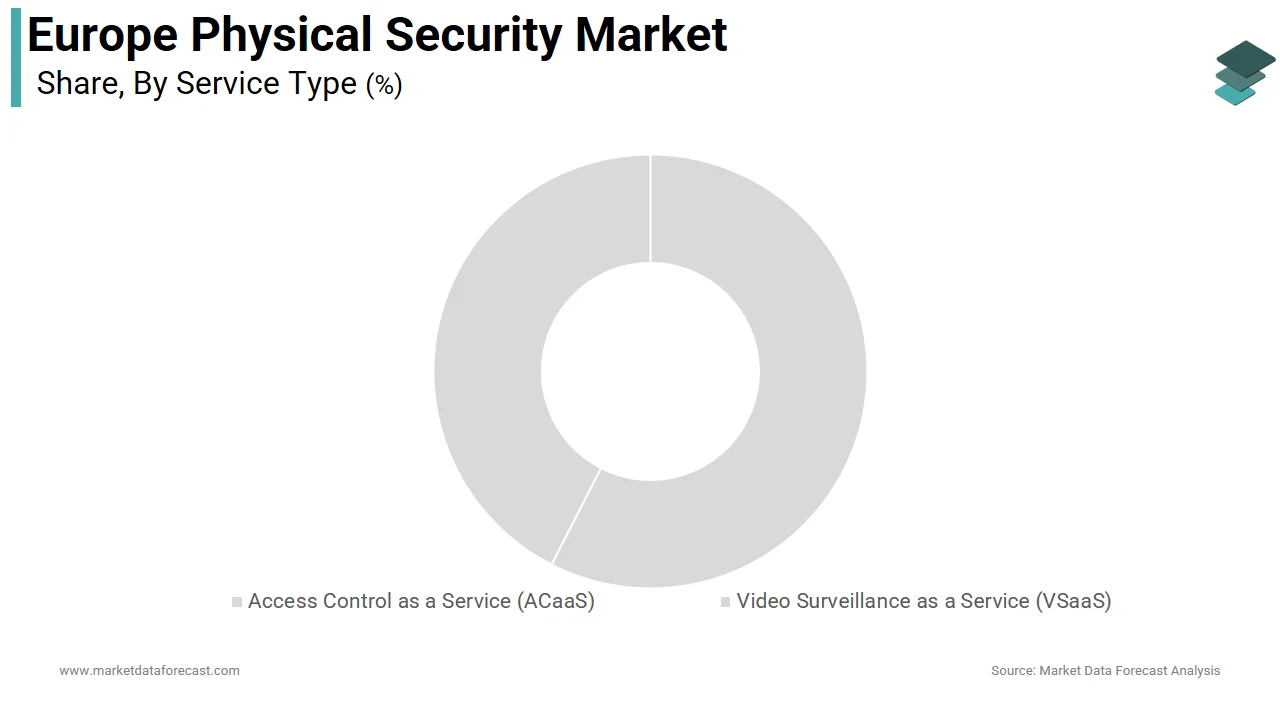
The Access Control as a Service (ACaaS) segment is anticipated to witness the fastest CAGR of 14.2% between 2026 and 2034 due to the convergence of workplace flexibility, cybersecurity mandates, and mobile identity trends. Modern ACaaS platforms enable employees to unlock doors via smartphone credentials, biometric authentication, or QR codes, eliminating the need for physical cards and supporting hot desking in hybrid office models. Operators of critical infrastructure are increasingly adopting security measures that align physical access with digital identity systems. Compliance with updated security regulations is driving the integration of multi-factor authentication for physical entry points. Government entities are implementing, or working towards implementing, enhanced access management systems with secured, immutable logging capabilities. There is a notable shift toward cloud-based solutions for tracking and monitoring entry into secure facilities. Additionally, the rise of coworking spaces and shared logistics hubs demands granular permission management, assigning temporary access to contractors or delivery personnel, which ACaaS delivers through intuitive dashboards. Providers have integrated their platforms with Microsoft Entra ID and Okta, enabling single sign-on across digital and physical domains. This seamless fusion of IT and physical security positions ACaaS as the fastest evolving layer in the modern protection stack.
By Organization Size Insights
The large enterprises segment led the Europe physical security market by capturing a significant share in 2025. The leading position of the large enterprises segment is attributed to its extensive asset footprints, complex regulatory obligations, and high consequence risk profiles. Multinational corporations operating airports, data centers, manufacturing plants, and corporate campuses require integrated security ecosystems combining thousands of cameras, access points, and intrusion sensors managed through enterprise command centers. The updated directive requires numerous, extensive organizations within critical infrastructure sectors to establish verified, robust, and constantly monitored safety frameworks, along with procedures for reporting breaches. Industrial organizations are incurring significant annual expenditures on security enhancements to meet compliance standards. These regulatory changes are necessitating ongoing, continuous monitoring and structured incident reporting as core operational requirements. The directive extends the scope of mandatory compliance to a wider range of large entities in areas such as energy, health, and transport. Their procurement power also enables custom integrations with building management and cybersecurity operations centers, ensuring holistic threat response. Furthermore, insurance underwriters increasingly tie premium rates to verified security maturity levels, compelling sustained investment. The scale complexity and compliance burden inherent to large organizations ensure their continued dominance in market spend despite growing SME adoption.
The small and medium enterprises (SMEs) segment is likely to experience the fastest CAGR of 12.7% during the forecast period, owing to rising retail crime, digital transformation, and affordable cloud-based solutions tailored to limited budgets. Retailers are increasingly experiencing incidents of theft, prompting a shift toward adopting entry-level, subscription-based cloud video surveillance solutions. Small and medium-sized enterprises are investing in smart technology, including remote-controlled access systems, to secure premises against forced entry incidents. Public funding initiatives and digital transformation programs are accelerating the adoption of enhanced security measures, such as cloud video and mobile access systems. Crucially, these solutions require no on-premises servers or IT staff—installation often takes under two hours using existing Wi-Fi networks. Vendors like Axis Communications and Bosch Security now offer pre-bundled SME kits with GDPR compliant data handling and multilingual support, lowering adoption barriers. The democratization of threats is matched by the democratization of protection, positioning SMEs as the most dynamic sector for expansion.
COUNTRY LEVEL ANALYSIS
Germany Physical Security Market Analysis
Germany outperformed other countries in the Europe physical security market by holding a 22.5% share in 2025. The supremacy of the German market is credited to stringent regulatory enforcement, particularly under the NIS2 Directive and the Federal Data Protection Act, which mandate layered physical protections for critical infrastructure and workplaces. A large portion of energy grid operators and major hospitals have implemented integrated security operations centers. Germany also leads in industrial security with automotive and chemical plants deploying AI-powered perimeter intrusion detection and drone countermeasures. The presence of global vendors like Bosch Security and Siemens Smart Infrastructure fosters innovation while vocational training programs produce a steady pipeline of certified installers. Public funding through the GAIA X initiative further supports sovereign cloud platforms for secure video storage, ensuring data remains within EU jurisdiction. This blend of regulation industry density and technological sovereignty cements Germany’s role as the continent’s security benchmark.
United Kingdom Physical Security Market Analysis
The United Kingdom followed closely in the Europe physical security market by accounting for a 17.4% share in 2025. Despite post-Brexit divergence, the UK maintains alignment with core EU security principles while pioneering retail and urban safety initiatives. As per research, a significant share of mid-sized retailers now use cloud video systems with AI analytics to combat organized shoplifting, which costs the sector a substantial amount. London’s Metropolitan Police collaborates with private operators through the Digital Custody Platform, enabling rapid evidence sharing during investigations. The government’s Security and Resilience Industry Suppliers Community provides certification for SME friendly systems, accelerating adoption beyond large enterprises. Moreover, the UK leads in biometric access trials with airports like Heathrow testing contactless facial recognition lanes that reduce congestion while maintaining auditability. Strong insurance incentives and a mature private security workforce of professionals sustain robust demand across commercial, residential, and critical national infrastructure domains.
France Physical Security Market Analysis
France holds a noteworthy position in the Europe physical security market due to strong state coordination with national agencies like ANSSI and the Ministry of Interior, setting uniform standards for airports, hospitals, and transport hubs. Urban environments in France have experienced an increase in the deployment of surveillance technology following heightened security concerns, with real-time video feeds increasingly integrated into regional command centers. Major sporting events have served as catalysts for investment in scalable, temporary security infrastructure, including advanced perimeter control and aerial surveillance capabilities. Municipal security procurement is heavily influenced by regulations requiring enhanced intrusion detection and lockdown systems within large public facilities. Companies like Thales and Idemia leverage this ecosystem to develop sovereign security platforms compliant with both GDPR and national defense requirements. This top-down model ensures high baseline protection while fostering domestic technology champions.
Italy Physical Security Market Analysis
Italy expanded steadily in the European physical security market owing to a dense network of millions of small businesses, many operating in high-theft-risk sectors like fashion, electronics, and hospitality. National recovery funding has supported initiatives aimed at improving digital security for small and medium-sized enterprises, with a focus on subsidizing technologies such as cloud-based surveillance and smart access systems. A significant number of businesses have participated in this initiative, leading to a shift toward enhanced monitoring for previously unsecured commercial storefronts. The implementation of these security measures in specific urban areas has been associated with a decrease in reported burglary incidents. Additionally, Italy’s extensive cultural heritage sites, from museums to archaeological zones, require discreet yet effective protection, driving demand for thermal cameras and vibration sensors that preserve aesthetic integrity. This blend of public subsidy, grassroots vulnerability, and heritage preservation creates a distinctive demand profile centered on accessibility and discretion.
Sweden Physical Security Market Analysis
Sweden is anticipated to grow in the Europe physical security market over the forecast period due to a balanced integration of advanced technology and strict privacy ethics reflecting its societal values. Many new residential and commercial developments are incorporating access control and video systems designed to automatically obscure faces and license plates, ensuring data is only reviewed following a verified security incident. Municipal initiatives are increasingly utilizing edge AI technology to link traffic cameras with emergency services, allowing for the detection of incidents without the retention of raw surveillance footage. Sweden also leads in sustainability-aligned security, with companies like Axis Communications designing carbon-neutral cameras powered by renewable energy. The absence of a standing army and low violent crime rates shifts focus toward asset protection and cyber-physical resilience, particularly for data centers hosting EU cloud infrastructure. Sweden sets a benchmark for ethical safety by leveraging high institutional trust and digital proficiency to treat security as a catalyst for an open, safe society rather than a surveillance tool.
COMPETITIVE LANDSCAPE
Competition in the Europe physical security market is defined by a tripartite structure comprising global technology leaders, specialized European vendors, and agile cybersecurity native entrants. Established players like Axis Bosch and Thales dominate through regulatory expertise, vertical integration, and proven reliability in critical infrastructure. Meanwhile, niche firms compete on domain-specific innovation such as drone detection, anti-spoofing biometrics, or heritage site protection. The market is undergoing rapid transformation as legacy analog systems give way to IP-based cloud-connected platforms demanding new competencies in data governance and network resilience. Regulatory fragmentation across member states creates both opportunity and complexity, with vendors tailoring solutions to national interpretations of NIS2 and data protection laws. Price pressure from low-cost Asian manufacturers is countered by European emphasis on data sovereignty, ethical AI, and local support. Differentiation increasingly hinges on the ability to deliver unified platforms that merge physical security with cyber identity building, management, and emergency response within a compliant, sustainable framework.
KEY MARKET PLAYERS
The leading companies operating in the Europe physical security market include:
- Securitas AB
- Axis Communications AB
- Bosch Security Systems GmbH
- Dahua Technology Co., Ltd.
- Thales Group
- Hanwha Vision Co., Ltd.
- Secom Co., Ltd.
TOP PLAYERS IN THE MARKET
- Axis Communications AB is a Swedish multinational and a global pioneer in network video surveillance headquartered in Lund. The company plays a central role in the Europe physical security market by providing IP-based cameras, video management software, and analytics solutions that comply with stringent EU data protection and cybersecurity standards. Axis contributes to the global market through its open platform approach, which enables third-party developers to integrate artificial intelligence applications for crowd detection, license plate recognition, and anomaly behavior analysis. The company also expanded its cloud-hosted video service across Southern Europe, enabling small businesses to access enterprise-grade surveillance without on-premises infrastructure, reinforcing its leadership in ethical, scalable security technology.
- Bosch Security Systems GmbH is a key European provider of integrated physical security solutions, including video surveillance, access control, intrusion detection, and public address systems. As part of Robert Bosch GmbH, the division leverages deep engineering expertise to deliver robust, reliable systems for airports, hospitals, and industrial facilities across the continent. Globally, Bosch is recognized for its emphasis on data sovereignty, offering on-premises and edge-based processing to ensure sensitive footage never leaves customer premises unless authorized. The company also introduced AI-enabled camera firmware updates that detect unattended objects or perimeter breaches in real time without cloud dependency. These innovations strengthen its position as a trusted partner for mission-critical infrastructure operators seeking resilient sovereign security architectures.
- Thales Group is a French multinational technology leader with a significant footprint in Europe’s high assurance physical security segment, particularly for defense transport and critical national infrastructure. The company provides end-to-end solutions ranging from biometric access control and secure credentialing to perimeter intrusion detection and command center integration. Thales contributes globally through its expertise in secure identity management, having supplied national e-passport and border control systems to numerous countries. In Europe, it supports major rail networks, airports, and energy grids with cyber-hardened physical security platforms aligned with ENISA and ANSSI certification frameworks. This reinforces its role as a strategic enabler of secure, seamless mobility in high-scrutiny environments.
TOP STRATEGIES USED BY THE KEY MARKET PARTICIPANTS
Key players in the Europe physical security market prioritize compliance with EU regulations such as GDPR, NIS2, and the Cyber Resilience Act by embedding privacy by design and data localization into their hardware and software. They invest heavily in artificial intelligence at the edge to enable real-time threat detection without relying on cloud transmission, thereby addressing latency and sovereignty concerns. Companies increasingly offer subscription-based security as a service models to lower entry barriers for small and medium enterprises while ensuring recurring revenue. Strategic partnerships with system integrators, cloud providers, and identity management platforms facilitate seamless interoperability across IT and operational technology domains. Additionally, firms focus on sustainability by designing energy-efficient devices and implementing circular economy practices such as product take-back and component reuse to align with the European Green Deal.
MARKET SEGMENTATION
This research report on the Europe physical security market has been segmented and sub-segmented into the following categories.
By System Type
- Video Surveillance System
- IP Surveillance
- Analog Surveillance
- Hybrid Surveillance
- Physical Access Control System (PACS)
- Biometric System
- Perimeter Security
- Intrusion Detection
By Service Type
- Access Control as a Service (ACaaS)
- Video Surveillance as a Service (VSaaS)
By Type of Deployment
- On-Premises
- Cloud
By Organization Size
- Small and Medium Enterprises (SMEs)
- Large Enterprises
By End-user Industry
- Government Services
- Banking and Financial Services
- IT and Telecommunications
- Transportation and Logistics
- Retail
- Healthcare
- Residential
- Other End-user Industries
By Country
- United Kingdom
- France
- Spain
- Germany
- Italy
- Russia
- Sweden
- Denmark
- Switzerland
- Netherlands
- Rest of Europe