- Product Description Description
- Table of Contents TOC
- List of Table & Figure LOT
- Get Free Sample PDF Sample PDF
Market Size, 2025
$4.30 BnMarket Estimate, 2026
$4.97 BnMarket Forecast, 2034
$15.90 BnCAGR, 2026–2034
15.64%Global Magnetic Beads Market Size
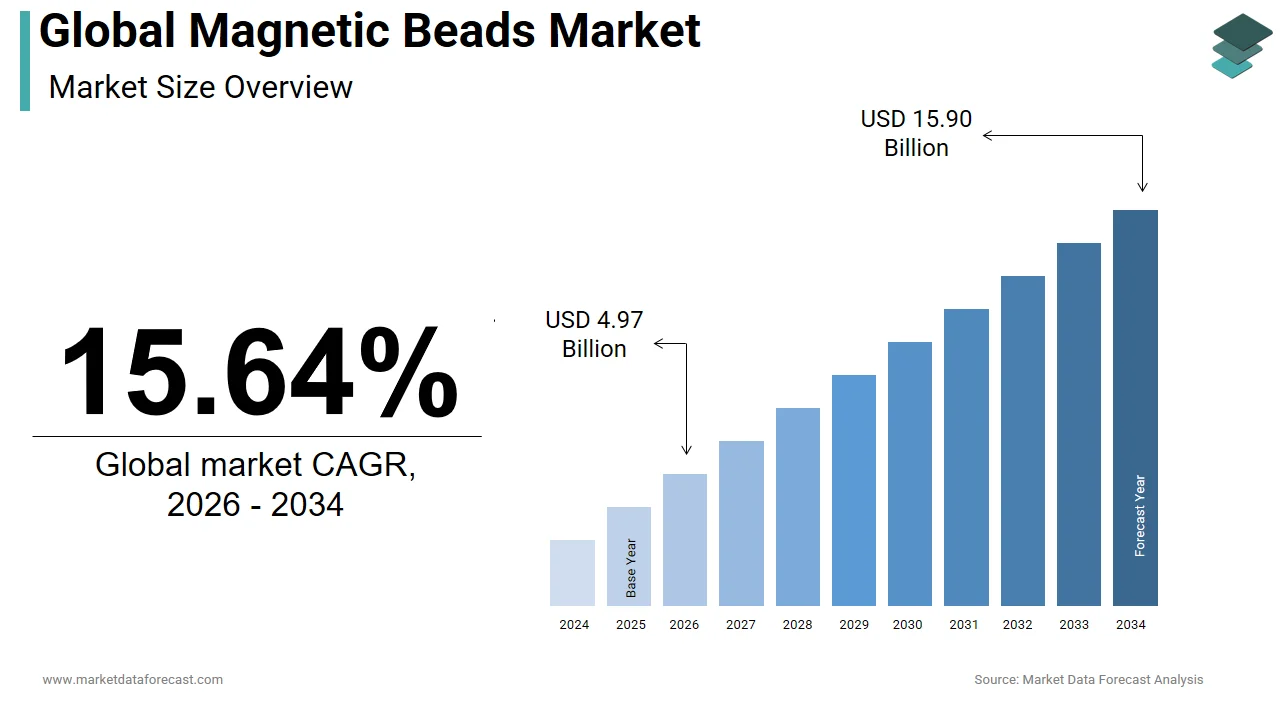
The size of the global magnetic beads market was worth USD 4.30 billion in 2025. The global market is anticipated to grow at a CAGR of 15.64% from 2026 to 2034 and be worth USD 15.90 billion by 2034, up from USD 4.97 billion in 2026.
Small spherical magnetic particles with superparamagnetic characteristics are known as magnetic beads. It has made a substantial contribution to developing novel medical research and bioanalysis methods and instruments. Superparamagnetic particles are non-magnetic unless they are exposed to a magnetizing field. Immobilization is caused by a constant field, whereas actuation, transport, and rotation are all affected by a field gradient. Magnetic forces modify samples bound to Magnetic Beads independently of other chemicals, microfluidic, or biological processes.
MARKET DRIVERS
The growing demand for magnetic beads from biological and genetic research activities majorly drives the market growth.
Due to a significant increase in research activities in the biomedical industry, demand for magnetic beads is expected to increase. Magnetic beads were also in high demand due to their use in virus-detection test kits. Magnetic beads are utilized in NGS workflows for various purposes, including nucleic acid purification and isolation, as well as size selection in the NGS process. NGS technology is being more widely employed in the medical field because it has significant advantages over conventional sequencing approaches. This is expected to boost the market's growth.
Magnetic Beads market growth is being accelerated by technological advances and rising demand for in-vitro tests worldwide. Affinity particles with high throughput and capacity for antibody immunoprecipitation and purification utilizing robotic or manual magnetic separators. Antibodies from various animals, including humans, mice, goats, sheep, rabbits, and cows, bind to these beads. Magnetic Beads are used in various applications, from immunoassays to hyperthermia therapies, DNA extraction, cell manipulation, magnetic resonance imaging, and colloidal nanocrystal integration. Promising investments in genetic and microbiology research activities are expected to significantly boost product demand for magnetic beads, propelling the market growth. In addition, growing awareness and application of technology for medicinal purposes will offer more opportunities for the development of magnetic beads over the forecast period.
MARKET RESTRAINTS
Protein and cellular purification are time-consuming procedures requiring additional accelerators such as tiny particles, which adds to the cost, limiting the growth of the global magnetic beads market. In addition, magnetic beads are difficult to automate and unsuitable for high-throughput processing, which would challenge the development of the market in the foreseeable period.
REPORT COVERAGE
| REPORT METRIC | DETAILS |
| Market Size Available | 2025 to 2034 |
| Base Year | 2025 |
| Forecast Period | 2026 to 2034 |
| Segments Covered | By Type, Application, End-user & Region. |
| Various Analyses Covered | Global, Regional, and Country-Level Analysis, Segment-Level Analysis, Drivers, Restraints, Opportunities, Challenges; PESTLE Analysis; Porter’s Five Forces Analysis, Competitive Landscape, Analyst Overview of Investment Opportunities |
| Regions Covered | North America, Europe, Asia Pacific, Latin America, Middle East & Africa |
| Market Leaders Profiled | Thermo Fisher Scientific Inc., Merck KGaA, Bangs Laboratories, Inc., Spherotech, Inc., GenScript, CardioGenics, Inc., Bio-Rad Laboratories, Inc., Miltenyi Biotec, Ferrotec (USA) Corporation, Eurofins Technologies, and micromod Partikeltechnologie GmbH. |
SEGMENTAL ANALYSIS
By Type Insights
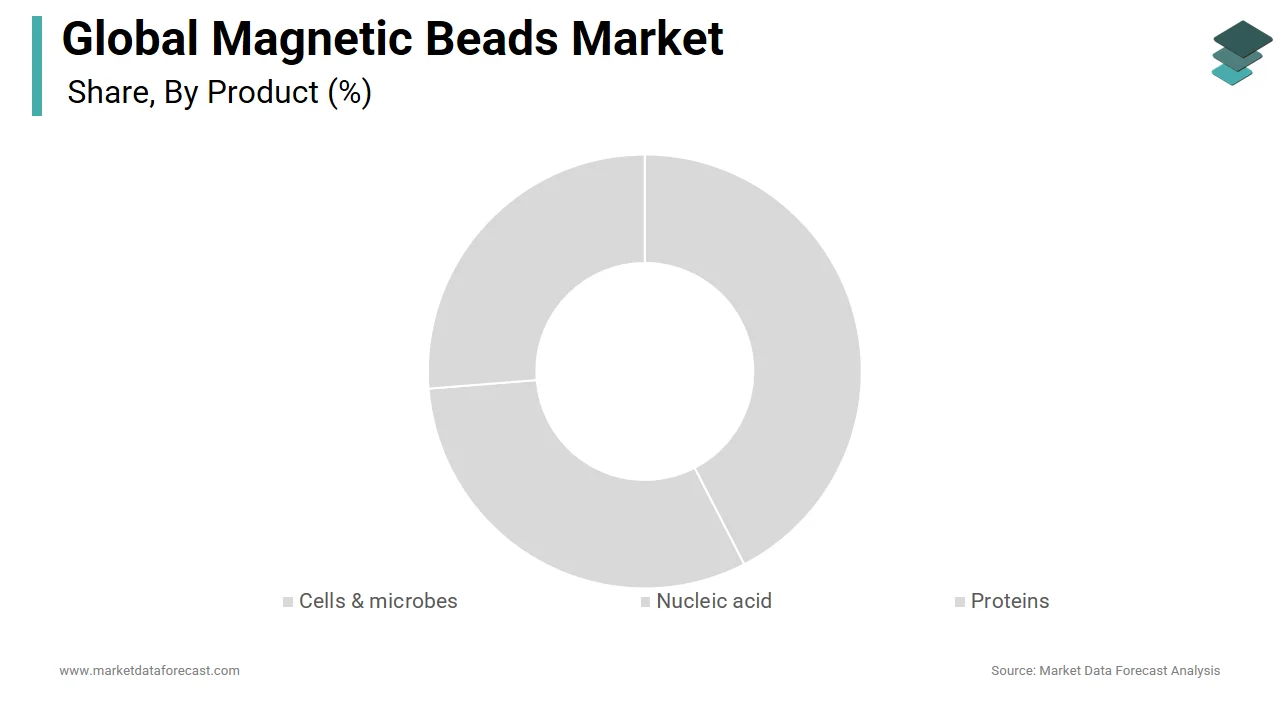
Based on type, the segment of the cells and microbes segment is estimated to have the largest share of the global magnetic beads market during the forecast period. This form of magnetic bead includes attaching ligands or antibodies to the surface of magnetic beads directed towards specific cell surface antigens to target cells for depletion or selection. Magnetic cell manipulation is a common practice in various domains, including medicine, tissue engineering, and primary and fundamental biomedical research, and it helps boost segment growth.
By Application Insights
The in-vitro diagnostics application segment led the market and is expected to rise substantially throughout the forecast period. Magnetic beads are predicted to grow in demand due to increased demand for cellular studies by various scientists and pharmaceutical businesses to establish the physiological and chemical mechanisms within a molecule, contributing significantly to market expansion. In addition, medical equipment makers and scientific laboratory professionals are pursuing in-vitro diagnostic approaches using magnetic bead technology due to these changes.
By End-User Insights
Based on the end-user, the research labs segment is anticipated to lead the magnetic beads market during the forecast period. Magnetic beads are being used in more research studies worldwide to identify novel diagnostic and therapeutic methods, fueling the segment's expansion. The market is expected to rise during the forecast period due to the increased number of research labs in growing regions.
REGIONAL ANALYSIS
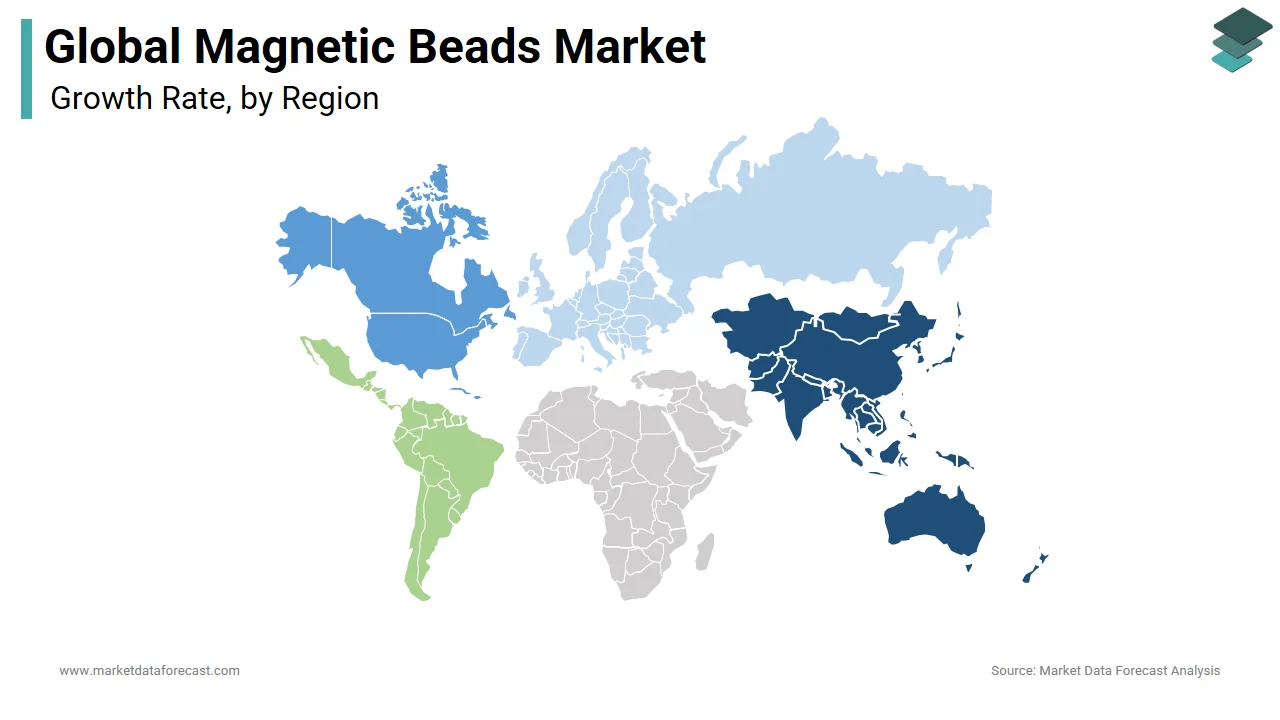
Geographically, North America dominated the magnetic beads market in 2024. Magnetic beads are in high demand in North America since it is home to some of the world's most important genetic research centers. The market's expansion has been aided by strong demand for in vitro testing from the US and Canadian healthcare sectors. Because of developments in medical technologies, growing medical equipment prices in the health sector, and increased demand for medical services from the aging population, spending in the United States is anticipated to rise. Over the period, growing investments in genetic and microbiological research are expected to drive demand for magnetic beads significantly.
Due to increased demand for diagnostics and treatments due to rising health concerns, Europe became the second-largest regional market for magnetic beads. Furthermore, a surge in chronic diseases, infectious diseases, mental health, and the current COVID-19 has prompted a demand for diagnostic centers and allied healthcare facilities to address and mitigate the situation.
Because of the region's growing healthcare and diagnostics sectors, Asia Pacific is predicted to increase significantly during the forecast period. Furthermore, during the forecast period, rising adoption rates of in-vitro diagnostic technology and expenditures in the construction of healthcare infrastructure are expected to drive product demand in the area.
KEY MARKET PARTICIPANTS
Some of the companies that are playing a dominating role in the global magnetic beads market include
- Thermo Fisher Scientific Inc.
- Merck KGaA
- Bangs Laboratories, Inc.
- Spherotech, Inc.
- GenScript
- CardioGenics, Inc.
- Bio-Rad Laboratories, Inc.
- Miltenyi Biotec
- Ferrotec (USA) Corporation
- Eurofins Technologies
- micromod Partikeltechnologie GmbH
GLOBAL MAGNETIC BEADS MARKET NEWS
- In 2019, Thermo Fisher Scientific announced the release of an automation-ready DNA and RNA isolation kit to help researchers better understand the microbiome.
- JW Therapeutics, a leading cell therapy firm in China, has inked a non-exclusive commercial access deal with Thermo Fisher Scientific, the world leader in serving science, for Thermo Fisher's Gibco CTS Dynabeads CD3/CD28 in 2021.
MARKET SEGMENTATION
This market research report on the global magnetic beads market has been segmented and sub-segmented based on type, application, end-user, and region.
By Type
- Cells & microbes
- Nucleic acid
- Proteins
- Others
By Application
- In-vitro Diagnostics
- Cell separation & Expansion
- Protein sample preparation & protein purification
- Nucleic acid isolation
- Immunoprecipitation
- Exosome analysis
- Antibody purification
By End-User
- Healthcare Facilities
- Individual Pathology Labs
- Research Labs
By Region
- North America
- Europe
- Asia-Pacific
- Latin America
- Middle East and Africa