- Product Description Description
- Table of Contents TOC
- List of Table & Figure LOT
- Get Free Sample PDF Sample PDF
Market Size, 2025
$220.4 BnMarket Estimate, 2026
$234.57 BnMarket Forecast, 2034
$385.3 BnCAGR, 2026–2034
6.4%Global Wellness Supplements Market Size, Growth, Trends & Forecast (2025–2034)
The global wellness supplements market size was valued at USD 220.46 billion in 2025, is estimated to reach USD 234.57 billion in 2026, and is projected to expand up to USD 385.31 billion by 2034, registering a compound annual growth rate (CAGR) of 6.4% from 2026 to 2034. Driven by an aging global demographic, a rising prevalence of chronic conditions, escalating micronutrient inadequacies from urban dietary shifts, and a strong pivot toward preventive healthcare, the industry continues to advance across diverse dietary and dermo-cosmetic formats.
Key Executive Metrics (At-a-Glance)
- 2025 Base Valuation: USD 220.46 Billion
- 2026 Current Valuation: USD 234.57 Billion
- 2034 Forecast Valuation: USD 385.31 Billion
- Compound Annual Growth Rate (CAGR): 6.4% (2026–2034)
- Dominant Product Segment: Dietary Supplements (holding a dominant share in 2025 backed by widespread consumer reliance on oral vitamins, minerals, and proteins)
- Fastest-Growing Product Segment: Dermo-Cosmetic Skin Essentials (projected to expand at a leading CAGR of 11.4% from 2026 to 2034 driven by the "inside-out" beauty and anti-aging trend)
- Dominant Region: North America (accounting for 39.3% of the global market share in 2025 supported by a deeply ingrained preventive self-care culture and high health literacy)
- Fastest-Growing Region: Asia-Pacific (projected to register the highest regional CAGR driven by rapid urbanization, rising disposable incomes, and preventive wellness adoption in countries like Japan, China, and India)
Core Market Drivers
- Micronutrient Deficiencies: Modern urban diets dominated by ultra-processed foods driving widespread vitamin and mineral inadequacies.
- Preventive Healthcare Focus: Heightened global awareness of immune resilience and wellness maintenance following recent public health shifts.
Primary Market Restraints & Challenges
- Regulatory Fragmentation: Absence of unified global standards for product safety claims and clinical substantiation, leading to cross-border distribution bottlenecks.
- Supply Chain Vulnerabilities: Climate change, overharvesting, and geopolitical instability threatening the sustainable sourcing of high-grade raw botanicals and marine oils.
Global Wellness Supplements Market Segmentation Breakdown
| Segment Category | Leading Sub-Segment | Fastest-Growing Sub-Segment |
|---|---|---|
| By Product | Dietary Supplements (dominant share in 2025 via vitamins, minerals, proteins, and herbs) | Dermo-Cosmetic Skin Essentials (11.4% CAGR driven by collagen peptides and anti-aging solutions) |
| By Region | North America (39.3% share in 2025 driven by robust health literacy and strong retail channels) | Asia-Pacific (highest CAGR fueled by rising middle-class disposable income and aging populations) |
Major Industry Players Profiled
Key enterprises shaping the competitive global wellness supplements market include Nestlé Health Science, Amway (Nutrilite Division), Blackmores Limited, Abbott Laboratories, Otsuka Holdings, Herbalife, Archer Daniels Midland Company, Glanbia Inc., GNC Holdings, and Nu Skin Enterprises.
Global Wellness Supplements Market Size
The global wellness supplements market size was worth USD 220.46 billion in 2025 and is estimated to grow at a CAGR of 6.4% from 2026 to 2034 and be worth USD 385.31 billion by 2034 from USD 234.57 billion in 2026. The growth of the global dietary supplement market is primarily driven by factors such as an increase in the elderly population and an increased prevalence of chronic diseases.
The Wellness Supplements are orally consumed products to support overall health, enhance physiological function, and prevent nutritional deficiencies. These include vitamins, minerals, herbal extracts, probiotics, omega-3 fatty acids, and adaptogens, typically marketed for immune support, digestive health, cognitive function, and energy optimization. Unlike pharmaceuticals, wellness supplements are not intended to treat diseases but to complement dietary intake and promote long-term well-being. As per the World Health Organization, over 2 billion people globally suffer from micronutrient deficiencies, particularly in vitamin A, iron, and iodine, reinforcing the public health relevance of supplementation.
MARKET DRIVERS
Growing Prevalence of Micronutrient Deficiencies Amid Urban Dietary Shifts
The widespread occurrence of micronutrient inadequacies linked to modern urban diets dominated by ultra-processed foods is major factor propelling the growth of the Wellness Supplements Market. According to the Lancet Global Health Commission on Ultra-Processed Foods, over 60% of daily caloric intake in high-income countries comes from processed and packaged foods lacking essential vitamins and minerals. In the United States, the National Health and Nutrition Examination Survey reveals that more than 90% of adults fail to meet the recommended daily intake of vitamin D and E through diet alone. Similarly, iron deficiency affects approximately 1.2 billion individuals worldwide, as reported by the World Health Organization, with women of reproductive age and older adults being particularly vulnerable.
Rising Consumer Focus on Preventive Health and Immune Resilience
The intensified global emphasis on preventive healthcare following the heightened awareness of immune system functionality during recent public health crises is also to elevate the growth of the Wellness Supplements Market. A 2023 global consumer health survey conducted by the International Food Information Council found that 78% of respondents actively use dietary supplements to support immune function, with vitamin C, vitamin D, and zinc being the most frequently consumed. In Japan, the Ministry of Health, Labour and Welfare reports that over 40% of adults regularly take supplements for preventive purposes, a figure that has risen steadily since 2020. Additionally, workplace wellness programs in countries like Germany and Canada now incorporate supplement recommendations as part of employee health initiatives.
MARKET RESTRAINTS
Regulatory Fragmentation and Lack of Standardized Efficacy Validation
The absence of uniform global regulatory standards for product claims, purity, and clinical substantiation is hampering the growth of the Wellness Supplements Market. In the United States, the Dietary Supplement Health and Education Act allows products to be marketed without pre-market approval from the Food and Drug Administration, leading to variability in quality. As per the U.S. Government Accountability Office, over 770 dietary supplement recalls occurred between 2019 and 2023 due to contamination, undeclared ingredients, or misleading labeling. In the European Union, the Novel Foods Regulation imposes stricter requirements, yet member states interpret guidelines differently, complicating cross-border distribution.
Persistent Misinformation and Consumer Skepticism Regarding Supplement Efficacy
The growing skepticism among consumers due to conflicting scientific narratives and widespread misinformation about supplement benefits is also impeding the growth of the Wellness Supplements Market. A 2023 study published in Nature Reviews Endocrinology found that only 12 out of 50 commonly marketed supplements had robust clinical evidence supporting their claimed health benefits. The Cochrane Collaboration reports that multivitamin supplementation shows no significant reduction in cardiovascular events or cancer incidence in well-nourished populations, challenging long-held assumptions. Social media amplifies unsubstantiated claims, with the UK’s Advertising Standards Authority receiving over 1,200 complaints in 2022 alone regarding false health assertions by supplement brands. This erosion of trust is further exacerbated by high-profile litigation, such as the 2021 class-action suits against major U.S. supplement retailers for inaccurate labeling.
MARKET OPPORTUNITIES
Expansion of Personalized Nutrition and Genetic-Based Supplement Formulations
The integration of genomics and artificial intelligence to deliver personalized supplement regimens tailored to individual metabolic profiles is eventually to accelerate the growth of the Wellness Supplements Market. Companies like Nutrigenomix and DNAFit offer genetic testing to identify predispositions to vitamin deficiencies, caffeine metabolism rates, and antioxidant needs, enabling customized formulations. According to the Personalized Nutrition Market Report by the Global Consortium for Personalized Medicine, over 3.2 million consumers underwent nutrigenomic testing in 2023, a 27% increase from the previous year.
Increasing Adoption of E-Commerce and Direct-to-Consumer Subscription Models
The digital transformation of retail through direct-to-consumer (DTC) platforms that offer tailored supplement subscriptions with data-driven recommendations is also to leverage new opportunities for the growth of the Wellness Supplements Market. As per the United Nations Conference on Trade and Development, global e-commerce sales of health products surpassed $180 billion in 2023, with supplements representing a dominant category. Companies such as Care/of and Ritual have leveraged algorithm-based quizzes and monthly delivery systems to capture millennial and Gen Z consumers, achieving customer retention rates exceeding 65%, as reported by McKinsey & Company. In India, PharmEasy and 1mg have integrated AI-powered supplement advisors into their apps, serving over 50 million users.
MARKET CHALLENGES
Difficulty in Establishing Causal Health Benefits Due to Limited Long-Term Clinical Trials
The scarcity of long-term, large-scale clinical trials that definitively link specific supplements to measurable health outcomes is impeding the growth of the Wellness Supplements Market. The National Institutes of Health acknowledges that fewer than 15% of commercially available supplements have undergone rigorous, multi-year human studies. For instance, while omega-3 fatty acids are widely promoted for heart health, the VITAL study found no significant reduction in major cardiovascular events among low-risk individuals after five years of supplementation. Similarly, beta-carotene supplementation was linked to increased lung cancer risk in smokers in the ATBC trial, underscoring potential harms. This evidentiary gap enables regulatory bodies like the European Food Safety Authority to reject health claims for over 80% of submitted dossiers.
Supply Chain Vulnerabilities in Sourcing High-Quality Raw Ingredients
The integrity of wellness supplements is increasingly threatened by disruptions in the global supply chain for botanicals, marine oils, and fermented nutrients. Climate change, geopolitical instability, and overharvesting have compromised the availability and purity of key ingredients. According to the Food and Agriculture Organization, global fish oil production declined by 12% between 2020 and 2023 due to overfishing and ocean warming, directly impacting omega-3 supplement manufacturing. According to the Union for Ethical BioTrade, 60% of medicinal plant species used in herbal supplements, such as ashwagandha and turmeric, that face sustainability risks due to unregulated harvesting in South Asia.
REPORT COVERAGE
| REPORT METRIC | DETAILS |
| Market Size Available | 2025 to 2034 |
| Base Year | 2025 |
| Forecast Period | 2026 to 2034 |
| CAGR | 6.4% |
| Segments Covered | By Product and Region |
| Various Analyses Covered | Global, Regional & Country Level Analysis, Segment-Level Analysis, DROC, PESTLE Analysis, Porter’s Five Forces Analysis, Competitive Landscape, Analyst Overview on Investment Opportunities |
| Regions Covered | North America, Europe, APAC, Latin America, Middle East & Africa |
| Market Leaders Profiled | Nestle, Abbott Laboratories, Amway, Otsuka Holdings, Herbalife, Archer Daniels Midland Company, Glanbia, NBTY, GNC Holdings, Nu Skin Enterprises and Others. |
SEGMENTAL ANALYSIS
By Product Insights
The dietary supplements segment dominated the global wellness supplements market by capturing a dominant share in 2025 with the widespread consumer reliance on oral supplements to address nutritional gaps in daily diets. The Centers for Disease Control and Prevention indicate that nearly 58% of U.S. adults regularly consume multivitamins, with vitamin D and omega-3 fatty acids among the most frequently used. The accessibility of over-the-counter formulations, combined with strong retail distribution and physician endorsements, reinforces consumer trust. Additionally, the Council for Responsible Nutrition highlights that 75% of supplement users perceive these products as essential for maintaining long-term health, reflecting deeply embedded behavioral patterns.
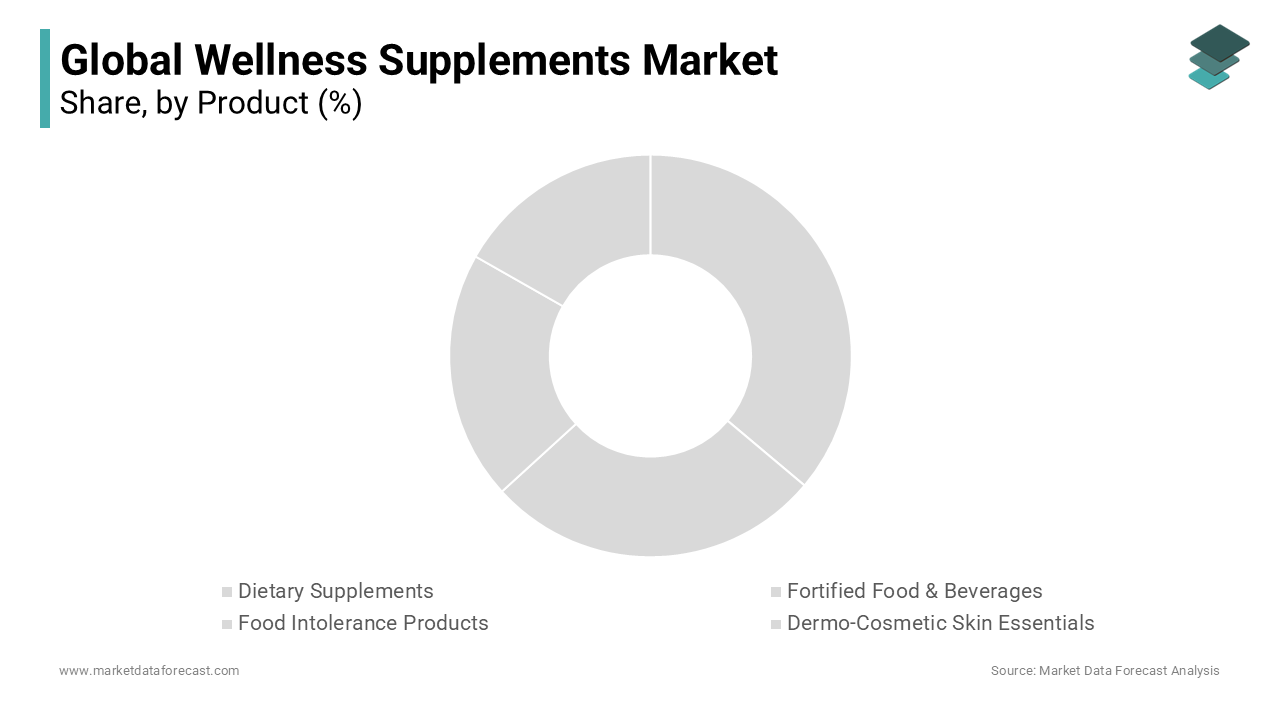
The dermo-cosmetic skin segment is projected to expand at a CAGR of 11.4% from 2026 to 2034 with the rising convergence of dermatology and nutrition, commonly referred to as "inside-out" skincare. Oral collagen peptides, hyaluronic acid, and antioxidants such as vitamin C and astaxanthin are increasingly adopted for improving skin elasticity, hydration, and anti-aging outcomes. A clinical trial published in Skin Pharmacology and Physiology demonstrated that daily intake of 2.5 grams of hydrolyzed collagen improved skin moisture and reduced wrinkles in 91% of participants after 12 weeks.
REGIONAL ANALYSIS
North America Wellness Supplements Market Insights
North America was the top performer in the global wellness supplements market by accounting for 39.3% of share in 2025 with a deeply ingrained culture of preventive self-care and high health literacy. In the United States, the National Institutes of Health reports that over 77% of adults use at least one dietary supplement, with multivitamins, calcium, and vitamin D being the most prevalent. Canada mirrors this trend, with Health Canada noting a 15% increase in supplement sales between 2020 and 2023, driven by aging demographics and rising interest in immune support. The presence of stringent regulatory oversight through the FDA and Health Canada enhances consumer confidence in product safety, despite ongoing challenges with label accuracy. Additionally, the proliferation of e-commerce platforms such as Amazon and iHerb has democratized access, enabling rapid market penetration.
Europe Wellness Supplements Market Insights
Europe wellness supplements market held 27.3% of the share in 2025. The region exhibits a diverse yet sophisticated supplement landscape, shaped by national health policies and consumer preferences. France and the UK show strong demand for probiotics and plant-based supplements, influenced by growing vegetarian and vegan populations—over 10% of UK adults now follow a plant-based diet, according to the Vegan Society. Regulatory rigor under the EU’s Novel Foods Regulation and health claim authorizations by the European Food Safety Authority ensures product credibility, though it slows innovation. Public healthcare systems in Scandinavia increasingly recognize the role of vitamin D supplementation in combating seasonal affective disorder, with Nordic governments distributing supplements in high-latitude regions.
Asia Pacific Wellness Supplements Market Insights
Asia Pacific wellness supplements market growth is likely to have highest CAGR in the next coming years due to the rising disposable incomes, urbanization, and increasing awareness of preventive health in countries like Japan, South Korea, and India. Japan has one of the most advanced supplement markets, with the Ministry of Health, Labour and Welfare estimating that over 50% of adults consume functional foods or supplements, particularly for joint and cognitive health. In China, the General Administration of Market Regulation reports a 20% annual increase in approved health food products since 2021, reflecting regulatory easing and consumer demand. India’s supplement penetration remains low but is accelerating, with the Indian Council of Medical Research noting a 35% rise in vitamin D deficiency diagnoses in urban centers, prompting medical recommendations for supplementation.
Latin America Wellness Supplements Market Insights
Latin America wellness supplements market is expected to have steady growth opportunities in the next coming years. The Brazilian Ministry of Health estimates that over 40 million Brazilians engage in regular physical activity, fueling demand for protein powders, vitamins, and energy boosters. Argentina and Mexico are also witnessing increased supplement adoption, particularly among younger demographics influenced by social media and fitness influencers. However, regulatory inconsistencies across countries hinder standardization; ANVISA, Brazil’s health regulator, has recalled over 1,200 supplement products since 2020 due to contamination or false claims.
Middle East & Africa Wellness Supplements Market Insights
Middle East & Africa wellness supplements market growth is expected to have slow growth in the next coming years. According to the UAE Ministry of Health and Prevention, 40% increase in supplement sales between 2021 and 2023, attributed to rising obesity rates and vitamin D deficiency due to limited sun exposure from cultural clothing and indoor lifestyles. In Saudi Arabia, the National Nutrition Strategy 2023–2030 includes targeted supplementation programs for pregnant women and children to combat iron and folic acid deficiencies.
KEY MARKET PLAYERS AND COMPETITIVE LANDSCAPE
Companies playing a major role in the global wellness supplements market include Nestle, Abbott Laboratories, Amway, Otsuka Holdings, Herbalife, Archer Daniels Midland Company, Glanbia Inc., NBTY Inc., GNC Holdings and Nu Skin Enterprises.
The competition in the Wellness Supplements Market is highly fragmented and increasingly innovation-driven, with multinational corporations, regional brands, and digital-native startups vying for consumer attention. Differentiation hinges on scientific credibility, ingredient transparency, and personalized health narratives. Established players leverage clinical research and global distribution, while emerging brands capitalize on niche positioning, such as vegan, organic, or genetically tailored supplements. Regulatory scrutiny in regions like Europe and North America favors companies with robust compliance frameworks, whereas in emerging markets, brand trust and affordability dominate purchasing decisions. E-commerce and social media marketing have lowered entry barriers, intensifying rivalry.
TOP PLAYERS IN THE MARKET
Nestlé Health Science
Nestlé Health Science has emerged as a pivotal force in the Asia Pacific wellness supplements market by integrating clinical nutrition with consumer wellness. The company has localized its product portfolio across Japan, Australia, and India, introducing science-backed formulations targeting gut health, cognitive function, and metabolic wellness. In 2023, it launched Peptamen Vitality, a specialized protein supplement, in Southeast Asia for aging populations experiencing sarcopenia, supported by partnerships with geriatric clinics. The company also acquired a stake in Singapore-based biotech firm Veracity Sciences to advance microbiome-based diagnostics and personalized nutrition. Nestlé Health Science collaborates with hospitals and dietitians to promote evidence-based supplementation. Its investment in digital health platforms, including AI-driven nutrition advisors, strengthens consumer engagement.
Amway (Nutrilite Division)
Amway’s Nutrilite brand maintains a strong presence in the Asia Pacific wellness supplements market through its vertically integrated model, from farm to finished product. The company operates organic farms in India, Indonesia, and China, ensuring traceability and quality control for key botanical ingredients such as tulsi, ashwagandha, and ginseng. In 2023, Amway launched Nutrilite Botanical Repair, a plant-based cellular health supplement, tailored for Asian consumers concerned with pollution-induced oxidative stress. It expanded its digital direct-selling platform across Vietnam and the Philippines, leveraging social commerce to reach younger demographics. Amway also partnered with the University of Hong Kong to study the impact of its vitamin C formulations on immune resilience in urban populations.
Blackmores Limited
Blackmores has its position as a leading wellness supplement provider in the Asia Pacific region by emphasizing natural ingredients and sustainability. Originating in Australia, the company has expanded into China, Malaysia, and New Zealand with formulations tailored to local health concerns, including liver detoxification, stress management, and seasonal immunity. In 2023, Blackmores introduced its Triple Action Digestive Health range in Singapore, incorporating probiotics and prebiotics to address rising gastrointestinal issues linked to urban diets. The company achieved carbon neutrality for its manufacturing facilities in Australia and committed to 100% recyclable packaging by 2026, aligning with regional environmental regulations. Blackmores also collaborates with Traditional Chinese Medicine (TCM) practitioners in China to blend herbal knowledge with modern supplement science.
TOP STRATEGIES USED BY KEY MARKET PLAYERS
Key players in the Wellness Supplements Market employ strategies such as product innovation, scientific validation, digital engagement, regional localization, and strategic partnerships to strengthen their competitive edge. Companies invest in clinical research to substantiate health claims and gain regulatory approval. They develop condition-specific formulations targeting immunity, gut health, and cognitive function. Digital platforms and AI-driven tools enable personalized recommendations and subscription models. Localization involves adapting ingredients and messaging to cultural preferences, such as Ayurvedic herbs in India or TCM-inspired blends in China. Partnerships with healthcare providers, fitness influencers, and e-commerce retailers enhance credibility and distribution.
RECENT HAPPENINGS IN THE MARKET
- In March 2023, Nestlé Health Science launched Peptamen Vitality in Thailand and Indonesia, a medical nutrition supplement designed to combat age-related muscle loss that supported by clinical studies and partnerships with geriatric care centers.
- In July 2023, Amway introduced Nutrilite Botanical Repair in India and South Korea, a plant-based antioxidant supplement formulated with regionally sourced herbs to address urban pollution-related cellular stress.
- In October 2023, Blackmores partnered with the University of Sydney to conduct a clinical trial on the efficacy of its high-potency vitamin D3 formulation in improving bone health among elderly Australians.
- In January 2025, Bayer launched its new digital platform, NutriBot, in Japan and Taiwan, an AI-powered chatbot that provides personalized supplement recommendations based on user health data and lifestyle inputs.
- In May 2025, Swisse Wellness expanded its manufacturing facility in Melbourne, Australia, to increase production capacity for its premium collagen and probiotic supplements, which is targeting export growth across Southeast Asia.
MARKET SEGMENTATION
This research report on the global wellness supplements market has been segmented and sub-segmented based on product and region.
By Product
- Dietary Supplements
- Vitamin
- Mineral
- Protein
- Herbal
- Fortified Food & Beverages
- Omega Fatty Acid
- Probiotic Food
- Branded Iodinated Salt
- Branded Wheat Flour
- Energy Drinks
- Sports Drinks
- Fortified Juices
- Food Intolerance Products
- Gluten-free
- Lactose-free
- Diabetic Food
- Dermo-Cosmetic Skin Essentials
- Anti-Aging
- Anti-Cellulite
- Anti-Acne Supplements
By Region
- North America
- The United States
- Canada
- Rest of North America
- Europe
- The United Kingdom
- Spain
- Germany
- Italy
- France
- Rest of Europe
- The Asia Pacific
- India
- Japan
- China
- Australia
- Singapore
- Malaysia
- South Korea
- New Zealand
- Southeast Asia
- Latin America
- Brazil
- Argentina
- Mexico
- Rest of LATAM
- The Middle East and Africa
- Saudi Arabia
- UAE
- Lebanon
- Jordan
- Cyprus